Veintena Myth Meaning & Symbolism
The sacred 20-day cycle where gods and humanity enact a cosmic drama of sacrifice, sustenance, and the perpetual renewal of time itself.
The Tale of Veintena
Listen. Feel the sun, Tonatiuh, heavy and white in the sky. It is not a given. It is a demand. The great clock of the world, Xiuhpohualli, has turned its face, and a new Veintena begins. The air in Tenochtitlan is thick with the scent of damp earth, blooming flowers, and the distant, metallic whisper of the lake.
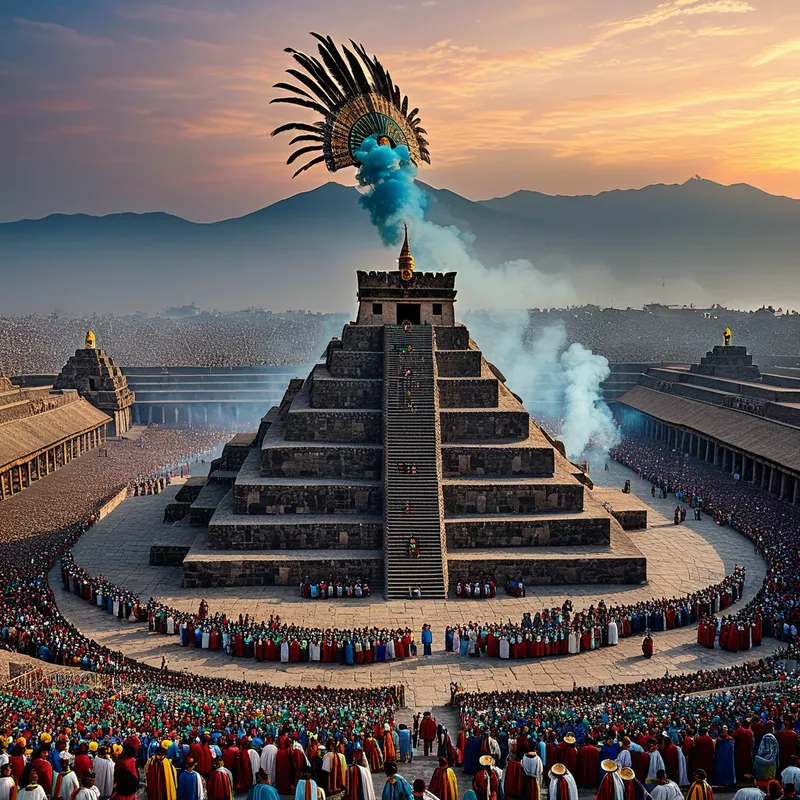
For twenty days, the people are not merely people. They are actors in a drama written in the stars and in the desperate hunger of the gods. This Veintena is dedicated to Tlaloc, he whose eyes are made of jade, whose voice is the thunder. The priests, their bodies blackened with sacred rubber, ascend the pyramid. They carry children, chosen for their perfect curls, the living tears of the sky. The little ones do not cry; they are told they go to a glorious garden. The crowd below holds its breath—a vast, silent exhalation of dread and hope. The children’s tears are precious; if they weep, the rain will surely come. The chant begins, a deep, rolling wave of sound. It is not a dirge, but a fierce, loving plea. A transaction. A life, given willingly in the hearts of the people, for the life of the corn, for the water in the stream, for the continued journey of the sun across the heavens.
In another Veintena, the mood shifts. Now it is time for Xipe Totec, Our Lord the Flayed One. A captured warrior, adorned as the god himself, dances for days, treated as royalty. On the final day, upon the killing stone, his heart is offered to the sun. Then, the priests perform the most terrifying sacrament: they flay his skin whole. A young priest, chosen for his vigor, struggles into this warm, bloody garment. For twenty days, he wears this second skin, this cloak of death-become-life, seeding the earth with his presence. He is the living seed, buried in the flesh of the fallen, soon to burst forth. The people behold him—a shuffling, grotesque, and utterly sacred figure. They see not a man in a skin, but the very principle of renewal: to bear fruit, the seed coat must be torn away.
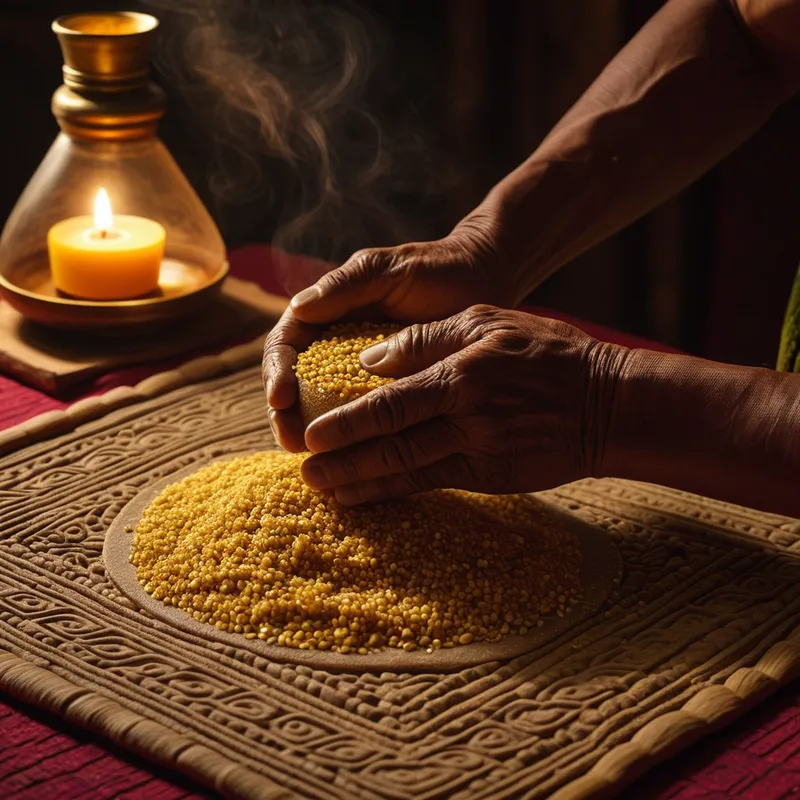
The drama continues, cycle after cycle. For Quetzalcoatl, offerings of serpents made of dough. For Teteoinnan, the Mother of Gods, women weave intricate amaranth figures, consuming the god to take her strength into themselves. Each Veintena is a chapter in an endless story, a pulse in the body of time. The conflict is eternal: the cosmos is starving. The resolution is eternal: we must feed it, with our art, our dance, our blood, our very attention. The sun rises on the twenty-first day, not because it must, but because it has been paid.
Cultural Origins & Context
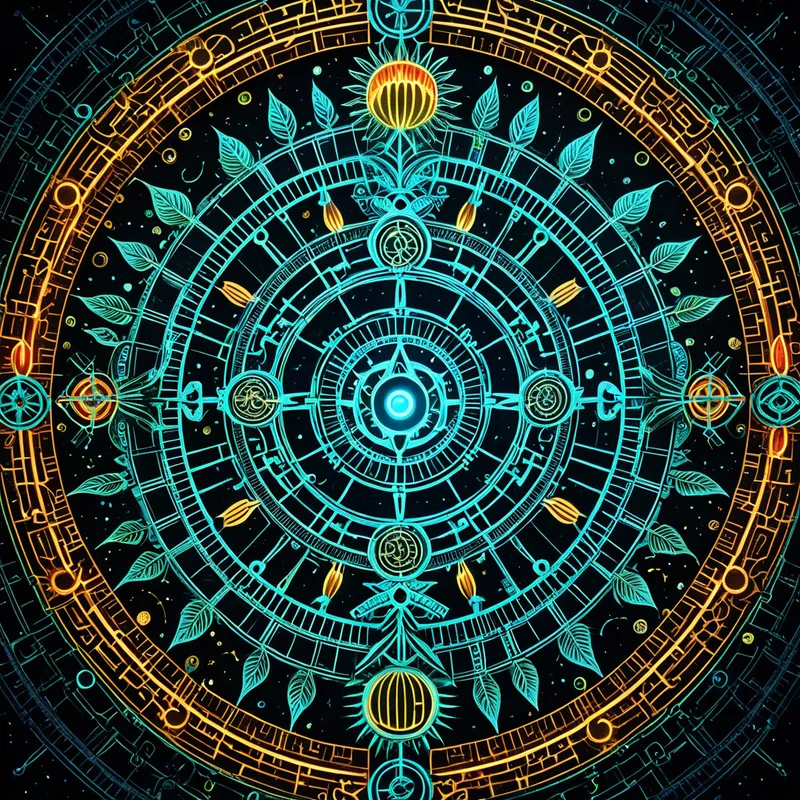
The Veintena was not a singular myth but the living, breathing framework of mythic time for the Mexica (Aztec) people. The Xiuhpohualli consisted of 18 such 20-day periods, with five ominous, uncounted days (Nemontemi) completing the solar cycle. Each Veintena was a named festival, a complex ritual program dedicated to specific deities and aligned with agricultural, celestial, and social necessities.
This mythic cycle was passed down not in a single book, but in the collective muscle memory of the culture. It was told by the Tlamatinime (wise ones), enacted by the priesthood, danced by the people, and visualized in the breathtakingly complex iconography of the calendar stones. Its societal function was total: it was a cosmological manual, a agricultural almanac, a religious liturgy, and a social glue. It answered the most profound existential questions: Why must we work? Why do we suffer? Why does the sun return? The answer was woven into the very fabric of time: existence is a sacred, reciprocal debt (tequitl), and the Veintena was the scheduled payment, ensuring balance and preventing the collapse of the Nahui Ollin, the Age of Movement.
Symbolic Architecture
At its core, the myth of the Veintena cycle symbolizes the unbearable yet necessary truth that life feeds on life. It is the ultimate expression of a universe built not on stasis, but on sacred exchange.
The cosmos is not a machine, but a stomach. To sustain the movement of the stars, the growth of corn, and the beating of the human heart, something of equal value must be digested.
The Veintena ritualizes this digestion. The sacrificed warrior or child is not destroyed but translated. They become the rain (Tlaloc), the sprouting corn (Xipe Totec), the sustaining breath (Quetzalcoatl). The god, in turn, is not a distant tyrant but a participant in the cycle, also dependent on the offering. This creates a terrifying intimacy: divinity is metabolized through human action. The flayed skin worn by the priest is the ultimate symbol of this—the outer form, the individual ego-shell, must be sacrificed to put on the generative, collective skin of the life force. Time itself is not linear progress but a series of consumptions and renewals, a wheel that must be constantly greased with conscious, ritualized attention.
The Dreamer’s Resonance
When this mythic pattern stirs in the modern unconscious, it rarely appears as an Aztec festival. Instead, it manifests as dreams of profound obligation, cycles of exhausting payment, or terrifying yet necessary exchanges.
You may dream of feeding a ravenous, silent presence in your basement with your own possessions, piece by piece. You may dream of a contract you signed long ago, demanding a payment you now fear to give—a creative project, a relationship, a piece of your identity. You may dream of shedding your own skin, painfully, to reveal a raw, new layer beneath. These are the somatic echoes of the Veintena. The psychological process is one of confronting the cost of sustenance. What are you feeding with your energy, your time, your life force? Is it a starving, ancient god of your own potential, or a hollow idol of obligation? The dream presents the archetypal debt (tequitl). The anxiety is the feeling of the Nemontemi—the uncounted, liminal time when the cosmic order is suspended, and one fears the payment was not enough.

Alchemical Translation
For the modern individual navigating the path of individuation, the Veintena offers a brutal but liberating model. Our psychic transmutation is not a gentle unfolding but a series of ritualized sacrifices.
Individuation is the conscious enactment of the Veintena cycle within the soul. We must identify what within us must be ritually “killed” and offered to feed a higher order of being.
The “god” that needs feeding is the nascent, integrated Self. The “payment” is the sacrifice of outmoded identities, cherished resentments, and comfortable illusions—the psychological skins we wear. The alchemical process follows the mythic pattern: First, Naming the Veintena: Recognizing the cyclical, recurring crisis in your life—the same relationship drama, the same creative block, the same anxiety. This is your personal festival period. Second, The Conscious Offering: Instead of the crisis happening to you, you consciously offer something to it. You sacrifice the need to be right. You offer your vulnerability. You dedicate time to the neglected creative act. This is the ritual heart-extraction. Third, Wearing the New Skin: After the sacrifice, you must inhabit the new condition. Like the priest in the flayed skin, it feels foreign, grotesque, and raw. This is the incubation period where the seed of new consciousness germinates in the flesh of the old. The cycle completes not with an end, but with the recognition that this is the very rhythm of a soul in growth. You become both the priest and the pyramid, the sacrificer and the sacred ground, sustaining the inner sun through your own willing, painful, and awe-inspiring payments.
Associated Symbols
Explore related symbols from the CaleaDream lexicon: