Veil of Isis Myth Meaning & Symbolism
The goddess Isis, through cunning and compassion, learns the secret name of the sun god Ra to heal and gain ultimate power, revealing the nature of reality.
The Tale of the Veil of Isis
Hear now a tale from the time when [the world](/myths/the-world “Myth from Tarot culture.”/) was young, when the gods walked with a foot in the Nile’s black mud and a hand among the imperishable stars.
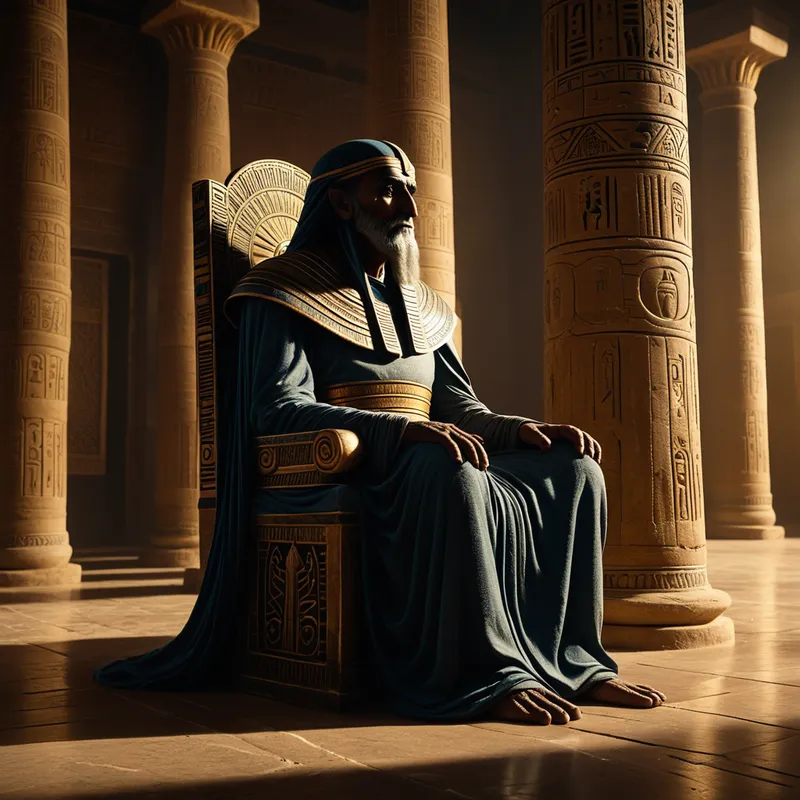
The sun, Ra, had grown old. His golden bones ached; his radiance, which once sculpted the mountains, now wavered like a desert mirage. A great lassitude settled upon him. While he still sailed his barque across [the sky](/myths/the-sky “Myth from Persian culture.”/) by day, by night he retreated to his palace, a silent, weary king. And in his weariness, a secret trembled on his lips—the secret of his true, hidden name, the sound that spun the universe into being, [the word](/myths/the-word “Myth from Biblical culture.”/) that held his ultimate power and his life.
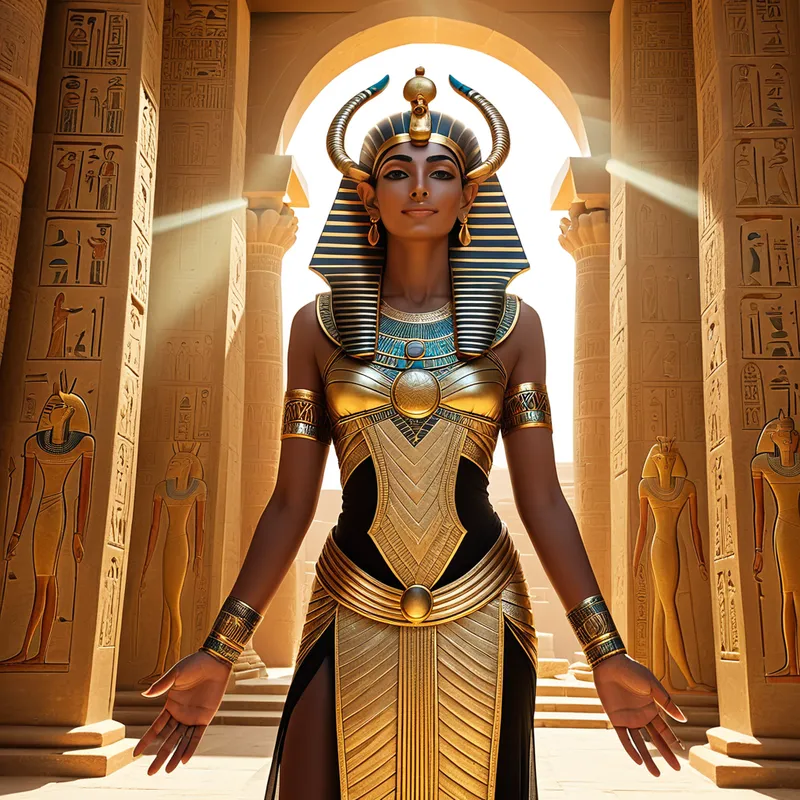
In the reeds by [the river](/myths/the-river “Myth from Buddhist culture.”/), another power watched. Isis, she of the ten thousand names, she whose love for her slain husband [Osiris](/myths/osiris “Myth from Global/Universal culture.”/) was a fire that would not die, perceived Ra’s fading light. Her heart held a mother’s compassion and a sorceress’s cunning. To restore her son [Horus](/myths/horus “Myth from Egyptian culture.”/) to his rightful throne, and perhaps to mend the very fabric of a world growing dim, she knew what she must do. She must learn the name.
But a god’s true name is not spoken; it is the core of his being, hidden deeper than his heart. So Isis, the great magician, began her work. She gathered the dust from Ra’s footsteps, the sweat from his brow, and the spittle that fell from his mouth as he drowsed. From these mundane leavings of divinity, she mixed the black earth of the Nile bank and, with spells older than time, fashioned a serpent—a creature of venom and earth, born from the god’s own substance.
She placed the serpent on the path where Ra walked in his evening procession. The strike was swift. A searing, alien fire, his own essence turned against him, coursed through Ra’s limb. A cry tore from the heavens, a sound of such profound shock and pain that the Nun itself seemed to shudder. The divine poison worked, a mystery no god could unravel, for it was of Ra himself.
The court of the gods was thrown into panic. Incantations were chanted, amulets applied, but the fire would not cool. The sun was being consumed from within. Finally, his voice a ragged whisper, Ra sent for Isis, whose fame as a healer was without peer.
She came, not as a subject, but as a sovereign. “O mighty Ra,” she said, her voice like cool [water](/myths/water “Myth from Chinese culture.”/), “a great power afflicts you. My magic is potent, but to draw out a poison of this nature, I must speak its name. And to name it, I must name you—your true name, the secret of your power.”
Ra recoiled. He listed his many titles—[Khepri](/myths/khepri “Myth from Egyptian culture.”/) at dawn, Atum at dusk, the Maker of Gods—but Isis remained unmoved, the serpent’s venom burning ever hotter. The pain became a universe, blotting out all else. At last, broken by the agony born of his own discarded self, the great sun god yielded. He leaned close, and into the ear of Isis, he breathed his hidden name, the vibration that sustained all things.
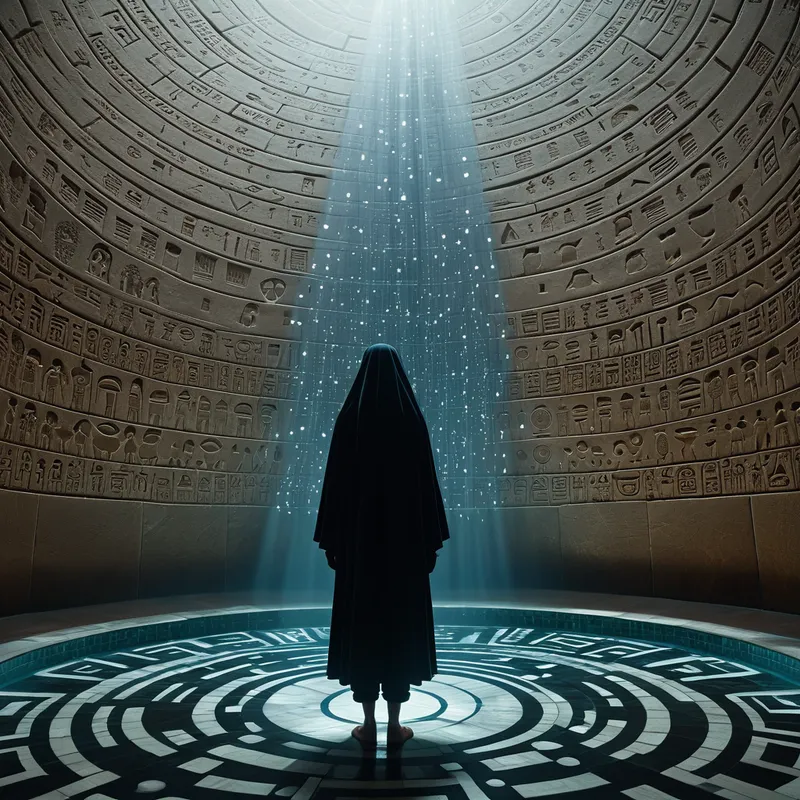
With the name flowing in her veins, Isis spoke a command. The poison retreated, drawn out into the air and dissolved. Ra was healed, but something fundamental had shifted. The ultimate knowledge had passed from the king to [the magician](/myths/the-magician “Myth from Tarot culture.”/). Isis did not usurp the sun’s journey, but she now held the key to its heart. She had lifted, for a moment, [the veil](/myths/the-veil “Myth from Various culture.”/) that separates the manifest world from the unspoken source that generates it. She saw the face behind the radiant mask, and in that seeing, gained the power to heal, to protect, and to make whole.
Cultural Origins & Context
This myth, part of the vast theological tapestry of ancient Egypt, is not a single, canonical text but a narrative woven from spells, temple inscriptions, and later Greek retellings like that of Plutarch. Its most potent home was in the realm of magical practice. The story served as the divine precedent and source of power for Egyptian hekau (magicians). By recounting the tale of Isis’s [triumph](/myths/triumph “Myth from Roman culture.”/), a healer or protector invoked her authority, essentially saying, “As Isis learned the name of Ra to heal, so I learn [the true name](/myths/the-true-name “Myth from Various culture.”/) of this disease or demon to cast it out.”
The myth functioned on multiple cultural levels. It explained the natural order—why the sun grows weak and is reborn, and why magic (embodied by Isis) is a fundamental, creative force co-existent with the sun’s power. Societally, it reinforced the idea that true authority (Maat) could come through wisdom and cunning as well as through brute strength or primacy. It was a story told not just in temples, but in the rooms of the sick and in the rites of protection, making the cosmic intimately personal.
Symbolic Architecture
The [Veil](/symbols/veil “Symbol: A veil typically symbolizes concealment, protection, and transformation, representing both mystery and femininity across cultures.”/) of Isis is the ultimate [symbol](/symbols/symbol “Symbol: A symbol can represent an idea, concept, or belief, serving as a powerful tool for communication and understanding.”/) of the [mystery](/symbols/mystery “Symbol: An enigmatic, unresolved element that invites curiosity and exploration, often representing the unknown or hidden aspects of existence.”/) that separates phenomenal [reality](/symbols/reality “Symbol: Reality signifies the state of existence and perception, often reflecting one’s understanding of truth and life experiences.”/) from its noumenal [source](/symbols/source “Symbol: The origin point of something, often representing beginnings, nourishment, or the fundamental cause behind phenomena.”/). The sun god Ra represents the visible, brilliant, conscious principle—[the ego](/myths/the-ego “Myth from Jungian culture.”/), the [persona](/symbols/persona “Symbol: The social mask or outward identity one presents to the world, often concealing the true self.”/), the light by which we perceive the world. His secret name is the unconscious, ineffable [source](/symbols/source “Symbol: The origin point of something, often representing beginnings, nourishment, or the fundamental cause behind phenomena.”/) of that light, the totality of [the Self](/myths/the-self “Myth from Jungian culture.”/) that includes both radiant [life](/symbols/life “Symbol: The symbol of ‘Life’ represents a journey of growth, interconnectedness, and existential meaning, encompassing both the joys and challenges that define human experience.”/) and the [shadow](/symbols/shadow “Symbol: The ‘shadow’ embodies the unconscious, repressed aspects of the self and often represents fears or hidden emotions.”/) of decay.
To lift the veil is not to destroy the mystery, but to engage in a sacred dialogue with the source of one’s own being.
Isis embodies the transformative function of the [psyche](/myths/psyche “Myth from Greek culture.”/). She is not a [destroyer](/symbols/destroyer “Symbol: A figure or force representing radical change through dismantling existing structures, often evoking fear and awe.”/), but a [healer](/symbols/healer “Symbol: A figure representing restoration, transformation, and the integration of physical, emotional, or spiritual wounds. Often symbolizes a need for care or a latent ability to mend.”/) who uses cunning (the [serpent](/symbols/serpent “Symbol: A powerful symbol of transformation, wisdom, and primal energy, often representing hidden knowledge, healing, or temptation.”/) crafted from spittle) to force a [crisis](/symbols/crisis “Symbol: A crisis symbolizes turmoil, urgent challenges, and the need for immediate resolution or change.”/) that leads to [integration](/symbols/integration “Symbol: The process of unifying disparate parts of the self or experience into a cohesive whole, often representing psychological wholeness or resolution of internal conflict.”/). The [serpent](/symbols/serpent “Symbol: A powerful symbol of transformation, wisdom, and primal energy, often representing hidden knowledge, healing, or temptation.”/), born from Ra’s own discarded substance, is the perfect symbol of the repressed shadow—the ignored, “spat out” aspects of the self that eventually strike back with venomous [precision](/symbols/precision “Symbol: The quality of being exact, accurate, and meticulous. It represents control, clarity, and the elimination of error in thought or action.”/). The healing occurs only when the conscious self (Ra) acknowledges and surrenders its deepest secret to the integrative, magical function of the [soul](/symbols/soul “Symbol: The soul represents the essence of a person, encompassing their spirit, identity, and connection to the universe.”/) (Isis). The power gained is not for domination, but for restoration and wholeness.
The Dreamer’s Resonance
When this myth stirs in the modern dreamer, it often manifests as a profound confrontation with a hidden source of power or pain. One might dream of a radiant but distant figure (a parent, a leader, an ideal self) who is ill or fading. The dreamer’s task becomes one of crafting a tool from an unlikely or “unclean” source—gathering forgotten memories, shameful emotions, or physical sensations—to create a catalyst for change.
The somatic experience is key: a burning poison, a whispered secret that vibrates in the bones, the tactile act of gathering “dust” or “clay.” These dreams signal a psychological process where the ego’s identified strength is failing, and the deeper Self is orchestrating a crisis to force an integration. The dreamer is both Isis, the active agent of cunning and compassion, and Ra, the one who must endure the painful revelation of their own hidden depths to be made whole.
Alchemical Translation
The alchemical journey modeled here is the opus contra naturam—the work against nature, or more precisely, the work of redirecting nature’s course for the purpose of refinement. The initial state is one of enervation: the conscious attitude (Ra) is rigid, aging, and disconnected from its vital source. [The first stage](/myths/the-first-stage “Myth from Alchemical culture.”/), [nigredo](/myths/nigredo “Myth from Alchemical culture.”/), is embodied by the crafting of the serpent from spittle and dust—the deliberate, often painful, confrontation with one’s shadow material, the rejected and “toxic” aspects of personality.
The poison and the cure are born from the same substance; the wound holds the secret of the medicine.
The crisis of the bite is the mortificatio, the necessary dissolution of the old, prideful ego structure. The whispering of the secret name is the pivotal coniunctio—[the sacred marriage](/myths/the-sacred-marriage “Myth from Various culture.”/) where conscious awareness (Isis) unites with the hidden Self (Ra’s true name). This is not an intellectual knowing, but a somatic, vibrational incorporation of one’s totality. The final stage, the healing, represents the [rubedo](/myths/rubedo “Myth from Alchemical culture.”/) or the birth of the philosophical gold: a consciousness now informed by and in harmony with its source, granting not omnipotence, but authentic, creative power. The individual is no longer just a vessel of light, but a knowing participant in the mystery that generates it. The veil remains, but one now understands it as a living membrane between worlds, to be respectfully approached, not torn asunder.
Associated Symbols
Explore related symbols from the CaleaDream lexicon: