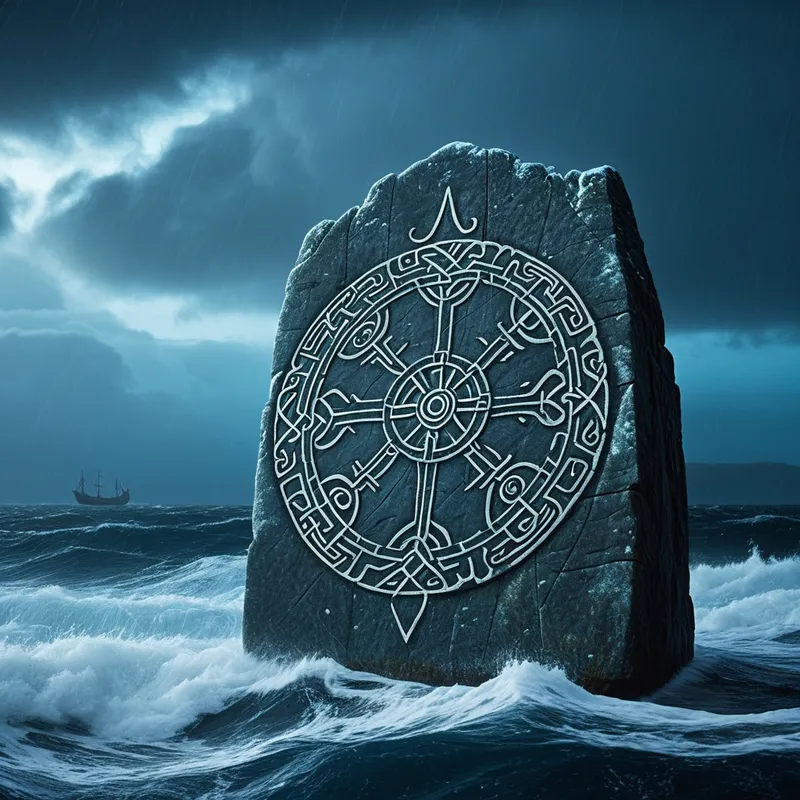
Vegvísir Myth Meaning & Symbolism
The myth of the Vegvísir, a magical stave, tells of finding one's path through the storm of existence, guided by an inner compass forged in the crucible of the self.
The Tale of Vegvísir
Listen, and hear the whisper of the salt wind. It does not speak of calm seas and gentle shores, but of the great Ginnungagap that lives within every voyage. This is not a tale of gods, but of the space between breaths in the heart of a sailor lost in the Útgarðr.
The world had shrunk to the groan of oak planks and the hiss of foam on black water. The sky was a lid of iron, hammered flat by the fist of the wind, and the sun had fled, a coward. Hrafn, at the steering oar, felt not fear, but a deeper dread: the unmaking of knowing. The landmarks of sea and star had been stolen. The ørlög written in his bones felt frayed, unwritten. His crew were ghosts, their eyes reflecting only the abyss that yawned on all sides. They were not sailing to anything, but out of everything—out of memory, out of hope, out of the very story of themselves.
In the third night of this grey dissolution, as the soul grows thin enough to see through, Hrafn ceased to fight the wheel. He let the storm have the ship. In that surrender, a silence louder than the gale opened within him. He saw not with his eyes, but with the sight that comes when eyes are useless. He saw the pattern of the winds not as chaos, but as a great, breathing sigil. He saw the spray not as water, but as the ink of the world, and the shuddering deck his parchment.
With a cry torn from a place deeper than his lungs, he took his seax and began to carve—not into wood, but into the air itself, tracing the memory of the pattern he had seen in the storm’s heart. It was a wheel of arms, each pointing a way that was not a direction on a map, but a direction of the spirit. As the final line was etched in his mind’s eye, a quiet fell. Not the end of the storm, but a center within it. The wind still roared, but it now had a shape. The waves still climbed, but they now had a rhythm. He knew, with a certainty that needed no star or shore, the way home. It was not east or west. It was through.

Cultural Origins & Context
The Vegvísir, the “Wayfinder,” is not a myth preserved in the grand eddas of gods and giants. Its home is humbler, more intimate. It emerges from the Galdrabók tradition—grimoires of post-medieval Iceland, where the old Norse worldview bled into Christian symbolism and practical folk magic. These were not the tales of skalds for kings, but the whispered knowledge of farmers, fishermen, and travelers surviving on the edge of the world.
Its societal function was starkly practical, yet profoundly metaphysical. In a landscape of featureless lava fields, blinding snowstorms, and treacherous seas, to lose one’s way was to court death. The Vegvísir, often inscribed on objects or drawn in blood or lead, was a physical anchor for an internal process. It was a technology of the soul, a cognitive map for when the external map had been obliterated. It spoke to a core Norse understanding: that the universe is inherently hostile and bewildering (Útgarðr), and that survival depends on hamingja and cunning guidance. It was passed down not as a dramatic saga, but as a crucial piece of survival lore, a charm against the ultimate terror: existential disorientation.
Symbolic Architecture
At its core, the Vegvísir is not a compass for geography, but for ontology. Its eight arms do not point to fixed cardinal directions, but to the ever-shifting poles of a lived experience. It symbolizes the innate, often forgotten, human capacity to find orientation from within when all external reference points vanish.
The true storm is not in the sky, but in the moment the inner world and the outer world become indistinguishable in their chaos. The Vegvísir is the pattern that emerges when one stops fighting the chaos and begins to read it.
Psychologically, it represents the Self—the central, organizing principle of the psyche in Jungian thought. The arms are the myriad aspects of the personality, the conflicting forces, memories, and drives. When one is centered in the Self, these aspects are not sources of fragmentation, but points of reference, each offering a potential “way” through a psychic dilemma. The symbol is a mandala for the soul under duress, a visual meditation that forces the scattered mind back to a singular, integrative point.
The Dreamer’s Resonance
When the Vegvísir appears in a modern dream, it is rarely as a clear, carved symbol. More often, it is felt as its function. The dreamer is in a labyrinth of their own making—a endless office corridor, a repeating neighborhood, a forest where every tree is familiar yet leads nowhere. There is a somatic quality of spiraling, of vertigo, of the ground having no true north.
This is the psyche’s signal of profound disorientation. The dreamer is in a life transition where old identities (jobs, relationships, beliefs) have dissolved, and new ones have not yet coalesced. The conscious ego has lost its map. The appearance of the Vegvísir, or the sudden, calm knowledge of the path in such a dream, signifies the activation of a deeper guidance system—the unconscious Self beginning to provide coordinates that the logical mind cannot compute. It is the dream equivalent of Hrafn’s surrender at the helm; the moment the struggle ceases, and a more ancient, intuitive intelligence takes the wheel to navigate the inner Útgarðr.

Alchemical Translation
The myth of the Vegvísir models the alchemical stage of nigredo—the descent into the black chaos where all form is lost. This is a necessary death. The old “way” of being, the conscious persona’s carefully plotted course, must be shattered by the storm of circumstance or inner turmoil. This dissolution feels like failure, like being utterly and hopelessly lost.
The act of “finding” the Vegvísir is the stage of albedo. It is not a discovery of something external, but a creation from the raw material of the chaos itself. The sailor does not find a map; he becomes the cartographer of his own dissolution.
Individuation is not about following a pre-drawn path to a known destination. It is about developing the capacity to inscribe the path itself from the substance of your wanderings, and to recognize that the center from which all directions radiate has been within you all along.
For the modern individual, the alchemical translation is this: your periods of greatest confusion, where life feels meaningless and directionless, are not errors to be corrected, but the crucial raw material. The Vegvísir emerges not in spite of the storm, but because of it. The work is to cease resisting the disorientation, to turn inward with the question not of “Where is the shore?” but of “What pattern is this chaos trying to show me?” The way through is forged in the crucible of being lost, and the compass that guides you is forged in the same fire. You do not find your way home. You realize, through the act of wayfinding, that you carry the blueprint of home within your very core.
Associated Symbols
Explore related symbols from the CaleaDream lexicon: