Vasilisa the Beautiful Myth Meaning & Symbolism
A motherless girl, guided by a magical doll, journeys into the dark forest to face Baba Yaga and bring back fire, transforming her fate.
The Tale of Vasilisa the Beautiful
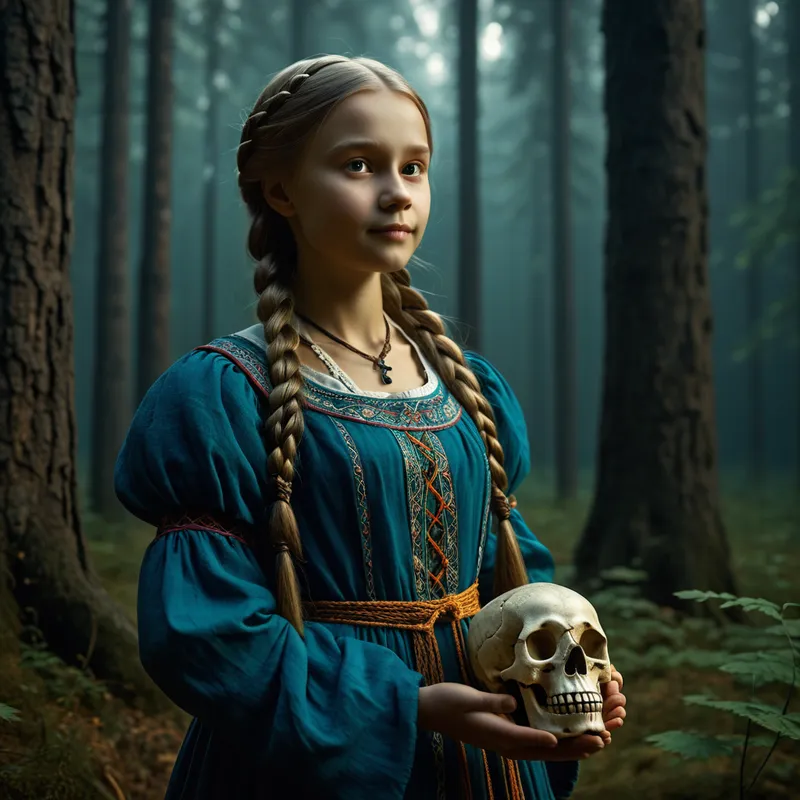
Listen, and let the old forest tell you a tale. In a time when the world was thick with spirits, there lived a merchant and his beloved wife. To them was born a daughter, Vasilisa, whose beauty was matched only by her gentle heart. But fate is a fickle wind. On her deathbed, the mother called Vasilisa close, placed a small wooden doll into her hands, and whispered a secret that would become her daughter’s soul: “Feed this doll, tell it your sorrows, and it will guide and protect you.” With that final breath, the mother was gone, and a great shadow fell upon the girl’s heart.
Time passed. The merchant, seeking solace, took a new wife—a widow with two daughters of her own. Cruelty entered the house like a winter frost. The stepmother and stepsisters, jealous of Vasilisa’s grace, heaped upon her every chore, every indignity, hoping to break her light. But in the darkest hour of each night, Vasilisa would retreat to the corner, share a crust of bread with her doll, and whisper her woes. And the doll, alive with her mother’s love, would work the tasks, spinning flax into gold thread, bringing comfort in the silent dark.
One evening, the stepmother devised a final cruelty. She extinguished every fire and lamp in the house. “Go,” she commanded Vasilisa, her voice sharp as ice. “Go to the house of Baba Yaga in the deep, black forest and bring back fire. If you do not, you are no longer welcome here.” The stepsisters shoved her into the impenetrable night, locking the door behind her.
Vasilisa walked. The forest was a living darkness, full of creaking bones and watching eyes. Terror gripped her heart. She reached into her pocket, fed the doll, and confessed her fear. The doll glowed warm. “Do not be afraid,” it seemed to say. “Walk. I will show you the way.” And so the doll guided her, its subtle pull leading her through the tangled roots and past spectral riders—one in white on a white horse (Dawn), one in red on a red horse (Sun), and finally one in black on a black horse (Night).
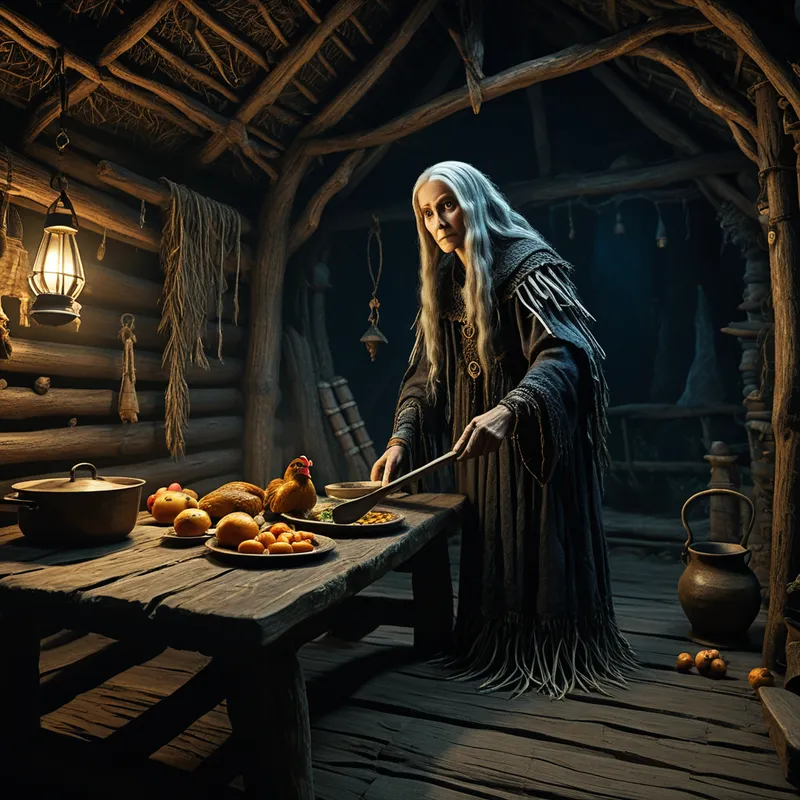
At last, she came to a clearing where a fence of human bones topped with skulls encircled a hut that stood and spun on giant chicken legs. Before it, Baba Yaga rode in a mortar, rowing with a pestle, sweeping her tracks with a broom. Her iron teeth gnashed, her nose hooked like a beak. “I smell the Russian spirit!” she screeched. Vasilisa, trembling, stated her errand. The witch growled, “You may stay and work for me. If you fail, I will eat you.”
The next day, Baba Yaga laid out impossible tasks: clean the hut, sort millet from poppy seeds, cook a feast. Then she flew away. Vasilisa despaired, but again consulted her doll. The doll called forth a legion of helper creatures—mice, birds, cats—and the work was done. Baba Yaga returned, sniffed the air, and knew magic was at work. On the second day, the tasks were more terrible: wash the black linen, separate darkness from light. Again, the doll and its helpers accomplished the impossible.
Finally, curious, Baba Yaga questioned Vasilisa. “How did you do this?” Vasilisa, remembering her mother’s final instruction to be humble, said simply, “By my mother’s blessing.” The witch hissed, “I want no blessed ones in my house! Take your fire and go!” She thrust a skull lantern, its eye sockets blazing with fire, onto a stick and sent Vasilisa back into the forest.
The skull’s light burned with an unearthly glow. When Vasilisa arrived home, the light fell upon her stepmother and stepsisters, and its gaze consumed them, turning them to ashes on the spot. Vasilisa buried the skull, honoring its power. She lived on, her mother’s wisdom and the doll’s guidance now fully her own. She grew to become a famed weaver, her beauty and skill known throughout the land, her life a tapestry woven from both darkness and light.
Cultural Origins & Context
The tale of Vasilisa is a cornerstone of East Slavic, particularly Russian, folklore. It belongs to the rich oral tradition preserved by peasant communities, told during the long winter nights (posidelki) or while engaged in communal work like spinning. These stories were not mere entertainment; they were a vital cultural technology for transmitting values, survival strategies, and a map of the psychic landscape. The teller was often an elder woman, a skazitelnitsa, who carried the collective memory.
The myth functions as a profound initiation story for young women, preparing them for the harsh realities of a patriarchal society where they might be orphaned, mistreated by a new marital family, or sent away. It encodes essential feminine wisdom: the necessity of a connection to the ancestral mother-line (the doll), the inevitability of confronting the wild, untamed, and fearsome aspects of the feminine (Baba Yaga), and the ultimate source of power residing in humility, obedience to inner guidance, and respectful engagement with the mysterious forces of nature and fate.
Symbolic Architecture
At its core, Vasilisa’s [journey](/symbols/journey “Symbol: A journey in dreams typically signifies adventure, growth, or a significant life transition.”/) is an archetypal descent into the unconscious to retrieve a vital, transformative [energy](/symbols/energy “Symbol: Energy symbolizes vitality, motivation, and the drive that fuels actions and ambitions.”/). The Baba Yaga is not merely a [villain](/symbols/villain “Symbol: A character representing opposition, moral corruption, or suppressed aspects of self, often embodying fears, conflicts, or societal threats.”/); she is the ultimate [Shadow](/symbols/shadow “Symbol: The ‘shadow’ embodies the unconscious, repressed aspects of the self and often represents fears or hidden emotions.”/) figure and the incarnate Dark [Goddess](/symbols/goddess “Symbol: The goddess symbolizes feminine power, divinity, and the nurturing aspects of life, embodying creation and wisdom.”/) of the [forest](/symbols/forest “Symbol: The forest symbolizes a complex domain of the unconscious mind, representing both mystery and potential for personal growth.”/). She represents the raw, amoral, [life](/symbols/life “Symbol: The symbol of ‘Life’ represents a journey of growth, interconnectedness, and existential meaning, encompassing both the joys and challenges that define human experience.”/)-and-[death](/symbols/death “Symbol: Symbolizes transformation, endings, and new beginnings; often associated with fear of the unknown.”/) power of [nature](/symbols/nature “Symbol: Nature symbolizes growth, connectivity, and the primal forces of existence.”/), the terrifying [aspect](/symbols/aspect “Symbol: A distinct feature, quality, or perspective of something, often representing a partial view of a larger whole.”/) of the Great [Mother](/symbols/mother “Symbol: The symbol of ‘Mother’ represents nurturing, protection, and the foundational aspect of one’s emotional being, often associated with comfort and unconditional love.”/) who tests, devours, and, if respected, bestows wisdom.
The doll is the silent voice of the Self, the psychic organ of orientation that operates when the conscious ego is lost and afraid.
Vasilisa’s magical [doll](/symbols/doll “Symbol: Dolls often symbolize innocence, childhood, and unmet desires, reflecting both nurturing aspects and potential hidden fears.”/) is the embodied [connection](/symbols/connection “Symbol: Connection symbolizes relationships, communication, and bonds among individuals.”/) to the positive [mother complex](/symbols/mother-complex “Symbol: A deep psychological pattern where unresolved maternal relationships influence identity, spirituality, and emotional life, often manifesting as dependency, idealization, or rebellion.”/)—the internalized guide, the [intuition](/symbols/intuition “Symbol: The immediate, non-rational understanding of truth or insight, often described as a ‘gut feeling’ or inner knowing that bypasses conscious reasoning.”/), the “still small voice.” It represents the psychic function that knows the way when the conscious mind is blinded by fear. The [skull](/symbols/skull “Symbol: The skull often symbolizes mortality, the afterlife, and the fragility of life.”/) lantern with its fiery eyes is the prize of the ordeal: illuminated [consciousness](/symbols/consciousness “Symbol: Consciousness represents the state of awareness and perception, encompassing thoughts, feelings, and experiences.”/). It is the light of discernment, the fierce [truth](/symbols/truth “Symbol: Truth represents authenticity, honesty, and the quest for knowledge beyond mere appearances.”/) that, when brought back from the [underworld](/symbols/underworld “Symbol: A symbolic journey into the unconscious, representing exploration of hidden aspects of self, transformation, or confronting repressed material.”/), has the power to incinerate falsehood and oppression (the stepfamily). The fire is not created; it is retrieved from the [heart](/symbols/heart “Symbol: The heart symbolizes love, emotion, and the core of one’s existence, representing deep connections with others and self.”/) of darkness itself.

The Dreamer’s Resonance
When this myth pattern stirs in the modern dreamer, it signals a critical phase of psychological initiation. To dream of being sent on an impossible errand by a cruel authority figure speaks to a feeling of being set up to fail by life or by internalized critics. The deep, dark forest is the dreamer’s own unexplored and frightening unconscious terrain.
Dreams of receiving guidance from a small, overlooked object (a doll, a stone, a key) point to the awakening of an inner guiding function. Encounters with a terrifying yet compelling feminine figure—a hag, a wild woman, a demanding teacher—often embody the dreamer’s confrontation with the repressed power of their own instinctual nature or with the complex legacy of the mother. The somatic feeling is often one of cold dread mixed with a strange, pulsing curiosity. The psyche is preparing to face what it has avoided, knowing that on the other side of that meeting lies a source of immense power and clarity.

Alchemical Translation
Vasilisa’s journey is a perfect allegory for the Jungian process of individuation. The orphaned ego (Vasilisa), oppressed by a false persona (the stepfamily’s demands), must heed the call of the Self (the doll’s guidance) and make the necessary descent. The hut of Baba Yaga is the vas or vessel of transformation, the sealed alchemical retort where impossible tasks—the nigredo or blackening—take place.
The fire in the skull is the lumen naturae, the light of nature, which can only be kindled by first serving the darkness that guards it.
By performing the tasks with humility and relying on her inner helper, Vasilisa does not fight the darkness; she works within it. This is the essence of psychic alchemy: submitting to the process. The witch’s questions are an interrogation of the ego’s source of power. Vasilisa’s honest answer, “my mother’s blessing,” is the key that unlocks the vessel. It is the acknowledgment that her strength is transpersonal, ancestral, and rooted in love, not in personal willfulness. This truth forces her ejection from the transformative womb, now carrying the liberated fire—the albedo (whitening) and rubedo (reddening)—back to the world. The incineration of the stepfamily is the final purgation of the oppressive complexes, allowing the integrated personality (the skilled weaver) to emerge and create her life from a place of authentic, hard-won power.
Associated Symbols
Explore related symbols from the CaleaDream lexicon:
- Doll — The embodied connection to ancestral wisdom and intuitive guidance, representing the small, often-ignored inner voice that knows the true path.
- Forest — The vast, unknown territory of the unconscious mind, a place of danger, testing, and profound initiation where one meets their deepest fears and greatest allies.
- Fire — The transformative light of consciousness and truth, retrieved from the heart of darkness, possessing the power to purify, illuminate, and destroy falsehood.
- Mother — The archetypal source of life, blessing, and protection, whose love persists beyond death as an internalized guide and moral compass.
- Shadow — The terrifying, amoral aspect of the psyche embodied by Baba Yaga, which must be encountered and served to access its hidden power and wisdom.
- Journey — The essential process of leaving the familiar (the oppressed home) to venture into the unknown, which is the fundamental structure of psychological growth and self-discovery.
- Light — The achieved goal of the quest, representing illuminated consciousness, clarity, and the ability to see truth where before there was only obscurity and fear.
- Task — The seemingly impossible trials set by the unconscious or by fate, which are not punishments but the necessary operations for refining and strengthening the psyche.
- Skull — A vessel of ancestral knowledge and a container for transformative fire, symbolizing the confrontation with mortality as the gateway to true wisdom.
- Door — The threshold between the known world and the magical, dangerous realm of the unconscious, which one must pass through to begin the transformative work.
- Bone — The structural, enduring essence beneath the surface; the fence of bones around Baba Yaga’s hut represents the stark, non-negotiable realities of life, death, and nature’s law.