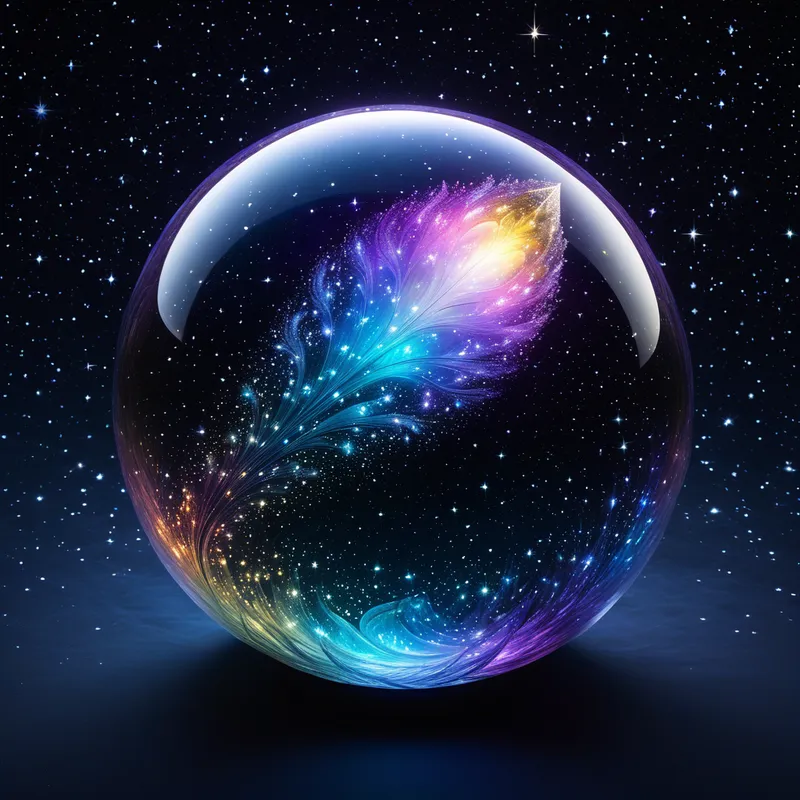
Vas Hermeticum Myth Meaning & Symbolism
The tale of the divine vessel, shattered by cosmic conflict and forged anew, embodying the alchemical process of dissolution and sacred reunion.
The Tale of Vas Hermeticum
In the time before time, when the breath of the Nous was still warm upon the face of the deep, there existed a perfect vessel. It was not wrought by hand, but dreamed into being by the longing of the cosmos for its own reflection. This was the Vas Hermeticum, a sphere of living crystal that held within its flawless walls the dance of all opposites—light and shadow, fire and water, spirit and matter—in harmonious, swirling communion.
Its keeper was Mercurius Duplex, the two-faced god, who was both the swift messenger and the hidden trickster. With one face, he gazed upon the vessel’s serene surface, singing the song of unity. With the other, he peered into the chaotic, fertile abyss from which all things spring. For eons, this balance held. The vessel was the still point of the turning world, the secret heart where the Coniunctio was not a goal, but a perpetual, breathing reality.
But a whisper grew in the abyss—a longing for distinction, for the thrill of separation. This whisper found form in Sal, the spirit of crystallization, who desired to make permanent the vessel’s fleeting beauties. And it found voice in Sulfur, the spirit of raging fire, who burned to experience its power unfettered. Together, they turned their gaze upon the Vas, no longer seeing a whole, but seeing only parts they coveted: its stability, its passion.
One fateful turning of the cosmic wheel, as Mercurius Duplex looked with both faces into the abyss, Sal and Sulfur struck. Not with weapons, but with a single, resonant note of contradiction—a demand to be known as separate, supreme. The note vibrated through the Vas Hermeticum, a frequency its unity could not absorb. A hairline fracture appeared, not on the surface, but in its very essence. Then, a soundless explosion of terrible beauty.
The vessel shattered. Not into mere fragments of crystal, but into the very substances of reality: shards of pure light became stars; droplets of dark water became oceans; sparks of restless fire fled to become souls; and flakes of heavy earth settled to become clay. Mercurius Duplex let out a cry that was both a lament and a birth pang, his two faces now eternally turned away from each other, one toward the scattered light, the other toward the retreating dark.
From the void where the Vas once rested, a profound silence echoed. Yet, within that silence, a new sound emerged—faint, insistent. It was the sound of the fragments themselves, humming across the vast distances of creation. A shard of star-light yearned for the coolness of the water-shard. A piece of the fiery core ached for the solidity of earth. It was the memory of wholeness, singing in each separate piece. And the legend says that this song is the first law of alchemy, and the promise that the vessel, though shattered, dreams of becoming whole once more.
Cultural Origins & Context
The myth of the Vas Hermeticum is the foundational narrative of the philosophical and spiritual tradition known as Hermeticism, which flourished in the early centuries of the common era, synthesizing Egyptian, Greek, and Gnostic thought. It was not a popular fable but a mythologem guarded within the scriptoriums and meditation chambers of alchemical adepts.
Passed down through encoded texts like the Tabula Smaragdina and whispered during the initiation rites of the Magnum Opus, its primary function was ontological and pedagogical. It explained the origin of a fractured universe and, more importantly, defined the human condition: we are not born into perfection, but into a sacred catastrophe. Our very substance is a fragment of the Vas. Therefore, the myth served as both the diagnosis of the human dilemma—the experience of separation, conflict, and longing—and the prescription for its cure. The society it informed was not a political one, but a society of the soul, where the ultimate civic duty was the inner work of recollection and reunification.
Symbolic Architecture
Psychologically, the Vas Hermeticum represents the original, potential state of the Self prior to the trauma of incarnation and ego-development. It is the psychic totality where opposites coexist without conflict.
The unbroken Vessel is the dream of the psyche before it knows itself as fragmented.
Mercurius Duplex symbolizes the transcendent function of consciousness itself, the faculty that can hold tension and mediate between opposites. His “two faces” are the conscious and unconscious minds. The catastrophic shattering represents the necessary fall into manifestation—the birth of the ego, the differentiation of cognitive functions, and the inevitable neuroses that arise from identifying with only one “shard” of our being (e.g., only thinking, only feeling). Sal and Sulfur are not villains, but essential psychic forces; they are the drives toward consolidation and passion which, when acting autonomously without the reconciling principle of Mercurius, lead to inner conflict and disintegration.
The Dreamer’s Resonance
When this myth stirs in the modern unconscious, it often manifests in dreams of profound repair or impossible synthesis. One may dream of painstakingly gluing together a shattered porcelain bowl, only to find the seams glow with a strange light. Another may dream of a room that is simultaneously a forest and a library, or of a key that fits a lock made of water. These are dreams of the Coagulatio stage.
Somatically, this process can feel like a deep, almost cellular yearning—a homesickness for a place one has never visited. It may arise during life transitions, after great losses, or in moments of quiet despair at the world’s fragmentation. It is the psyche’s intuition that the current state of being is not final, that the conflicts between one’s logic and intuition, duty and desire, are not mere problems to be solved, but sacred fragments calling to each other. The anxiety felt is the vibration of those fragments humming across the inner distances.
Alchemical Translation
The individuation process is the personal re-enactment of this myth. We begin life psychologically “shattered”—identified with a small cluster of fragments (our persona, our complexes). The first stage, Nigredo, is the conscious acknowledgment of this inner fracture: the depression, the confusion, the sense of being lost in one’s own life. This is the long gaze at the emptiness where the Vas once was.
The work is not to become someone new, but to remember the vessel that you are, and to become a worthy smithy for its repair.
The subsequent alchemical stages—Albedo, Citrinitas, and Rubedo—are the slow, meticulous process of gathering the scattered shards of soul. This involves integrating the rejected shadow (the dark, earthy fragments), reconciling anima and animus (the watery and fiery fragments), and ultimately, inviting Mercurius back to the center of one’s being. The repaired Vas Hermeticum is not a return to a naive, pre-conscious unity. It is a complexio oppositorum—a conscious, embodied wholeness that has integrated the experience of fracture. The adept who achieves this does not possess the Philosopher’s Stone; they have, through immense and patient work, become the living vessel that can contain it.
Associated Symbols
Explore related symbols from the CaleaDream lexicon: