Valley of Dry Bones Myth Meaning & Symbolism
The prophet Ezekiel's vision of a valley of scattered bones, re-knit and re-fleshed by divine breath, symbolizing national and spiritual restoration.
The Tale of Valley of Dry Bones
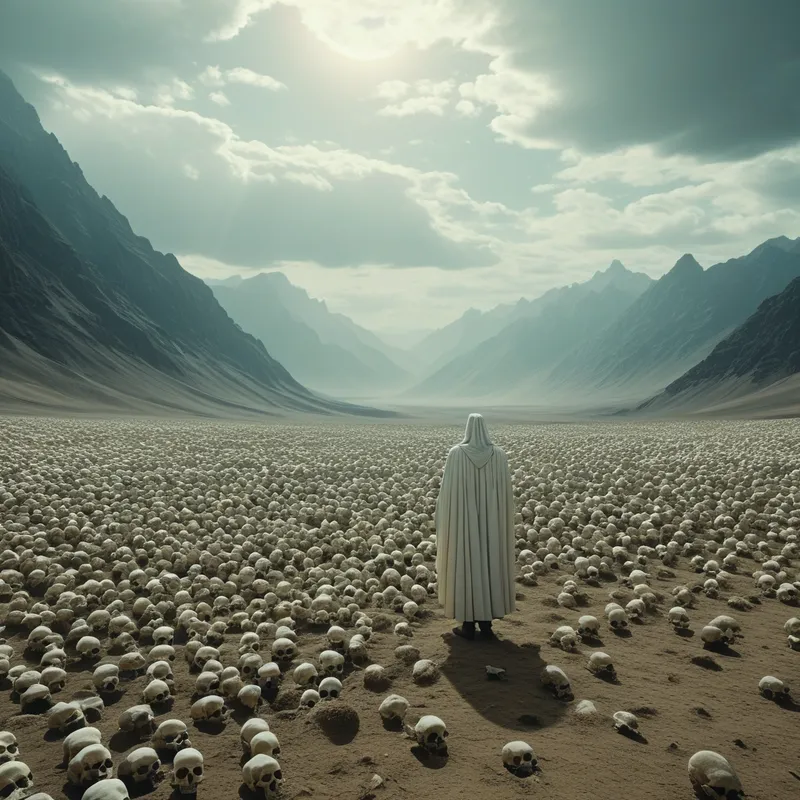
The hand of the Divine was heavy upon him. It was not a gentle touch, but a grip that pulled the soul from its moorings, lifting the prophet Ezekiel and setting him down in the center of a vast and silent horror. The air was a dry oven, tasting of dust and forgotten death. Before him, as far as his spirit-sight could pierce, stretched a valley—a plain of utter desolation.
It was not a field of the slain, for there was no recent violence here. This was a place of finality. The ground was a mosaic of bones. Not skeletons, whole and articulate, but bones scattered, disarticulated, thrown down by some great and ancient calamity. Femurs lay far from their hips, ribs were sundered from spines, skulls gazed emptily from shallow graves of dust. They were very many, and they were very dry. The sun had long since drunk every drop of moisture, bleaching them to a blinding, brittle white. No scavenger cried here; no plant dared sprout. There was only the immense, crushing silence of a hope that had died and turned to powder.
A voice, not from the sky but from within the very marrow of the vision, spoke to the prophet. “Son of man, can these bones live?”
Ezekiel, his own breath caught in his throat by the sheer impossibility of the scene, could only answer from a place of trembling faith. “O Lord YHWH, you alone know.”
Then came the command, a word that bridged the chasm between nothingness and being. “Prophesy to these bones. Say to them: O dry bones, hear the word of the Lord!”
And so Ezekiel spoke, his voice a fragile thread in that vast silence. He declared the promise of sinew and flesh, of skin drawn over the void. And as the words fell upon the dust, a sound arose—not a wind at first, but a rattling, a deep seismic trembling. Bone sought out bone with a terrible, clicking music. Before his eyes, the scattered pieces flew together, femur to hip, vertebra to vertebra, skull to crown the architecture of a person. Sinews wove themselves like living thread, and flesh clothed them, and skin covered them over. But they were not alive. They were perfect forms, an army of statues lying in the grim silence, a monument to form without function, vessel without breath.
Again the voice came. “Prophesy to the breath, son of man. Prophesy, and say to the breath: Thus says the Lord YHWH: Come from the four winds, O breath, and breathe upon these slain, that they may live.”
Ezekiel obeyed. He called to the Ruach. And it came. Not as a gentle zephyr, but as the rushing, roaring breath of creation itself, the same wind that moved over the face of the primordial deep. It swept into the valley, and where it touched, a shudder ran through the lifeless forms. Chests rose. Lungs, newly formed, drew in the spirit. A light kindled behind the eyes of the skulls. And they stood up—a vast, living, breathing multitude, a people resurrected from the dust of despair. The valley of death had become a field of standing men, animated by the divine and unkillable breath.

Cultural Origins & Context
This vision is recorded in the 37th chapter of the Book of Ezekiel. Its context is one of profound national trauma: the Babylonian Exile. Ezekiel himself was among the elites deported to Babylon. His community was spiritually and politically shattered. Jerusalem and its Temple—the geographic and symbolic heart of their identity and covenant with God—lay in ruins. The people felt cut off, dead in their hope, their national body dismembered and scattered.
Ezekiel’s prophecy was not a gentle comfort but a dramatic, public performance of divine power, meant to be heard and visualized by the exiles. It functioned as radical theological shock therapy. In a culture where collective identity was tied to land, king, and temple—all now lost—the vision redefined the source of life. It argued that even when the structures are utterly destroyed, even when hope is dry as sun-bleached bone, the creative and animating power of YHWH is not limited by geography or circumstance. The myth served to forge a new, resilient identity: a people defined not by a physical kingdom, but by the spirit that could resurrect them from any valley of death.
Symbolic Architecture
The myth operates on multiple symbolic levels, each a layer of profound psychological truth. The valley represents the depths of despair, the psychological landscape where all structure, meaning, and connection have been utterly lost. The dry bones are not just dead; they are desiccated, symbolizing a state beyond fresh grief—it is hopelessness that has been seasoned by time, a despair that has become a permanent residence.
The first resurrection is of form, the second is of spirit. We often rebuild the skeleton of our lives—the job, the routine, the outward shape—long before the animating breath returns.
The two-stage process of revival is critical. The coming together of bones, sinew, and flesh signifies the reassembly of the fractured self, the ego’s attempt to piece itself back together after trauma. But this can result in a kind of functional, yet lifeless, existence—going through the motions without vitality or purpose. The final, essential ingredient is the Ruach. In Hebrew thought, ruach is wind, breath, and spirit—the invisible, vitalizing force that distinguishes a living being from a corpse. It represents divine inspiration, life force, meaning, and psychic energy. The myth asserts that true wholeness requires not just the reassembly of parts, but the infusion of a transcendent, enlivening principle from beyond the ego.
The Dreamer’s Resonance
When this myth surfaces in modern dreams, it rarely appears as a biblical tableau. Instead, the dreamer may find themselves in a sterile office building filled with broken equipment, a childhood home emptied of all furniture and warmth, or a gray plain littered with plastic and debris—all modern valleys of dry bones. The feeling is one of profound desolation, alienation, and psychic disintegration.
The somatic experience is key. The dreamer may feel parched, brittle, hollow, or scattered. This is the psyche signaling a state of spiritual and emotional depletion. The dream is not merely reflecting depression; it is often presenting the underlying architecture of that depression—the sense that the internal structures that once held one’s identity and world together have come apart. The rattling, reassembling bones in the dream mirror the often-autonomous, subconscious process of beginning to gather the fragmented pieces of the self after a crisis. The dream may end before the breath arrives, leaving the dreamer with the tension of reassembled form awaiting animation—a precise snapshot of recovery in progress, where one is functional but not yet fully alive to joy or purpose.

Alchemical Translation
In the alchemical process of individuation, the Valley of Dry Bones maps directly onto the nigredo—the blackening, the stage of utter despair, dissolution, and confrontation with the shadow and one’s own mortality. It is the necessary, painful deconstruction of the old, outworn personality structures. The ego’s certainties are shattered and left to bleach in the sun of harsh reality.
The prophecy—the spoken word—represents the active, conscious intervention of the seeking ego or the guiding wisdom of the Self. It is the decision to engage with the devastation, to speak to it, to command it toward order. The reassembly of bones is the albedo, the whitening, where elements are purified and put back together in a new, more conscious arrangement.
The final, critical transmutation is not in the rebuilding, but in the inhalation. It is the moment the reclaimed self opens to a source of life greater than its own history.
The calling of the Ruach is the culmination: the rubedo, or reddening, where the integrated personality is infused with new life and purpose. Psychologically, this is the integration of the transcendent function, where the conscious mind aligns with the deeper, guiding currents of the unconscious Self. The breath is the symbol of this connection—it is what we share with the atmosphere, an endless exchange between the inner and the outer, the personal and the transpersonal. For the modern individual, the myth models a complete cycle of transformation: one must first fully inhabit the valley of despair, then actively participate in reassembling the self, but ultimate vitality depends on surrendering to and inviting in the animating spirit that comes from beyond the ego’s control. It is the journey from disintegration, through reformation, to inspiration.
Associated Symbols
Explore related symbols from the CaleaDream lexicon: