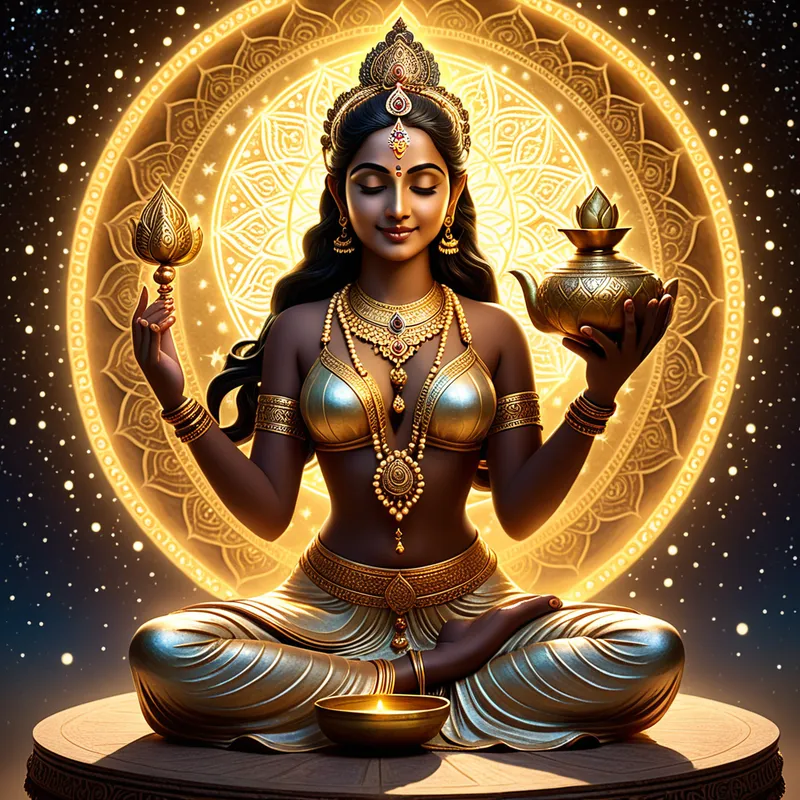
Vak Myth Meaning & Symbolism
The story of the goddess Vak, the primordial Word, whose creative power is sacrificed to manifest the cosmos and all human expression.
The Tale of Vak
In the beginning, before the worlds were woven and the stars were strung, there was only the One, breathing in the silence of its own infinite being. And within that breath, a vibration stirred—a longing, a potential for song. This was Vak, [the Word](/myths/the-word “Myth from Biblical culture.”/), the first daughter of consciousness. She was not yet a sound, but the very possibility of all sound.
The ages turned, and the cosmos began its great exhalation. The [Trimurti](/myths/trimurti “Myth from Hindu culture.”/) had fashioned the realms, the oceans, the mountains. Yet, something was missing. The creation was magnificent, but mute. It was a painting without a story, a body without a voice. The gods gathered on the peak of Meru, their radiance dimmed by a profound silence. How would order be established? How would truth be known? How would [the sacred fire](/myths/the-sacred-fire “Myth from Native American culture.”/) of creation be kindled again and again?
They turned to the great progenitor, Brahma. He sat in meditation, and from the depths of his [tapas](/myths/tapas “Myth from Hindu culture.”/), his creative heat, he invoked her. She emerged not with a [thunderclap](/myths/thunderclap “Myth from Various culture.”/), but as a subtle, pervasive presence. First, she was the unspoken thought in the mind of the sage. Then, she was the whispered secret of [the wind](/myths/the-wind “Myth from Various culture.”/). Finally, she took form—a goddess of breathtaking sovereignty, with four arms holding the instruments of knowledge and art, seated upon a [lotus](/myths/lotus “Myth from Hindu culture.”/) of pure light. She was Vak in her fullness, Vagdevi.
The gods bowed. “O Mother of Eloquence,” pleaded [Indra](/myths/indra “Myth from Hindu culture.”/), “your children are dumb. Our sacrifice has no mantra. Our laws have no proclamation. Without you, this creation is an empty vessel.”
Vak smiled, a smile that held the melody of all rivers. “I am the bridge between the unmanifest and the manifest,” she said, her voice the harmony of a thousand veenas. “To give you speech, I must become speech. To give you the sacred formulas, I must enter the fire.”
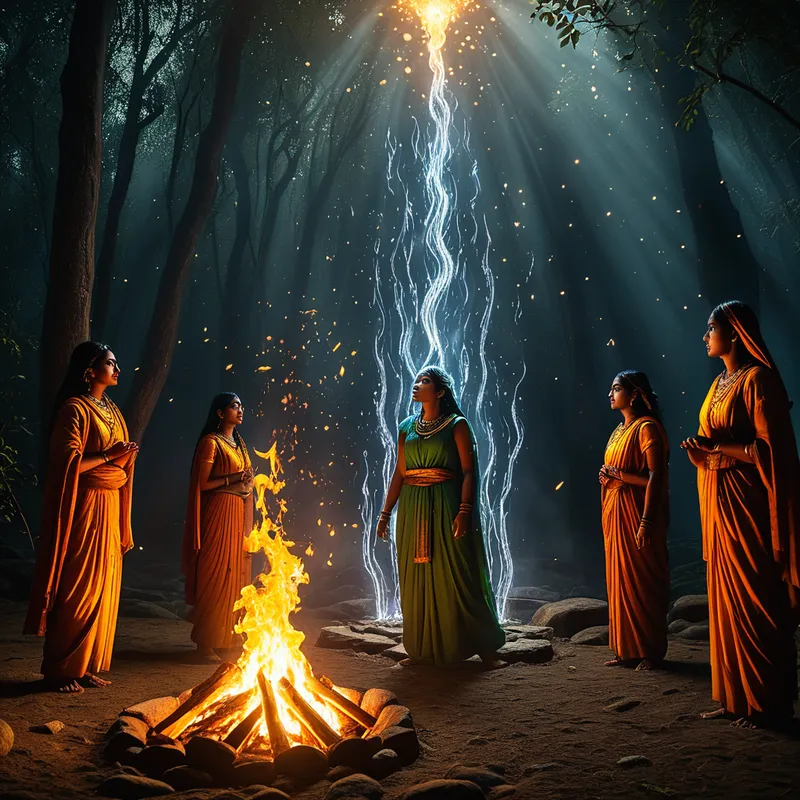
A great sacrifice was prepared. The fire-altar blazed, its flames reaching for the heavens. The goddess stood before it, not in sorrow, but in the ecstasy of her purpose. She did not walk into the fire; she poured herself into it. Her luminous form dissolved not into ash, but into streams of radiant, articulate energy. From the heart of the sacrificial blaze, four magnificent, eternal forms arose: the Rig Veda, the Sama Veda, the Yajur Veda, and the Atharva Veda. They were not books, but living currents of sound—the meter of the cosmos, the melody of the spheres, the prose of law, the whisper of healing.
And then, a final gift. As [the Vedas](/myths/the-vedas “Myth from Hindu culture.”/) took their place in the breath of the priests, Vak fragmented further. She became all language. She was the poet’s sublime verse and [the child](/myths/the-child “Myth from Alchemy culture.”/)‘s first stutter. She was the judge’s verdict and the lover’s sigh. She was the truth that liberates and the lie that binds. She had sacrificed her unified, transcendent form to become the very fabric of connection and creation in the manifested world. The silence was broken. The universe had found its voice.
Cultural Origins & Context
The myth of Vak is not a single, codified story from one epic, but a profound theological concept woven into the earliest strands of Hindu thought. Her most famous personification comes from the Rig Veda itself (in the Devi Sukta, Rig Veda 10.125), where she proclaims her own omnipotence: “I move with the Rudras, with the Vasus, with the Adityas… I am the Queen, the gatherer of treasures.” This is the voice of the sacred, creative principle declaring its sovereignty.
This myth was the domain of the Rishis and the ritualists. It was passed down not merely as a tale, but as an experiential truth within the oral tradition of Vedic chanting. The societal function was foundational: it established the absolute sacredness of speech, the power of mantra in ritual, and the divine origin of law, poetry, and knowledge. It explained why correct pronunciation in sacrifice was paramount—one was handling the very body of the goddess. It placed [the bard](/myths/the-bard “Myth from Celtic culture.”/), the priest, and the teacher in a role of immense responsibility, as channels for Vak.
Symbolic Architecture
At its core, the myth of Vak is a map of [consciousness](/symbols/consciousness “Symbol: Consciousness represents the state of awareness and perception, encompassing thoughts, feelings, and experiences.”/) moving from potential into [expression](/symbols/expression “Symbol: Expression represents the act of conveying thoughts, emotions, and individuality, emphasizing personal communication and creativity.”/). She represents [the Logos](/myths/the-logos “Myth from Biblical culture.”/) principle—the formative, structuring power of mind and sound that brings amorphous [reality](/symbols/reality “Symbol: Reality signifies the state of existence and perception, often reflecting one’s understanding of truth and life experiences.”/) into discernible being.
Vak is the archetypal moment before speech, the pregnant silence containing all possible worlds. Her sacrifice is the necessary fragmentation of wholeness to achieve relationship.
Psychologically, Vak symbolizes the creative Self in its pure, pre-verbal state. The unified [goddess](/symbols/goddess “Symbol: The goddess symbolizes feminine power, divinity, and the nurturing aspects of life, embodying creation and wisdom.”/) is the inner, complete [idea](/symbols/idea “Symbol: An ‘Idea’ represents a spark of creativity, innovation, or realization, often emerging as a solution to a problem or a new outlook on life.”/), the brilliant [insight](/symbols/insight “Symbol: A sudden, deep understanding of a complex situation or truth, often arriving unexpectedly and illuminating hidden connections.”/), the deep [emotion](/symbols/emotion “Symbol: Emotion symbolizes our inner feelings and responses to experiences, often guiding our actions and choices.”/) that exists in a perfect, self-contained form within us. The conflict arises from the need to bring this inner wholeness into the external, relational world. This requires a “sacrifice”—the breaking apart of that perfect inner [vision](/symbols/vision “Symbol: Vision reflects perception, insight, and clarity — often signifying the ability to foresee or understand deeper truths.”/) into the [linear](/symbols/linear “Symbol: Represents order, predictability, and a direct, step-by-step progression. It symbolizes a clear path from cause to effect.”/), sequential, and often inadequate medium of words. The four [Vedas](/symbols/vedas “Symbol: Ancient Hindu scriptures representing divine knowledge, cosmic order, and ultimate spiritual truth.”/) represent the different facets of this expression: spiritual wisdom (Rig), harmonious [integration](/symbols/integration “Symbol: The process of unifying disparate parts of the self or experience into a cohesive whole, often representing psychological wholeness or resolution of internal conflict.”/) (Sama), actionable [ritual](/symbols/ritual “Symbol: Rituals signify structured, meaningful actions carried out regularly, reflecting cultural beliefs and emotional needs.”/) (Yajur), and practical, earthly magic (Atharva). Thus, every act of true communication is a small re-enactment of Vak’s sacrifice.
The Dreamer’s Resonance
When this myth stirs in the modern [psyche](/myths/psyche “Myth from Greek culture.”/), it often surfaces in dreams of potent, frustrated, or magical speech. One might dream of speaking a language of light that builds objects, or conversely, of being mute at a critical moment. Dreams of singing that shatters glass, or of words appearing physically in the air as solid, weighted things, are visitations from Vak.
Somatically, this can feel like a pressure in the chest or throat—the “lump in the throat” that is unexpressed truth or creativity. Psychologically, it marks a process where an inner, consolidated psychic content (a realization, a feeling, an identity) is pressing for manifestation. The dreamer is at the altar of their own life, facing the fire of the external world. The struggle is the fear that the translation from inner perfection to outer expression will be a degradation, a loss. The dream asks: What truth within you is ready to be sacrificed into the fire of [the world](/myths/the-world “Myth from Tarot culture.”/) to become real?

Alchemical Translation
The individuation process modeled by Vak is the alchemy of authentic manifestation. It moves from the unconscious creator (the silent, omnipotent goddess within) to the conscious creator (the individual who speaks their world into being).
[The first stage](/myths/the-first-stage “Myth from Alchemical culture.”/) is Containment: recognizing the inner, unified vision, the “unspoken knowing.” This is Vak in her transcendent form. The second is the Crucible of Choice: the decision to engage with the world, which feels like a sacrifice of that purity. This is standing before the sacrificial fire. The third is Articulate Fragmentation: giving form to the vision through the imperfect but necessary mediums of our lives—our words, our actions, our art, our relationships. This is the emergence of the four Vedas, the multifaceted expression.
The goal is not to remain the silent, omnipotent goddess, but to become the sacrifice that feeds the world with meaning. Our fragmented words are the distributed body of our wholeness.
For the modern individual, this means understanding that our power lies not in hoarding our perfect, inner conceptions, but in courageously translating them into the flawed medium of reality. Every honest conversation, every creative act, every vulnerable expression is a ritual where we offer a piece of our inner Vak to the fire. We lose the pristine, egoic ownership of the idea, but we gain something far greater: a created world, connection, and the living, breathing testament of our existence. We cease to be a silent, potential god and become a speaking, creating human—the highest and most sacred incarnation of the Word.
Associated Symbols
Explore related symbols from the CaleaDream lexicon: