Vajrayogini Myth Meaning & Symbolism
The myth of the wrathful, ecstatic goddess Vajrayogini, who embodies the alchemical fire that burns illusion to reveal luminous, liberated awareness.
The Tale of Vajrayogini
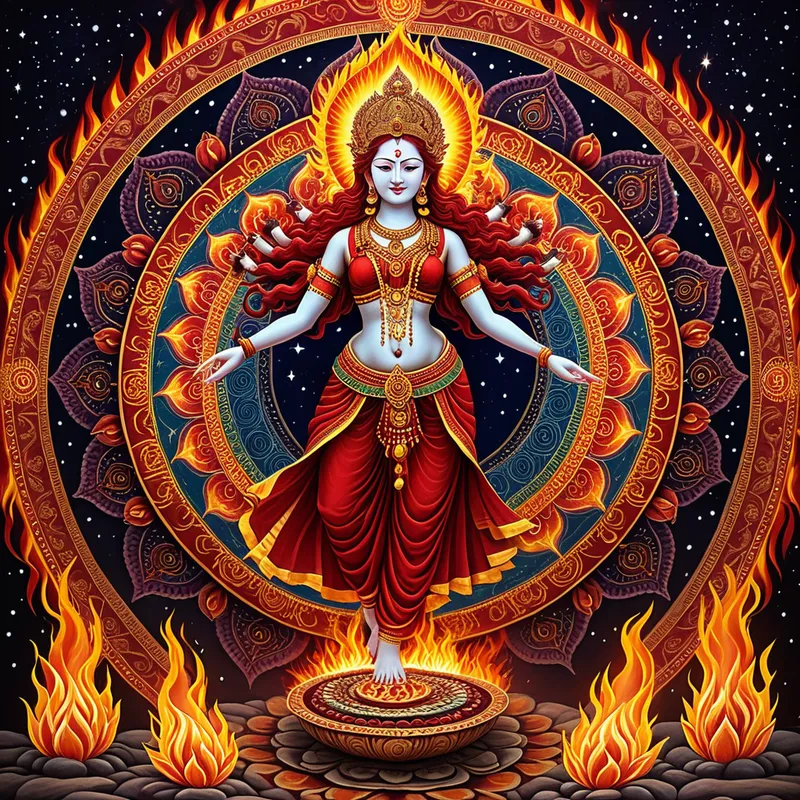
Listen. In the time before time, in a space that is not a space, a sound tore through the fabric of the mundane. It was the syllable BAM, a crimson thunderclap in the void. From this resonance, she emerged—not born, but appeared. Vajrayogini. Her skin was the color of a monsoon sunset, of lifeblood and rubies. She danced in a charnel ground, where the bones of the dead were her ornaments and the skulls of concepts her jewels.
Her hair, long and unbound, streamed upward like tongues of fire, defying gravity, defying order. In her right hand, she brandished a curved kartri, its edge sharp enough to sever the subtle threads of self-deception. In her left, she raised a kapala, filled not with blood, but with the nectar of immortal wisdom. She stood upon a corpse—a man, a god, a demon—it mattered not. It was the corpse of the ego, of all that says “I am this, and not that.”
The air around her did not stir; it vibrated with the hum of a thousand mantras. She was wrath and bliss fused into a single, unbearable point of light. She was not a goddess to be petitioned for favors, but a mirror held up to the darkest caverns of the soul. To encounter her was to be flayed alive, to have every cherished identity, every hidden shame, every spiritual pretense stripped away until nothing remained but the raw, pulsing core of awareness itself. Her three eyes saw past, present, and future simultaneously, seeing you as you were, are, and ever shall be—a being of pure, luminous potential, trapped in a web of your own spinning.
This was her realm: the mandala of Kechara, a palace not of stone, but of vibrating energy and rainbow light. To enter was to consent to dissolution. This is the tale not of her creation, but of her invitation. She waits at the crossroads of death and rebirth, at the moment of profound despair or ecstatic breakthrough, offering not a hand to hold, but a fire to walk through.
Cultural Origins & Context
Vajrayogini’s mythos flows from the deep streams of Indian Vajrayana Buddhism, which was transmitted to the Himalayas and profoundly shaped Tibetan spirituality. She is not a folk tale for the hearth but a terma, a treasure doctrine, concealed and later revealed by great tertöns like the visionary Khyungpo Naljor. Her practice was passed mouth-to-ear from guru to disciple in strict secrecy, a direct transmission of awakening’s fierce heart.
Societally, her function was radical. In a culture with complex monastic hierarchies, Vajrayogini’s path was the great equalizer—a swift, direct route to enlightenment that theoretically transcended gender, class, and conventional morality. She represented the ultimate authority of direct, non-conceptual wisdom over scholastic learning. Her myth and associated practices provided a structured, symbolic container for navigating the most terrifying and ecstatic dimensions of the human psyche, transforming neurosis into wisdom under the guidance of a lineage. She was the patroness of yogis and yoginis who practiced in charnel grounds, confronting death and desire head-on to burn away illusion.
Symbolic Architecture
Vajrayogini is not an external deity but a map of the enlightened mind’s own fierce, compassionate energy. Every aspect of her iconography is an alchemical equation.
The wrath of the dakini is the fury of truth against the fortress of lies we call the self.
Her red color signifies the alchemy of tummo, the inner psychic heat that burns the dross of dualistic thought. The kartri is the incisive discernment that cuts through the knot of egoic grasping. The kapala is the mind itself, now a vessel capable of holding the vast, often terrifying, experiences of the unconscious without being shattered. The bone ornaments signify her complete victory over death and her embodiment of the ultimate reality that persists when all transient identities (the flesh) have fallen away.
She stands upon Kama and Rati, representing the triumph of wisdom over the twin dictators of Samsara: the compulsive pull of desire and the paralyzing fear of death. Her dwelling in the charnel ground is the ultimate instruction: enlightenment is not found by avoiding the morbid, the taboo, or the decaying, but by making that very ground your seat of practice. She is the psychological process of facing one’s own shadow, one’s own mortality, and one’s most intense passions, not with repression, but with a transformative, embracing awareness.
The Dreamer’s Resonance
When Vajrayogini erupts in the modern dreamscape, she heralds a profound somatic and psychological uprising. She appears not as a gentle guide, but as an eruptive force. To dream of her is to dream of a kundalini-like awakening that feels less like bliss and more like a psychic earthquake.
The dreamer may experience intense heat, a sensation of being chased or confronted by a fierce feminine presence, or find themselves in surreal, liminal spaces like abandoned hospitals or burning landscapes. This is the psyche’s innate wisdom initiating a necessary demolition. It signals that the dreamer’s conscious identity has become a prison of inauthenticity, spiritual bypassing, or unexpressed rage and passion. Vajrayogini arrives as the personification of the repressed life force—the creative, sexual, and assertive energies that have been denied or feared. The dream is an invitation, or perhaps a demand, to stop managing the shadow and to begin a sacred dance with it.
Alchemical Translation
The myth of Vajrayogini models the most radical stage of individuation: the voluntary dissolution of the ego-complex in the fires of direct experience. It is the alchemical nigredo made conscious.
The path of the dakini is the practice of offering your most cherished self-image as fuel for her wisdom fire.
The modern individual’s “charnel ground” is the inner landscape of failed relationships, career disappointments, childhood wounds, and secret shames. Vajrayogini’s instruction is to sit squarely in that ground, to stop trying to prettify it or flee from it. Her kartri is the courageous act of ruthless self-honesty—cutting away the stories of “why I am this way” to touch the raw sensation beneath. Her kapala is the capacity to hold the intense emotional energies of grief, rage, or desire without acting them out or suppressing them, allowing them to be transmuted into vivid presence and compassion.
To invoke her principle is to rebel against the internalized voices of conformity, safety, and spiritual complacency. It is to recognize that true liberation often wears the face of a terrifying goddess before she reveals herself as the most intimate aspect of your own mind. The triumph is not over external demons, but over the hypnotic pull of the habitual self. The nectar in the skull-cup is the taste of freedom that arises when nothing is left to defend, and what remains is a luminous, empty awareness, dancing freely in the world of form.
Associated Symbols
Explore related symbols from the CaleaDream lexicon:
- Fire — The primordial, transformative element that Vajrayogini embodies, representing the inner psychic heat that burns away illusion and purifies perception into wisdom.
- Dance — Her dynamic, ecstatic posture symbolizes the continuous, spontaneous movement of enlightened energy and the liberation found in the flow of the present moment.
- Skull — As the kapala, it signifies the transformation of death and mortality into a vessel for the nectar of immortal, non-conceptual awareness.
- Knife — The kartri represents the incisive, discriminating wisdom that cuts through the veils of ignorance, attachment, and dualistic thought.
- Blood — Symbolizes the vital, passionate life force that is not denied but consecrated and transformed into the essence of compassionate activity.
- Shadow — Vajrayogini is the ultimate mistress of the shadow, the archetypal force that compels the confrontation and integration of all that is repressed or feared within the psyche.
- Ritual — Her entire form is a ritual enactment of enlightenment; following her path is a sacred technology for deconstructing the ego through precise symbolic and meditative practices.
- Rebirth — She presides over the moment of death and the intermediate state (bardo), symbolizing the possibility of awakening in every instant of dissolution and becoming.
- Bone — Her ornaments of bone signify the stark, beautiful reality that remains when all transient identities and attachments have been stripped away—the indestructible essence of being.
- Lightning — Represents the sudden, illuminating, and irreversible flash of insight (prajna) that she embodies, which shatters delusion in an instant.
- Chaos — The charnel ground of her abode is the chaotic, unstructured raw material of experience from which she generates the perfect order of her wisdom mandala.
- Buddhist Lotus — While she is wrathful, her wisdom is rooted in the same ground as the peaceful lotus—the muddy waters of Samsara—symbolizing purity and enlightenment arising from the midst of worldly existence.