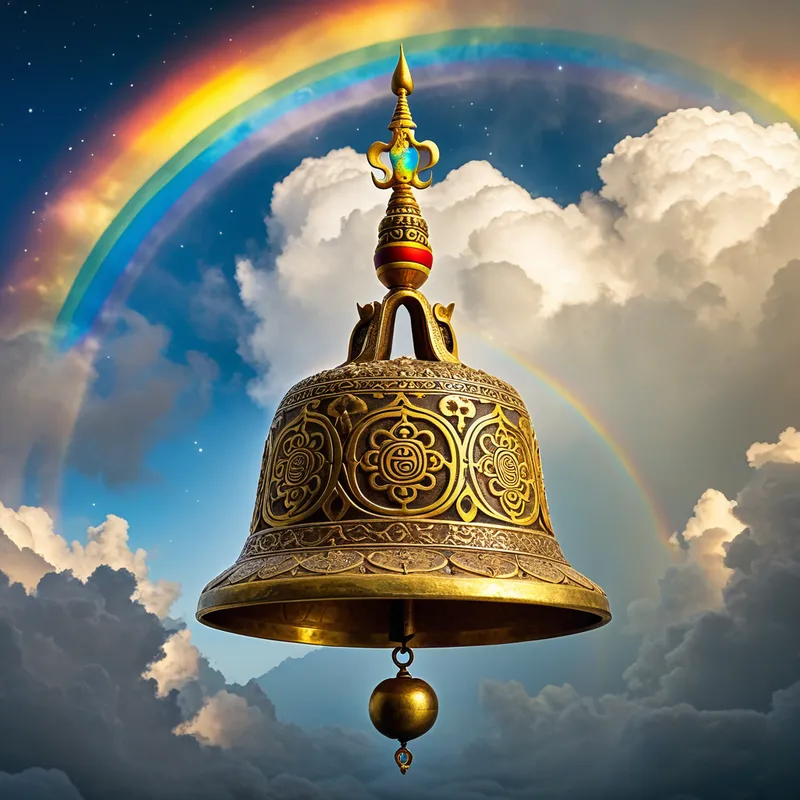
Vajra Bell Myth Meaning & Symbolism
A mythic tale of the sacred bell and thunderbolt, embodying the indivisible union of ultimate wisdom and boundless compassion in the awakened mind.
The Tale of Vajra Bell
Listen. In the time before time, when the fabric of reality was still a shimmering potential, there existed a silence so profound it was a presence. It was the silence of the unmanifest, [the womb](/myths/the-womb “Myth from Various culture.”/) of all that would be. From this silence, a longing arose—not a human longing, but the universe’s own desire to know itself. This longing took form as a vibration, a single, pure tone that was both sound and the absence of sound.
This tone sought its counterpart. It yearned for a vessel to give it shape, a boundary to define its boundless nature. And so, from the adamantine essence of reality itself—the substance that is empty of inherent existence yet harder than any diamond—a form coalesced. It was the [Ghanta](/myths/ghanta “Myth from Hindu culture.”/), the Bell. Its body was the dome of [the sky](/myths/the-sky “Myth from Persian culture.”/), its rim [the horizon](/myths/the-horizon “Myth from Various culture.”/) where being meets non-being. Its voice was the mother of all mantras, the compassionate call that beckons all wandering minds back to their source.
Yet the Bell, in its infinite compassion, was incomplete. Its call was gentle, all-encompassing, but it needed a force to cut through the thicket of illusion, to shatter the stubborn granite of ignorance. Thus, from the same adamantine ground, a second form erupted. It was the [Vajra](/myths/vajra “Myth from Hindu culture.”/), the Thunderbolt. Forged in the heart of a cosmic storm, it was unbreakable reality, the fierce and precise power that demolishes falsehood without hesitation. It was a scepter of lightning, its prongs grasping the emptiness at the center of all phenomena.
The Bell and the Vajra circled each other in the luminous void. The Bell’s sound was a soft, magnetic pull; the Vajra’s presence was a sharp, electric push. They were opposites, yet each felt a profound recognition. One day, a great Bodhisattva, whose mind was a clear mirror reflecting the truth of things, entered this mythic space. He saw the dance of these two supreme principles. With a gesture of ultimate integration, he reached out.
In his left hand, the hand of wisdom, he took up the Bell. In his right hand, the hand of compassionate action, he took up the Vajra. And then, he brought them together. Not in conflict, but in sacred union. He crossed his hands at his heart. The Vajra was held aloft, its prongs pointing to the wisdom of the ultimate. The Bell was held below, its mouth open to shower compassion upon the relative world.
In that moment of crossing, a miracle occurred. They were not two tools, but one inseparable reality. The Vajra became the handle of the Bell. The Bell became the womb from which the Vajra’s power was born. Their separate essences dissolved into a single, resonant truth: the Vajra Bell. Its sound was no longer just a call, but a call that simultaneously shattered delusion. Its form was no longer just a weapon, but a weapon that simultaneously embraced [the world](/myths/the-world “Myth from Tarot culture.”/). [The Bodhisattva](/myths/the-bodhisattva “Myth from Buddhist culture.”/) rang it once. The tone that echoed forth did not merely travel through space—it created the sacred space, the [Mandala](/myths/mandala “Myth from Buddhist culture.”/), wherein all beings could awaken.
Cultural Origins & Context
The mythos of the Vajra Bell is not a single, linear narrative found in one [sutra](/myths/sutra “Myth from Hindu culture.”/), but a living, symbolic doctrine woven into the very fabric of <abbr title=“The “Diamond Vehicle,” a major branch of Buddhism known for its esoteric practices and rituals”>Vajrayana Buddhism. It emerged in the fertile philosophical ground of India between the 5th and 8th centuries CE, as Buddhist thought deepened into sophisticated explorations of emptiness ([Sunyata](/myths/sunyata “Myth from Buddhist culture.”/)) and compassion ([Karuna](/myths/karuna “Myth from Hindu culture.”/)).
This myth was passed down not primarily through written epic, but through ritual transmission and iconographic canon. A guru would place the physical vajra and bell in the hands of a disciple, saying, “This is not a bell. This is not a vajra. This is the nature of your mind.” The story was told in the language of mudra (ritual gesture), mantra (empowered sound), and visualization. Its societal function was initiatory and transformative. It served as an encoded map for the practitioner’s own [psyche](/myths/psyche “Myth from Greek culture.”/), a blueprint for the alchemy of awakening that turns the base metal of confused perception into the gold of enlightened awareness. To hold the Vajra Bell was to hold the entire path in one’s hands.
Symbolic Architecture
The myth’s power lies in its perfect symbolic [dyad](/symbols/dyad “Symbol: A fundamental pair or duality representing unity, opposition, and the foundational structure of existence in spiritual and mythological traditions.”/). The [Bell](/symbols/bell “Symbol: A bell signifies communication, awakening, and the call to attention, often associated with new beginnings or signals.”/) (Ghanta) represents the feminine principle, wisdom (Prajna), and the ultimate [truth](/symbols/truth “Symbol: Truth represents authenticity, honesty, and the quest for knowledge beyond mere appearances.”/) of [emptiness](/symbols/emptiness “Symbol: Emptiness signifies a profound sense of void or lack in one’s life, often related to existential fears, loss, or spiritual quest.”/). Its hollow [body](/symbols/body “Symbol: The body in dreams often symbolizes the dreamer’s self-identity, personal health, and the relationship they have with their physical existence.”/) signifies the mind’s [capacity](/symbols/capacity “Symbol: A measure of one’s potential, limits, or ability to contain, process, or achieve something, often reflecting self-assessment or external demands.”/) to be open, receptive, and free of solid concepts. Its sound represents the compassionate [activity](/symbols/activity “Symbol: Activity in dreams often represents the dynamic aspects of life and can indicate movement, progress, and engagement with personal or societal responsibilities.”/) that naturally arises from that emptiness—the call to awakening that permeates all realms.
The Bell is the womb of space where all things are allowed to be, and the Vajra is the lightning flash of discernment that cuts through what they are not.
The Vajra represents the masculine principle, skillful means (Upaya), and the unshakeable, active [compassion](/symbols/compassion “Symbol: A deep feeling of empathy and concern for others’ suffering, often involving a desire to help or alleviate their pain.”/) that engages with the world of form. Its prongs, often five, symbolize the five wisdoms that transform the five poisonous delusions (anger, pride, attachment, [jealousy](/symbols/jealousy “Symbol: A complex emotion signaling perceived threat to valued relationships or status, often revealing insecurities and unmet needs.”/), ignorance). Psychologically, the Vajra is the focused will, the penetrating [insight](/symbols/insight “Symbol: A sudden, deep understanding of a complex situation or truth, often arriving unexpectedly and illuminating hidden connections.”/), and the courageous [action](/symbols/action “Symbol: Action in dreams represents the drive for agency, motivation, and the ability to take control of situations in waking life.”/) required to break addictive patterns and neurotic structures.
Their union is the non-dual mind. The myth teaches that true wisdom is not passive withdrawal; it is fiercely compassionate. True compassion is not sentimental attachment; it is grounded in the wisdom of emptiness. The crossed-arms [mudra](/symbols/mudra “Symbol: A symbolic hand gesture used in Hindu and Buddhist traditions to channel spiritual energy, express teachings, and focus meditation.”/) is the body’s testament to this: the ultimate (wisdom/Bell) and the relative (compassion/Vajra) are engaged in a perpetual, dynamic embrace at the very center of one’s being.
The Dreamer’s Resonance
When this mythic pattern stirs in the modern unconscious, it often manifests in dreams of profound duality seeking resolution. One might dream of a powerful, silent bell that they cannot ring, or a brilliant, static bolt of lightning they cannot wield—a representation of wisdom without action, or compassion without discernment, feeling stuck and impotent.
Conversely, one might dream of a chaotic, deafening noise (unbounded, chaotic compassion) or of destructively shattering objects with a ruthless tool (wisdom turned into cold, critical intellect). The somatic process is one of tension between receptivity and agency, between yielding and penetrating. The psyche is wrestling with the integration of its own polarities: the anima and animus, the receptive and the assertive, the nurturing and the disciplined. The dream of the Vajra Bell becoming one artifact signals a readiness for a profound inner marriage, where one’s deepest understanding begins to inform one’s way of being in the world, and vice versa.

Alchemical Translation
The individuation process modeled by the Vajra Bell is the alchemy of conscious union. The modern individual often suffers from a painful split: the spiritual seeker versus the worldly actor, the empathetic heart versus the logical mind, the dreamer versus the doer. The myth instructs us that these are not enemies to be reconciled, but lovers to be wed.
[The first stage](/myths/the-first-stage “Myth from Alchemical culture.”/) is recognizing and honoring the separate qualities. One must cultivate the “Bell” of the psyche: mindfulness, openness, the capacity to listen and hold space without judgment. Simultaneously, one must forge the “Vajra” of the psyche: clear intention, ethical boundaries, the courage to cut away what is false or harmful in one’s life.
The alchemical fire is lit in the crucible where the softness of the heart meets the hardness of truth.
The transmutation occurs in the “crossing at the heart.” This is the moment of integration where wisdom is not just contemplated but enacted with compassion, and where compassionate action is not draining but is energized by the wisdom of non-attachment. It turns spiritual insight into embodied ethics, and worldly engagement into a sacred practice. The “sound” of this integrated being is one’s unique presence in the world—a presence that both embraces reality as it is and works skillfully to alleviate suffering within it. One becomes a living Vajra Bell, a localized point where the ultimate and the relative dance together, creating a mandala of meaning and purpose in the midst of the world’s chaos.
Associated Symbols
Explore related symbols from the CaleaDream lexicon: