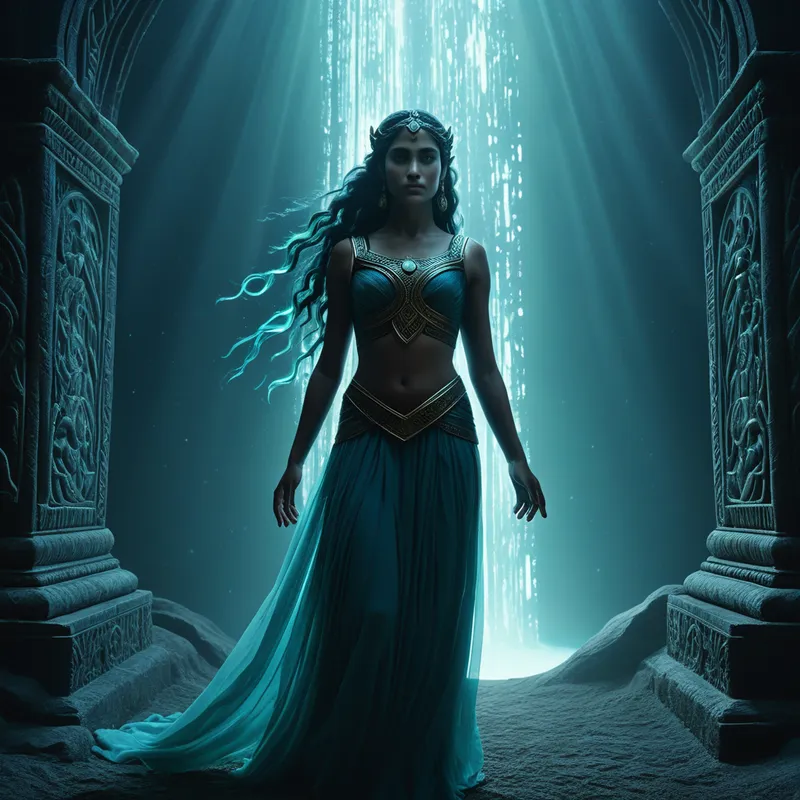
Utnapishtim and the Flood
The Babylonian flood hero who built an ark to survive divine punishment, earning eternal life as humanity's sole survivor.
The Tale of Utnapishtim and the Flood
The tale begins not with rain, but with a secret whispered in reeds. The great god Ea, moved by a compassion the other gods did not share, could not speak directly to [Utnapishtim](/myths/utnapishtim “Myth from Mesopotamian culture.”/), a righteous king of Shuruppak. To bypass the divine decree of silence, Ea spoke to the wall of Utnapishtim’s reed house, knowing the king would overhear. The message was a riddle wrapped in a warning: abandon wealth, seek life, scorn possessions, keep the soul alive. Within these cryptic words lay the blueprint for salvation—a command to build a vast, cube-shaped vessel.
Utnapishtim understood. To the bewildered elders of his city, he spun a tale of his own impending exile, claiming the god [Enlil](/myths/enlil “Myth from Sumerian culture.”/) had grown to hate him, forcing him to flee to the Apsu, Ea’s domain. He asked for their help in building a great ship. For six days and seven nights, the city worked: [the vessel](/myths/the-vessel “Myth from Alchemical culture.”/) was an acre in floor space, with six decks, its dimensions perfectly square. He loaded it with all his silver and gold, his kin and family, the beasts of the field both wild and tame, and every kind of craftsman. Then, as a storm of terrifying portent gathered on [the horizon](/myths/the-horizon “Myth from Various culture.”/), he sealed the door, smearing the seams with bitumen.
At the first light of dawn, the foundation of [the world](/myths/the-world “Myth from Tarot culture.”/) broke. The Anzu-bird tore [the sky](/myths/the-sky “Myth from Persian culture.”/) with its talons. The gods themselves, who had decreed [the flood](/myths/the-flood “Myth from Biblical culture.”/), now cowered like dogs, retreating to the highest heaven of Anu. They huddled against the walls, their lips pressed shut in terror at the [chaos](/myths/chaos “Myth from Greek culture.”/) they had unleashed. For six days and seven nights, the tempest raged. The land was shattered like a pot. The gods, witnessing the totality of the destruction, wept, their tears mingling with the torrential rain. On the seventh day, the flood-weary sea grew calm. All of humanity had been returned to clay.
Utnapishtim’s ark came to rest on the slopes of Mount Nimush. He waited seven more days. He released a dove, and it returned, finding no perch. He released a swallow, and it too returned. Finally, he released a [raven](/myths/raven “Myth from Haida culture.”/), which saw the waters receding, and it flew away, croaking, never to return. Then Utnapishtim emerged. He poured a libation upon the mountain’s peak and set out seven and seven cult vessels, placing reeds, cedar, and myrtle beneath them. The sweet savor of the offering reached the gods, who clustered around it like flies. Enlil, [the architect](/myths/the-architect “Myth from Various culture.”/) of the flood, arrived last, furious to see survivors. But Ea, the wise counselor, rebuked him for the disproportionate wrath. There were wiser ways to punish sinners than to unleash total annihilation.
In atonement, and as a seal upon this new [covenant](/myths/covenant “Myth from Christian culture.”/), Enlil approached Utnapishtim and his wife. He touched their foreheads and said, “Hitherto Utnapishtim has been but human. Henceforth Utnapishtim and his wife shall be like unto us gods. He shall dwell far away, at the mouth of the rivers.” Thus, the sole survivors were taken to live in a distant, blessed land, granted the gift—and the burden—of eternal life, becoming living witnesses to the gods’ fury and their remorse.
Cultural Origins & Context
The story of Utnapishtim is immortalized in Tablet XI of the Epic of [Gilgamesh](/myths/gilgamesh “Myth from Mesopotamian culture.”/), the great Mesopotamian poem dating to the second millennium BCE. It is not a standalone myth but the climax of Gilgamesh’s quest for immortality. Having witnessed the [death](/myths/death “Myth from Tarot culture.”/) of his friend [Enkidu](/myths/enkidu “Myth from Sumerian culture.”/), the hero-king journeys to the ends of [the earth](/myths/the-earth “Myth from Hindu culture.”/) to find Utnapishtim, the only mortal to have conquered [death](/myths/death “Myth from Tarot culture.”/), hoping to learn his secret. The flood narrative is thus embedded within a deeper meditation on mortality, legacy, and the limits of human power.
This Babylonian account is part of a wider Mesopotamian tradition; earlier Sumerian versions feature a flood hero named Ziusudra. The story reflects the existential reality of life between [the Tigris and Euphrates](/myths/the-tigris-and-euphrates “Myth from Mesopotamian culture.”/) rivers, where catastrophic, unpredictable floods could indeed erase entire communities, perceived as divine judgment. The gods of this [pantheon](/myths/pantheon “Myth from Roman culture.”/) are not monolithic in will; they are capricious, quarrelful, and subject to fear and regret. The flood results from a collective, almost impulsive decision by the assembly of gods, highlighting a worldview where cosmic order is maintained through debate, conflict, and eventual reconciliation, often with humanity as the collateral.
Symbolic Architecture
The myth constructs a profound [architecture](/symbols/architecture “Symbol: Architecture in dreams often signifies structure, stability, and the framing of personal identity or life’s journey.”/) of transition. The cube-shaped ark is not a ship for sailing but a sealed, floating [temple](/symbols/temple “Symbol: A temple often symbolizes spirituality, sanctuary, and a deep connection to the sacred aspects of life.”/), a perfect geometric [microcosm](/symbols/microcosm “Symbol: A small, self-contained system that mirrors or represents a larger, more complex whole, often reflecting the universe within an individual.”/) preserving the seed of all [life](/symbols/life “Symbol: The symbol of ‘Life’ represents a journey of growth, interconnectedness, and existential meaning, encompassing both the joys and challenges that define human experience.”/) against a return to the formless, watery [chaos](/symbols/chaos “Symbol: In Arts & Music, chaos represents raw creative potential, uncontrolled expression, and the breakdown of order to forge new artistic forms.”/). It is a [womb](/symbols/womb “Symbol: A symbol of origin, potential, and profound transformation, representing the beginning of life’s journey and the unconscious source of creation.”/) of [clay](/symbols/clay “Symbol: Clay symbolizes malleability, creativity, and the potential for transformation, representing the foundational aspect of life and the ability to shape one’s destiny.”/) and [pitch](/symbols/pitch “Symbol: Pitch symbolizes a rough, sticky substance often associated with barriers and obstacles, reflecting the idea of struggle and the effort required to achieve goals.”/), from which a new, singular humanity is born. The [sequence](/symbols/sequence “Symbol: The symbol of ‘sequence’ often signifies the order of events and the progression towards a desired outcome or goal.”/) of released birds—dove, swallow, [raven](/symbols/raven “Symbol: The raven is often seen as a messenger of the divine and a symbol of transformation, wisdom, and the mysteries of life and death.”/)—maps the gradual re-[emergence](/symbols/emergence “Symbol: A process of coming into being, rising from obscurity, or breaking through a barrier, often representing birth, transformation, or revelation.”/) of stable land and [life](/symbols/life “Symbol: The symbol of ‘Life’ represents a journey of growth, interconnectedness, and existential meaning, encompassing both the joys and challenges that define human experience.”/), a slow, cautious probing of a world reborn.
The seven days of the storm and the seven days of waiting are not mere chronology. They are the complete, sacred cycle of dissolution and incubation. Seven is the number of divine totality in Mesopotamian thought; the flood is a full reset of the cosmic order, and the survival is its necessary, paradoxical conclusion.
Utnapishtim’s transformation is the ultimate [alchemy](/symbols/alchemy “Symbol: A transformative process of purification and creation, often symbolizing personal or spiritual evolution through difficult stages.”/). He does not earn immortality through heroic feats in battle, but through the passive, obedient act of preservation and a subsequent divine apology. His eternal life is [less](/symbols/less “Symbol: The concept of ‘less’ often signifies a need for simplicity, reduction, or minimalism in one’s life or thoughts.”/) a reward and more a relocation. He is set apart, at the “mouth of the rivers”—a liminal [space](/symbols/space “Symbol: Dreaming of ‘Space’ often symbolizes the vastness of potential, personal freedom, or feelings of isolation and exploration in one’s life.”/) where the sweet waters of the Apsu meet the mortal world, a living bridge between the divine and the [human](/symbols/human “Symbol: The symbol of a human represents individuality, complexity of emotions, and social relationships.”/), forever separated from the cyclical world of [death](/symbols/death “Symbol: Symbolizes transformation, endings, and new beginnings; often associated with fear of the unknown.”/) and generation he saved.
The Dreamer’s Resonance
For the modern [psyche](/myths/psyche “Myth from Greek culture.”/), Utnapishtim is the archetype of the witness who carries the unbearable memory. He is the survivor of cosmic trauma, the one who has seen the world end and must live with that knowledge forever. His story resonates with anyone who has endured a personal cataclysm—a loss so total it feels like the end of their world. The quest to find him, as Gilgamesh undertakes, is the soul’s search for meaning after such devastation, the hope that survival itself might contain a secret key to transcendence.
Psychologically, Utnapishtim represents the part of [the Self](/myths/the-self “Myth from Jungian culture.”/) that is tasked with preservation during periods of overwhelming psychic flood—the eruptions of unconscious material, grief, or rage that threaten to dissolve [the ego](/myths/the-ego “Myth from Jungian culture.”/). Building the “ark” becomes the inner work of creating a contained, sacred space (therapy, ritual, creative practice) where the essential elements of identity and soul can be protected until the inner storms pass. His immortality, however, speaks to a potential danger: the survivor can become frozen, eternally defined by the catastrophe, dwelling in a remote paradise that is also a kind of exile from the flowing river of ordinary, mortal life.
Alchemical Translation
The alchemical process here is [solutio](/myths/solutio “Myth from Alchemical culture.”/) followed by [coagulatio](/myths/coagulatio “Myth from Alchemical culture.”/)—dissolution into the primal waters and re-coagulation into a new, perfected form. The flood is the [nigredo](/myths/nigredo “Myth from Alchemical culture.”/), the blackening, the utter reduction of all things to their undifferentiated state. The ark is [the alembic](/myths/the-alembic “Myth from Alchemical culture.”/), the vessel where the [prima materia](/myths/prima-materia “Myth from Alchemical culture.”/) of life is held. The mountain where it rests is the stable, eternal lapis, the foundation upon which new life can be built.
Utnapishtim’s offering is the crucial moment of conjunctio. By giving back to the gods what he has saved—symbolized in the sweet savor—he reconciles the opposing forces. He does not hoard his survival; he transforms it into an act of communion, mending the severed relationship between heaven and earth. His immortality is the rubedo, the reddening, the final stage: not a return to the old mortal state, but the creation of a wholly new mode of being, a “divine mortal.”
His eternal life at the source of the rivers signifies a permanent connection to the origin, the source of psychic and spiritual life. He becomes the Self that exists prior to and after the ego’s floods, a point of stillness and remembrance. To seek Utnapishtim, as in the inner journey, is to seek that part of us which is prior to trauma, which remembers the blueprint of the soul and can navigate by the stars of destiny even in total darkness.
Associated Symbols
Explore related symbols from the CaleaDream lexicon:
- Flood — The overwhelming, annihilating force of divine or unconscious wrath that dissolves the known world, necessitating a total rebirth from preserved seeds.
- Ark — The sealed, sacred vessel of preservation; a mobile temple or womb that carries the essence of life through the chaos of dissolution.
- Mountain — The stable, enduring axis of the world that emerges after the flood; a place of landing, sacrifice, and revelation between earth and heaven.
- Door — The sealed threshold of the ark, representing the boundary between the doomed old world and the potential for new life, shut by divine command.
- Rain — The agents of dissolution and divine tears; the weeping of the gods for their own destructive actions, merging sorrow with punishment.
- Raven — The scout of the new world; the dark messenger of practical reality who finds the receding waters and does not return, signaling it is safe to emerge.
- Sacrifice — The act of offering that mends [the broken covenant](/myths/the-broken-covenant “Myth from Biblical culture.”/); the sweet savor that draws the gods back from wrath to reconciliation and remorse.
- Immortality — The paradoxical gift and exile; eternal life granted not as a [triumph](/myths/triumph “Myth from Roman culture.”/) but as a witness state, separating one from the mortal cycle of death and generation.
- River — The source of life and the location of [the immortal](/myths/the-immortal “Myth from Taoist culture.”/)’s dwelling; the flowing boundary between the divine realm (the Apsu) and the mortal world.
- Clay — The substance to which humanity returns in the flood and from which it is originally formed; symbolizing both mortality and the primal material for recreation.
- Dream — The medium of divine communication, as Ea’s warning comes through a whispered dialogue with a wall, heard in the liminal space between sleep and waking.
- Grief — The emotion that moves both gods and humanity; the profound regret of the destroyers and the enduring sorrow of the survivor who remembers the world that was.