
Urim and Thummim Myth Meaning & Symbolism
Mysterious oracular stones worn by the High Priest, used to discern the will of the divine in moments of national crisis and profound uncertainty.
The Tale of Urim and Thummim
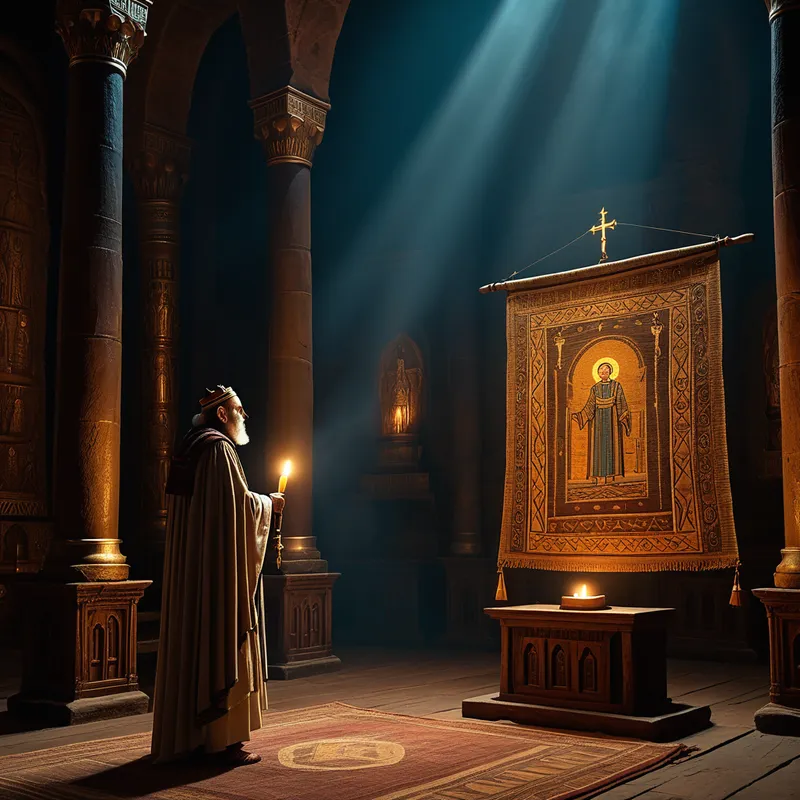
Listen. In the days when the desert wind whispered secrets to the sand and the people walked with a pillar of cloud by day and fire by night, there was a silence that spoke louder than any prophet’s cry. It was the silence of the Tabernacle, the Tent of Meeting, where the air was thick with the scent of incense and the weight of the Unseen.
Within the Holy Place, behind a veil woven with cherubim, stood a man apart—the High Priest. Upon his heart, over robes of blue, purple, and scarlet, he bore a square of doubled linen: the Breastplate of Judgment. It was a mosaic of the cosmos, twelve stones set in gold, each inscribed with the name of a tribe of Israel: carnelian for Reuben’s fire, topaz for Simeon’s strength, emerald for Judah’s royalty. But within its folded pouch, against the priest’s own heartbeat, lay the mystery. Two stones, unlike any other. No man living could describe their shape, only their purpose. They were called Urim and Thummim.
The people did not come for parables. They came in crisis. When the Philistine host gathered like locusts at the valley’s mouth, when a king had sinned and the land grew barren, when the path forward was shrouded in a fog of doubt—then they came. The petitioner, often the king himself, would stand in the outer court, his fate hanging on a breath. The High Priest would enter the sacred silence, the people’s question burning in the air. He would stand before the Ark of the Covenant, the very footstool of the Divine. His hand would slip into the breastplate, fingers brushing the cool, enigmatic surfaces.
There was no voice from the heavens. No thunder. Only a knowing, a sudden clarity that descended upon the priest like a mantle. Perhaps a stone grew warm. Perhaps a pattern of light fell upon a specific tribal gem. The answer emerged—not as a speech, but as a verdict: “Go up and triumph,” or “Do not go up, for you will be defeated.” It was a binary revelation in a world of grays, a piercing beam of divine will cutting through the tangled thicket of human uncertainty. The stones did not speak; they manifested the verdict. They were the instruments through which the silent, sovereign will became a word that could steer a nation. And then, the silence would return, deeper than before, holding the mystery once more in its keeping.
Cultural Origins & Context
The tradition of Urim and Thummim is embedded in the priestly strata of the Hebrew Bible, a practice belonging to the early monarchic period of Israel, likely between the 11th and 8th centuries BCE. They are not characters in a narrative myth but sacred objects within a ritual technology. Their origins are deliberately obscure, said to be given by YHWH to Moses for his brother Aaron, the first High Priest. This shrouded origin elevates them from mere tools to direct emanations of divine authority.
Their function was profoundly societal and political. In a theocracy where divine law was civil law, national decisions—particularly of war and peace, judgment in insoluble cases, and the identification of covenant-breakers—required a mechanism perceived as beyond human manipulation. The Kohen Gadol, acting as the intermediary, used the Urim and Thummim to translate the inscrutable divine will into a actionable, communal directive. They were the constitutional check of the sacred upon the power of the king. The practice faded after the time of King David, as prophecy (the spoken word of God through individuals) became a more prominent mode of revelation. By the time of the Second Temple, they were a memory, a lost artifact of a more direct, if more enigmatic, form of communion.
Symbolic Architecture
At its core, the symbolism of Urim and Thummim addresses the human confrontation with the ultimate Unknown. They represent the archetypal longing for clarity in the midst of chaos, for a sign when all paths seem shrouded.
They are the embodied paradox of revelation: a clear answer born from an utterly mysterious process.
The breastplate itself is a microcosm, bearing the entire community (the twelve tribes) over the heart of the mediator. The Urim and Thummim, resting within it, symbolize the hidden, ordering principle at the center of that cosmos. Linguistically, Urim (from or, light) suggests illumination, revelation, the sudden flash of understanding. Thummim (from tamim, complete, perfect) suggests integrity, wholeness, and truth. Together, they form a binary whole: the illuminating flash and the state of perfected truth it reveals. They are not tools for personal curiosity but for communal fate, representing the moment when individual anxiety is subsumed into a collective, divinely-sanctioned destiny.
Psychologically, they map onto the critical function of discernment. They are the internal “oracle” we consult when faced with life-altering decisions where logic and emotion are at an impasse. They represent the capacity to access a deeper layer of knowing—what Jung might call the Self—that transcends the ego’s calculations.

The Dreamer’s Resonance
When this mythic pattern stirs in the modern unconscious, it often manifests in dreams of seeking decisive answers. A dreamer might find themselves in a vast, official building (a modern Tabernacle), holding two objects—perhaps stones, dice, or coins—that feel charged with fate. They are trying to “cast” them or have them interpreted by a figure of authority (the internal High Priest), but the results are ambiguous or the figure is silent.
Somatically, this can correlate with a feeling of constriction in the chest—the “breastplate” of anxiety—and a desperate need for a release of tension through a definitive “yes” or “no.” The dream signals a psyche at a crossroads, burdened by a decision of significant consequence (relational, professional, existential). The frustration of the dream mirrors the ego’s impotence; it wants the oracle to work on demand, to relieve it of the burden of choice and its attendant responsibility. The dream process is the psyche’s way of staging its own ritual of inquiry, pressing the dreamer to acknowledge the gravity of their uncertainty and to stop seeking easy, external answers.

Alchemical Translation
The alchemical journey modeled by Urim and Thummim is not one of heroic conquest, but of sacred intermediation and the transmutation of uncertainty into grounded action. The modern individuation process it mirrors is the development of inner discernment.
The first stage is the confrontation with the Nigredo—the “blackening” of confusion and doubt. The petitioner-king represents the ego, lost in a crisis, admitting its limitations. The journey to the Tabernacle is the turning inward, away from external counsel, toward the sacred inner space (the Self). The High Priest is the mediating function of the psyche, the connection between ego-consciousness and the deeper, transpersonal wisdom.
The alchemical work occurs in the folded pouch, the vas hermeticum where opposites (Urim/Thummim, Light/Perfection, Yes/No) are held in tension until a third, transcendent thing emerges: the Verdict.
This is the coniunctio oppositorum—the conjunction of opposites. The ego does not receive a detailed plan, but a clarified direction. The psychic transmutation is the acceptance of this directive from a source beyond the ego’s rationality. It requires surrendering the illusion of total control and trusting the emergent wisdom of the whole psyche. The final stage is not possession of the stones, but the ability to enact the received word—to “go up” or “refrain”—with conviction, integrating the divine “fiat” into one’s life action. Thus, the mysterious oracle becomes the internal compass, guiding the individual not with constant chatter, but with rare, profound, and decisive clarities that arise from the depths of their own completed being.
Associated Symbols
Explore related symbols from the CaleaDream lexicon: