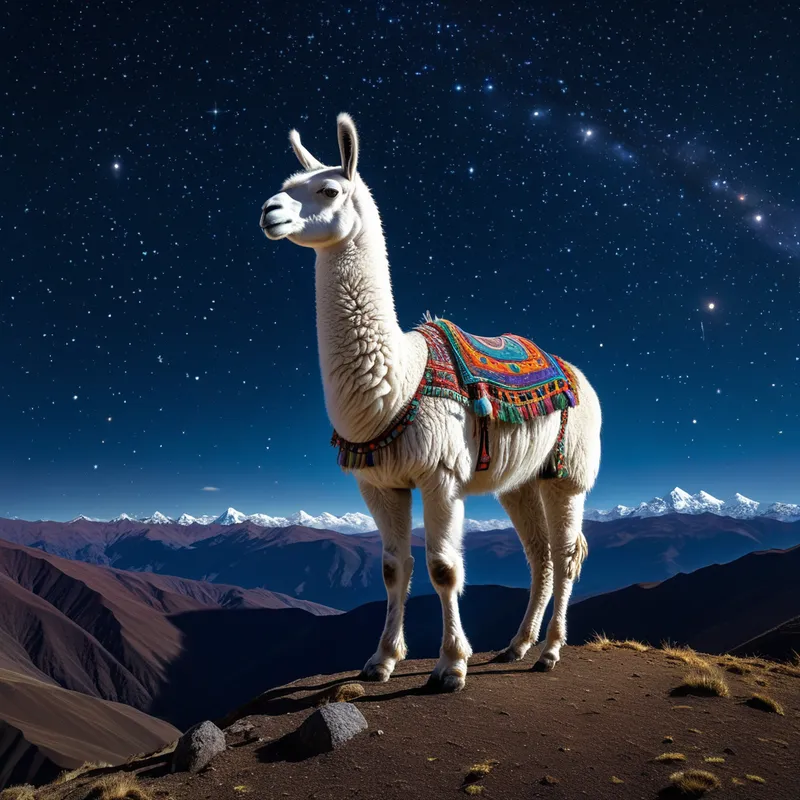
Urcuchillay Myth Meaning & Symbolism
The myth of a celestial llama whose sacrifice weaves the fabric of the cosmos, binding the earthly herd to the starry vault of the heavens.
The Tale of Urcuchillay
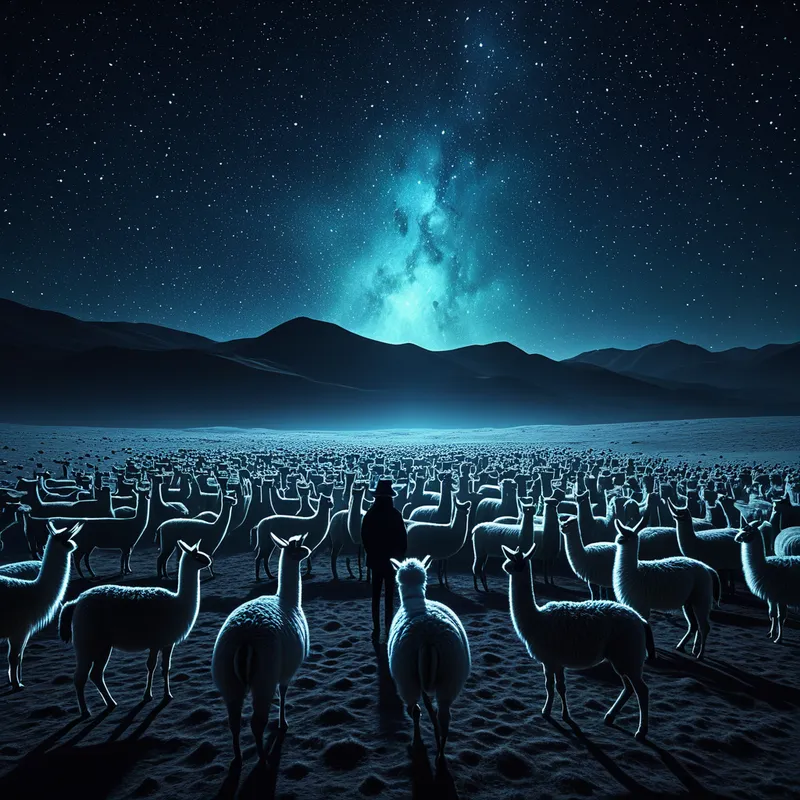
Listen. The air is thin here, on the roof of the world. It tastes of ice and distant stone. Below, in the folds of the Pachamama’s skirts, the herds of llamas and alpacas move like a slow, breathing river of wool—the lifeblood of the people, the warmth against the killing frost, the promise of tomorrow.
But high above, where the sun is a sharp diamond and the night is a black lake studded with cold fire, another herd moves. This is the celestial flock, and its shepherd is no mortal man. He is Urcuchillay, the star-llama, a being woven from the very fabric of the sky. His fleece is not of white or brown, but of the deep violet of twilight, the burning gold of dawn, and the impossible black of the space between stars. In his eyes, the constellations wheel.
The people knew of him. They saw his form in the dark patches of the Mayu, the celestial river. They felt his gaze upon their own precious herds. For a time, there was harmony—a silent pact. The earth-herds flourished, and the sky-herd shone brightly, a mirror across the vast divide.
But the world is a place of balance, and balance demands exchange. A great silence fell upon the high pastures. The terrestrial llamas grew listless; their numbers did not increase. The people felt a chill that no fire could warm—a disconnect. The mirror between earth and sky had clouded. The celestial herd was drifting away, its bond to the world below grown thin and fragile.
It was then that Urcuchillay, from his lofty pasture, made the choice. Not in anger, not in sorrow, but in the profound understanding of the shepherd who knows one life must be given so the flock may live. In a descent silent as starlight, he came to the highest peak, a place where earth scrapes the sky. There, under the watching eyes of Inti and Mama Killa, he offered himself.
He did not fight. He lay down upon the sacred stone, and as the first priest—his hand trembling with the weight of the cosmos—performed the rite, Urcuchillay’s starry essence did not bleed like earth-blood. It unraveled. Strands of luminous wool, threads of constellation and nebula, rose from his form. They did not vanish into nothingness. They ascended, weaving themselves back into the dark tapestry of the night, but now… now they were tethered. Each glowing thread remained connected, a shimmering umbilical cord stretching from the revitalized celestial herd in the Mayu down to every llama and alpaca sleeping in the mountain valleys.
The connection was restored. The earthly herds thrived once more, their vitality a gift from the sky. And on the clearest nights, if you know how to look, you can see it—the celestial llama, whole again in the heavens, his luminous form forever bound to his children below, a covenant written in light.
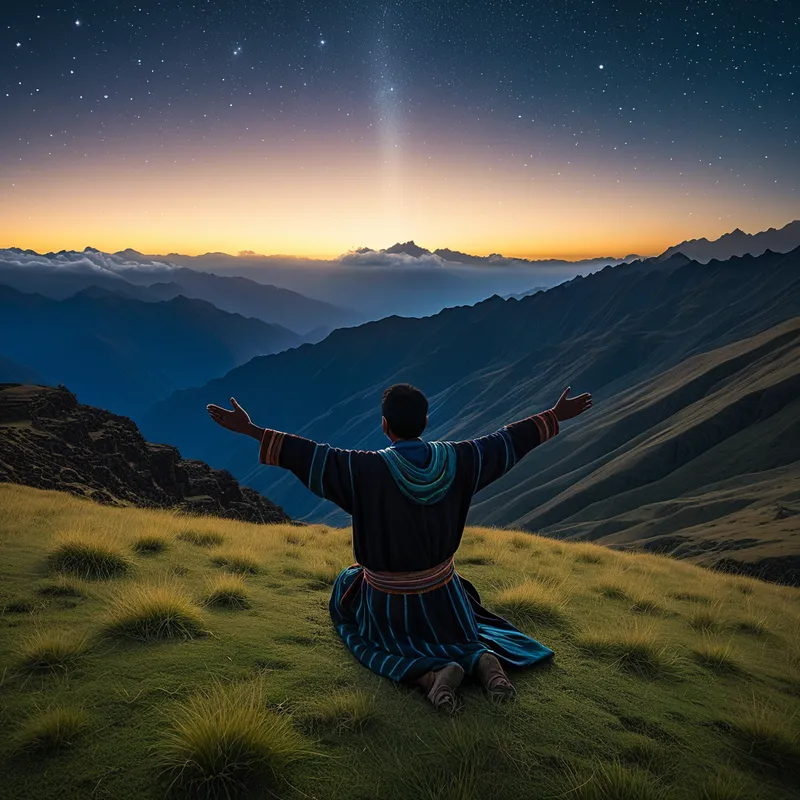
Cultural Origins & Context
The myth of Urcuchillay was not merely a story for the Inca; it was a cosmological map and an economic doctrine fused into narrative. In a civilization where the state’s wealth and the people’s survival were literally built on the backs of camelids—for wool, meat, and as pack animals—the well-being of the herd was synonymous with the well-being of the empire. This myth provided the sacred rationale for that relationship.
It was likely preserved and transmitted by the Amautas and through state-sponsored rituals. During ceremonies like the <abbr title=“The “Great Festival of the Sun,” the most important Incan celebration”>Inti Raymi, or in specific husbandry rituals, the story would be invoked to explain the necessity of careful herd management and the spiritual significance of animal sacrifice. The sacrifice was not an act of waste or cruelty, but an act of cosmic reciprocity—an ayni—with the celestial realm. By honoring Urcuchillay’s ultimate sacrifice, the Inca ensured the continued flow of vitality (camac) from the sky-herd to the earth-herd, legitimizing both their pastoral practices and the emperor’s role as the shepherd of the people.
Symbolic Architecture
At its core, Urcuchillay is the archetype of the Self-as-Sacrificial-Bond. He is not a warrior-hero conquering through force, but a unifying principle that voluntarily undergoes dissolution to create a lasting, animating connection.
The highest service is not to rule from above, but to become the bridge between realms, allowing essence to flow by offering one’s own form as the conduit.
Psychologically, Urcuchillay represents the aspect of the psyche that must be “sacrificed”—not destroyed, but transmuted—to establish a living connection between our conscious, earthly existence (the personal herd of our daily identities, instincts, and resources) and the vast, impersonal realm of the collective unconscious (the celestial herd of archetypes, potential, and cosmic patterns). The “listlessness” of the herd symbolizes a life lived in disconnection from this numinous source, where instinct becomes mere habit and loses its vitality.
The multi-colored fleece signifies the totality he holds—the integration of all opposites (day/night, earth/sky, life/death) within one form. His sacrifice is an act of unio mentalis, a psychic operation where a unified conscious content is deliberately offered back to the unconscious to forge a permanent channel.
The Dreamer’s Resonance
When this myth stirs in the modern dreamer, it often manifests not as a literal llama, but as a profound motif of necessary surrender for the sake of connection. You may dream of a cherished personal project, identity, or possession that must be given up or radically altered. There is a somatic quality of a “pulling apart” or “unraveling,” not as a violent tearing, but as a deliberate loosening of threads.
The psychological process is one of releasing a hypertrophied conscious attitude that has isolated the ego. The dreamer is in the stage where their “herd”—their relationships, creativity, or life force—feels stagnant, protected yet lifeless. The unconscious is presenting the solution: a sacred sacrifice. This is the call to offer up a part of the self-defined personality to restore circulation with the deeper Self. The anxiety in the dream is the fear of this dissolution; the resolution is the felt sense of a new, invisible sustenance flowing in afterward, a connection to a larger, nourishing order.
Alchemical Translation
The alchemical journey modeled by Urcuchillay is the opus of creating the filum Ariadnis—the thread that guides the soul through the labyrinth of the psyche, connecting the center to the periphery. For the modern individual seeking individuation, the myth outlines a precise, if challenging, sequence.
First, one must recognize the Disconnect (the ailing herd): the feeling that one’s life, however orderly, is under-nourished by meaning, that one is tending to forms without spirit.
Second, one must Identify the Unifying Symbol (Urcuchillay): This is the hard-won realization of what within you holds the potential to bridge the gap. It is often a nascent, integrated state of being you have glimpsed—a moment of profound peace, a creative vision, a unified understanding—that feels “too big” for ordinary life.
Individuation demands the courage to sacrifice the perfected symbol to the process, trusting that its essence will survive its form and become the law of your new being.
Third, and most critical, is the Willing Sacrifice (the unraveling): This is the active, conscious work of de-integrating that precious, hard-won state. It is sharing the profound insight until it feels common, applying the creative vision until it becomes routine, dissolving the moment of peace back into daily strife. You offer the form of your understanding back to the process of life itself.
The final stage is the Establishment of the Circuit (the luminous threads): The sacrifice does not leave you empty. Instead, it establishes a permanent, sub-psychic connection. What was a fleeting state of grace becomes a continuous, background nourishment. Your “earthly herd”—your daily actions, relationships, and instincts—is now perpetually revitalized by a connection to the celestial, the archetypal. You have not become the star-llama; you have become the shepherd whose entire flock is forever touched by starlight, because you had the courage to offer the brightest part of yourself back to the sky from which it came.
Associated Symbols
Explore related symbols from the CaleaDream lexicon: