
Urashima Taro Myth Meaning & Symbolism
A fisherman rescues a turtle, journeys to an undersea palace, and returns home to find centuries have passed in his absence.
The Tale of Urashima Taro
Listen, and hear the tale of a man who walked the border between worlds, and paid the price for a glimpse behind [the veil](/myths/the-veil “Myth from Various culture.”/).
On the sun-drenched shores of Mizunoe, there lived a young fisherman named Urashima Taro. His life was the rhythm of the tide and the pull of the net, a simple man with a kind heart. One day, as he mended his nets, he saw a group of children tormenting a small turtle on the beach. Moved by compassion, he chased them away and gently returned the creature to the embracing sea.
Days later, while out in his boat, a great shadow fell across the [water](/myths/water “Myth from Chinese culture.”/). Before him rose the same turtle, now grown to a colossal size, its shell a mosaic of ancient patterns. “I am Otohime,” a voice echoed, not from [the turtle](/myths/the-turtle “Myth from Chinese culture.”/), but from the deep. “You showed mercy to my messenger. The Ryūgū-jō opens its gates to you. Come, and be honored.”
With a heart full of wonder and fear, Taro climbed onto the broad shell. They descended, the light fading to a cool, blue twilight. Pressure became weightlessness. He passed forests of swaying kelp and schools of fish like living jewels, until the palace itself materialized from the gloom—a structure of coral and [pearl](/myths/pearl “Myth from Chinese culture.”/), shimmering with a light of its own.
At its gates stood the Princess Otohime, a vision of otherworldly beauty. For three days—or was it three years?—Taro was her guest. He feasted on foods that tasted of dreams, was entertained by fish and octopi in dazzling dances, and walked in gardens where seasons flowed at a whim. Time, in the Ryūgū-jō, was not a river but a placid lake. Yet, a quiet longing began to stir in his chest—a memory of his aging mother, the smell of pine on the shore, the solid feel of earth.
He approached the Princess. “Your grace is boundless,” he said, “but my heart yearns for home.” Sadness touched Otohime’s perfect features. “If you must go,” she whispered, “take this.” She presented him with a layered, lacquered box, the Tamatebako. “It holds something precious. But you must never, under any circumstance, open it.”
The great turtle carried him back to the sunlit world. He stumbled onto his familiar beach, but nothing was familiar. The pine tree was a giant, gnarled relic. The path to his village was overgrown. The people wore strange clothes and spoke in an odd cadence. When he asked for his mother, for his home, they stared at him as at a ghost. An old man, consulting a village chronicle, gasped. “Urashima Taro? That is a legend! A fisherman lost at sea… three hundred years ago.”
Desolation hollowed him out. [The world](/myths/the-world “Myth from Tarot culture.”/) he knew was dust. In his trembling hands, the Tamatebako felt like his only tether to reality. Surely, inside, was the answer, [the way](/myths/the-way “Myth from Taoist culture.”/) back. Forgetting his vow, his fingers fumbled with the latch. He opened the box.
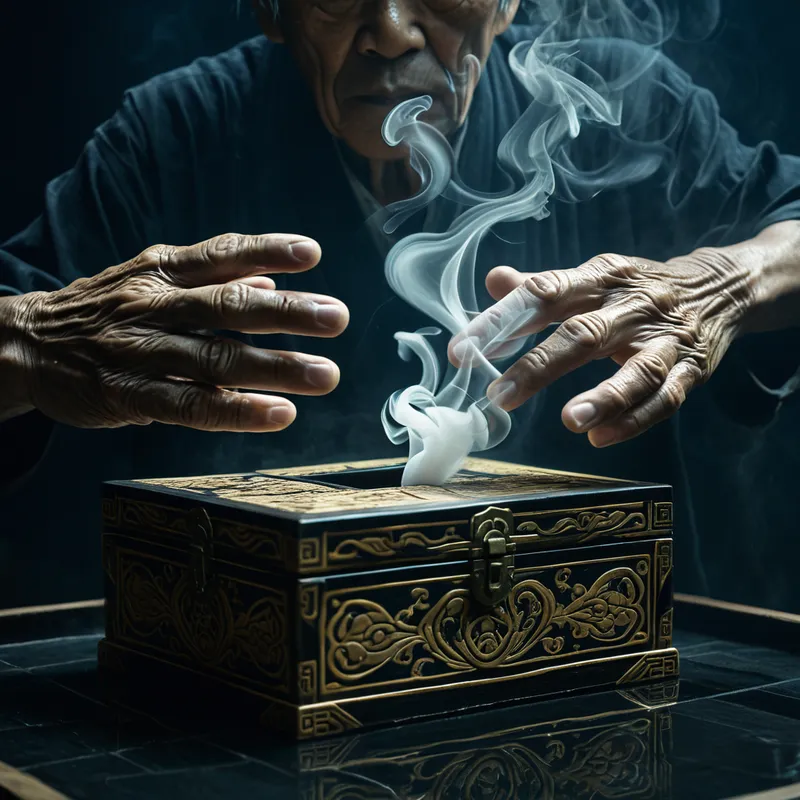
Not jewels, not a map. A wisp of white, ethereal smoke curled out, touching his face. In an instant, the youth drained from his body. His back bent, his hair turned frost-white, his skin wrinkled like dried seaweed. Three hundred years of withheld time rushed upon him in a single breath. As the last of the smoke vanished on [the sea](/myths/the-sea “Myth from Greek culture.”/) wind, so too did Urashima Taro, leaving behind only an ancient, empty box on an endless shore.
Cultural Origins & Context
The tale of Urashima Taro is one of Japan’s most enduring mukashibanashi, with roots likely stretching back to the 8th century. Early versions appear in the Nihon Shoki and the Man’yōshū, though the most familiar narrative was solidified during the Edo period. It is a classic example of the “iryōtan” genre, where a mortal visits a timeless paradise—often the Ryūgū-jō or the celestial palace of the Yama-no-Kami.
Passed down orally by village storytellers and later published in woodblock-printed storybooks (akahon), the story served multiple societal functions. On one level, it was a moral fable about gratitude and the perils of breaking a promise. On a deeper, cultural level, it articulated a profound, pre-modern understanding of time and place. It warned of the existential danger of transgressing the sacred boundary between the human world (konoyo) and the eternal world (tokoyo). The story preserved the anxiety that contact with the divine, while wondrous, fundamentally unravels the mortal coil.
Symbolic Architecture
At its core, Urashima Taro is a supreme myth of time and the unintegrated self. The Ryūgū-jō is not merely an undersea [kingdom](/symbols/kingdom “Symbol: A kingdom symbolizes authority, belonging, and a sense of identity within a larger context or community.”/); it is the unconscious itself—eternal, beautiful, and outside the [linear](/symbols/linear “Symbol: Represents order, predictability, and a direct, step-by-step progression. It symbolizes a clear path from cause to effect.”/) [progression](/symbols/progression “Symbol: Symbolizes forward movement, development, or advancement through stages toward a goal or state of being.”/) of ego-[consciousness](/symbols/consciousness “Symbol: Consciousness represents the state of awareness and perception, encompassing thoughts, feelings, and experiences.”/). Taro’s [journey](/symbols/journey “Symbol: A journey in dreams typically signifies adventure, growth, or a significant life transition.”/) is a spontaneous dive into the [depths](/symbols/depths “Symbol: Represents the subconscious, hidden emotions, or foundational aspects of the self, often linked to primal fears or profound truths.”/) of the [psyche](/myths/psyche “Myth from Greek culture.”/), prompted by an act of [compassion](/symbols/compassion “Symbol: A deep feeling of empathy and concern for others’ suffering, often involving a desire to help or alleviate their pain.”/) (saving the [turtle](/symbols/turtle “Symbol: The turtle symbolizes wisdom, longevity, and the importance of taking one’s time.”/), an ancient [symbol](/symbols/symbol “Symbol: A symbol can represent an idea, concept, or belief, serving as a powerful tool for communication and understanding.”/) of longevity and the world-supporting Genbu).
The treasure of the unconscious is not meant to be possessed by the conscious mind; it is a state to be visited, whose essence must be translated, not captured.
The three days (or years) in the [palace](/symbols/palace “Symbol: A palace symbolizes grandeur, authority, and the pursuit of one’s ambitions or dreams, often embodying a desire for stability and wealth.”/) represent a [period](/symbols/period “Symbol: Periods in dreams can symbolize cyclical patterns, renewal, and the associated emotions of loss or change throughout life.”/) of psychic [incubation](/symbols/incubation “Symbol: A period of internal development, rest, or hidden growth before emergence, often associated with healing, creativity, or transformation.”/), where [the ego](/myths/the-ego “Myth from Jungian culture.”/) is immersed in the nourishing, timeless waters of the [soul](/symbols/soul “Symbol: The soul represents the essence of a person, encompassing their spirit, identity, and connection to the universe.”/). But [the ego](/myths/the-ego “Myth from Jungian culture.”/) cannot stay. The longing for “home” is the psyche’s imperative toward consciousness and [relationship](/symbols/relationship “Symbol: A representation of connections we have with others in our lives, often reflecting our emotional state.”/) in the real world. The tragedy is not the journey, but the failed return. The Tamatebako is the fatal symbol of this failed [translation](/symbols/translation “Symbol: The process of converting meaning from one form or language to another, representing communication, adaptation, and the bridging of differences.”/). It is the sealed container of the numinous experience. To try to “open” it—to rationally dissect, cling to, or literally re-enter that unconscious state—is to release the very [thing](/myths/thing “Myth from Norse culture.”/) that protects [the ego](/myths/the-ego “Myth from Jungian culture.”/): psychological time. The white smoke is the raw, unassimilated substance of the eternal, which, when confronted directly by the temporal self, annihilates it.
The Dreamer’s Resonance
When this myth pattern stirs in modern dreams, it often manifests as profound disorientation. One may dream of returning to a childhood home to find it utterly alien, or of meeting old friends who do not recognize them. The somatic feeling is one of groundlessness—the floor of identity seems to vanish.
Psychologically, this signals a rupture between a recently experienced state of being (a period of creative flow, spiritual insight, or deep therapy—the Ryūgū-jō) and the attempt to return to “normal life.” The dreamer is Taro holding the box, caught between worlds. The dream is the psyche’s warning: the transformation experienced in the depths cannot be brought back intact. An alchemical process is required. To try to force the new, expansive self into the old, familiar structures of identity will result in a feeling of catastrophic aging, irrelevance, and existential loss—the psyche’s equivalent of rapid decay.

Alchemical Translation
The individuation process modeled here is brutally clear: one cannot remain in the paradise of the unconscious, nor can one return unchanged. The true work happens in the tension of the return.
The first alchemical stage is the descensus ad inferos—the descent into the sea (the unconscious) via an instinctive, compassionate act (saving the turtle). The second stage is the sojourn, the receptivity to the nourishing, anima-guided realm (Otohime). The critical, failed third stage is the integration. Taro’s error is literalism. He tries to carry the unconscious (the box) as a physical object into consciousness, rather than allowing it to transform him from within during the journey back.
The true Tamatebako is not a box to be opened, but the transformed vessel of the self. The treasure is not inside; it becomes the container.
A successful alchemical translation would require Taro to hold the vow. To live with the sealed mystery inside him. To walk his transformed world as a stranger, yet carry the inner certainty of the palace. The aging that would then occur would be natural, meaningful—the aging of a sage, not the withering of a ghost. The myth, in its tragic form, shows us the peril of seeking to possess mystery. In our own lives, it instructs us to let profound experiences season us slowly, to resist the urge to prematurely “open” and explain them, and to accept the inevitable, poignant distance that forms between who we were before the descent and who we must become after. Our task is not to retrieve the box, but to become sturdy enough to carry it, unopened, as we build a new home on the changed shore.
Associated Symbols
Explore related symbols from the CaleaDream lexicon: