
Urashima Tarō Myth Meaning & Symbolism
A kind fisherman saves a turtle, journeys to an undersea palace, and returns home to find centuries have passed in his absence.
The Tale of Urashima Tarō
Listen, and hear the tale of Urashima Tarō, a story whispered by the salt wind and carried on the tides of the Nihonkai. In a time when the world was closer to the kami, there lived a young fisherman in the village of Mizunoe. His heart was as calm as a morning cove, and his hands were gentle with the nets. One day, while mending his boat, he saw a band of cruel children tormenting a small turtle on the shore. Without a second thought, he chased them away and tenderly carried the creature back to the embracing sea.
The next morning, as his boat rocked on the swells, a great head broke the surface. It was a turtle, vast and ancient, its shell patterned with the wisdom of the deep. “I am Otohime,” a voice resonated in his mind, though the turtle’s mouth did not move. “The one you saved was my daughter. In gratitude, I will take you to my father’s kingdom, the Ryūgū-jō, where time itself bows to the rhythm of the waves.”
Bewildered yet trusting, Urashima climbed onto the broad shell. They descended, leaving the sun behind, passing through schools of luminous fish and forests of swaying kelp until a palace of coral and pearl emerged from the gloom. Gates of mother-of-pearl swung open, and he was greeted not by a turtle, but by a radiant princess—Otohime in her true form, daughter of the Ryūjin. For what felt like three days, he was feasted in halls where jellyfish were lanterns and music came from the sighing of conches. He wandered gardens of bioluminescent flowers, his heart light, the weight of the sunlit world forgotten.
But a shadow grew in that paradise—a longing for his home, for his aging parents, for the familiar smell of pine smoke and earth. When he spoke of his wish to return, Otohime’s smile was tinged with a profound sadness. “If you must go,” she said, placing a beautiful, lacquered tamatebako in his hands, “take this. But you must promise, with all your soul, never to open it.”
The great turtle carried him back to the surface. He waded ashore at Mizunoe, but the cove was unfamiliar. The pine tree he knew as a sapling was a gnarled giant. The faces in the village were all strangers, and when he spoke his name, they laughed, saying it belonged to a man lost at sea centuries ago. Despair hollowed him out. In his anguish, the promise to Otohime shattered. His fingers fumbled with the clasp of the tamatebako. The lid creaked open.
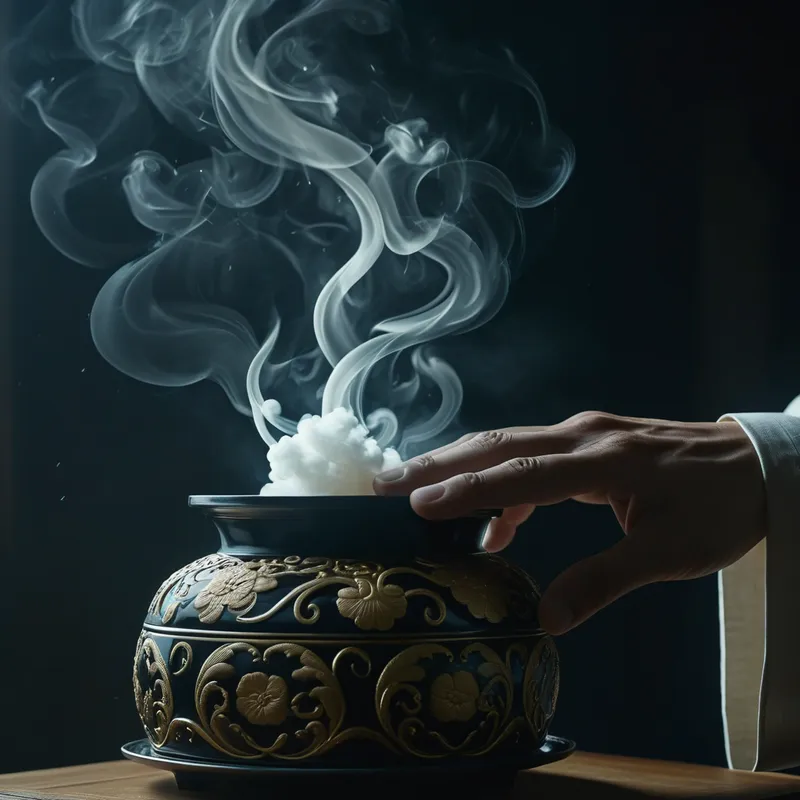
A wisp of white smoke, the very essence of the time he had borrowed, escaped and coiled around him. In an instant, the youth drained from his face. His back bent, his hair turned the color of winter frost, and his skin became like ancient parchment. The weight of three hundred years settled upon him in a single breath. As his last strength faded, he heard, carried on the wind from the distant sea, the sound of a woman weeping.
Cultural Origins & Context
The story of Urashima Tarō is one of Japan’s oldest and most beloved mukashibanashi, with roots likely stretching back to the 8th century. It is recorded in early chronicles like the Nihon Shoki and the Tango no Kuni Fudoki, though its most enduring form was shaped by oral tradition, passed down by village elders and traveling storytellers. The tale functions as a foundational narrative exploring the relationship between the human world and the tokoyo, the eternal realm often located beyond the sea. It served not just as entertainment, but as a cosmological map and a moral lesson on gratitude, promise-keeping, and the incomprehensible scales of time governed by the kami. The Ryūgū-jō represents a classic motif in Japanese folklore—a paradise that is both a reward and a trap, reflecting the ambivalent nature of blessings from the spirit world.
Symbolic Architecture
At its core, Urashima’s journey is a profound encounter with a different order of reality. The Ryūgū-jō is not merely a physical location but the unus mundus of the sea—the unconscious itself, timeless, beautiful, and governed by its own laws. Otohime is the anima figure, a guide and emissary from this depth who offers the hero a taste of wholeness, free from the tyranny of chronological time.
The tamatebako is the sealed container of the transformed self, holding the psychic reality of the otherworld within the vessel of the ego. To open it prematurely is to literalize the numinous, destroying its power.
His return represents the impossible task of reintegrating a numinous experience into ordinary consciousness. The village that has moved on symbolizes the ego’s world, which cannot accommodate the scale of transformation he has undergone. The opening of the box is the catastrophic moment of literalization—when the soul’s experience is forced into the language of the mundane world, it evaporates, leaving only the husk of its consequence.

The Dreamer’s Resonance
When this myth pattern stirs in the modern dreamer, it often manifests as dreams of profound dislocation. You may dream of returning to your childhood home to find it utterly alien, or of meeting old friends who do not recognize you. These are not dreams of simple anxiety, but somatic signals of a deep psychological shift. The psyche is reporting that a part of the dreamer has journeyed to its own Ryūgū-jō—perhaps through a period of introspection, creative work, or trauma—and has returned changed. The familiar “village” of one’s conscious identity can no longer house the returning soul. The dream is the body feeling the ache of temporal dissonance, the strain of holding two experiences of time—personal, linear time and the eternal time of the inner world.

Alchemical Translation
The alchemy of Urashima Tarō is the perilous process of holding the tension between worlds. The myth models, in tragic form, the necessity of the vas, the sealed vessel, in the work of individuation. The hero’s initial mistake is one of compassion turned outward (saving the turtle), which grants him access to the deep. His fatal error is attempting to make the unconscious conscious on a timeline demanded by the ego.
True psychic transmutation requires one to carry the tamatebako unopened—to live with the mystery of one’s transformation without demanding immediate understanding or validation from the outer world.
The modern individuation journey implied by this myth is not about avoiding the return, but about learning to inhabit the threshold. It asks: Can you bear the loneliness of being misunderstood by your own past? Can you hold the treasure of your inner experience without breaking the seal to prove it exists? The ultimate teaching is that the treasure is not the youth preserved, but the wisdom gained in the palace of the deep. To integrate it is to become the turtle—to carry the weight of both worlds, moving slowly between the surface and the abyss, without losing the essential connection to either. The tragedy is not the aging, but the failure to find a community of the similarly transformed—a new village for the soul that has tasted eternity.
Associated Symbols
Explore related symbols from the CaleaDream lexicon: