Uranus Myth Meaning & Symbolism
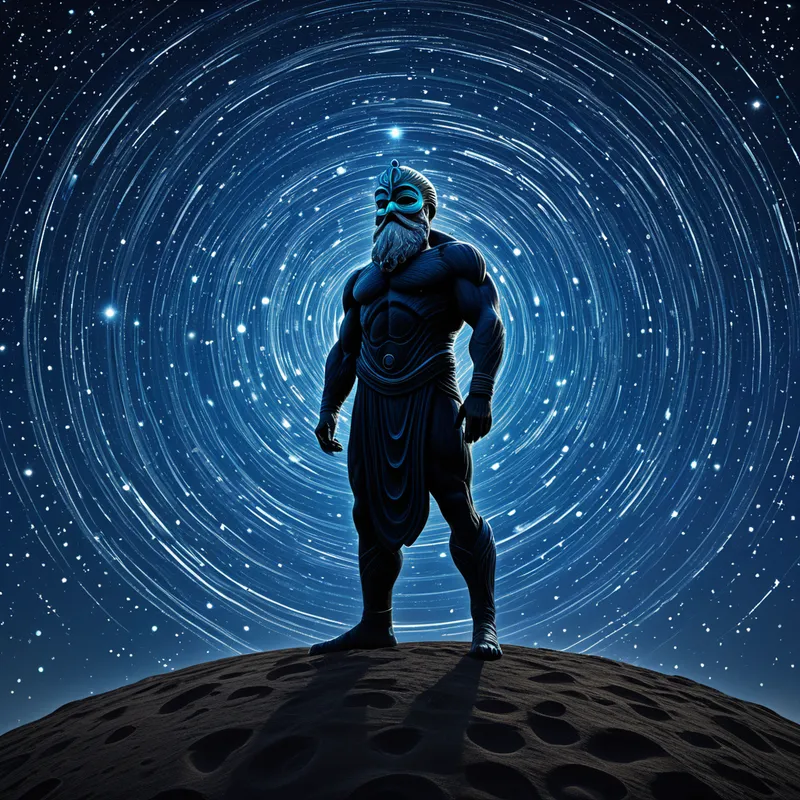
The primordial sky god, castrated by his son Cronus, whose blood and seed gave birth to the Furies, Giants, and Aphrodite from the sea.
The Tale of Uranus
In the beginning, there was only Chaos. From its yawning depths emerged Gaia, broad-bosomed and deep, the ever-sure foundation of all things. And she, alone, gave birth to Uranus, equal to herself, to cover her on every side and be a home for the blessed gods.
Uranus was the starry sky, a vault of unyielding bronze, studded with cold, watchful lights. He descended, and with Gaia, he mingled. From their union sprang the first races: the Titans, vast and mighty; the Cyclopes, with their thunderous strength; and the Hecatoncheires, each with a hundred arms and fifty heads, monsters of raw, untamed power.
But Uranus looked upon his children, and fear coiled in his starry heart. The Cyclopes with their single, blazing eyes saw too deeply. The Hecatoncheires, with their forest of arms, could upheave the very world. He could not bear their potential, their challenge to his sole, overarching dominion. So, as each was born, Uranus, the father, did not lift them up to the light. Instead, he pushed them back. He forced them down, deep into the secret, suffocating places of [the Earth](/myths/the-earth “Myth from Hindu culture.”/), into the dark womb of their mother Gaia. He imprisoned them in [Tartarus](/myths/tartarus “Myth from Greek culture.”/), a gloom as vast as the distance between earth and sky, and there they languished, bound in anguish.
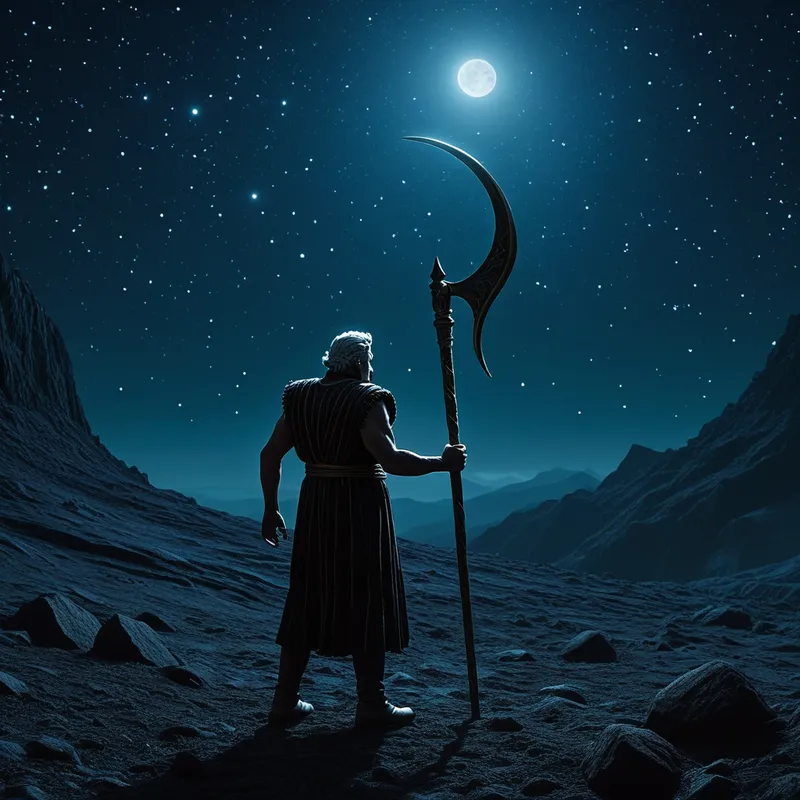
The broad Earth groaned under this weight, strained and sorrowful. The injustice festered within her. From her deep heart, she forged a weapon: a great sickle of adamant, grey and flinty, with teeth like jagged stars. And she called her children, [the Titans](/myths/the-titans “Myth from Greek culture.”/), and laid her plan before them. She asked for a champion, one who would wield the sickle and end the tyranny of [the sky](/myths/the-sky “Myth from Persian culture.”/).
A dreadful silence fell. Fear of their father’s vast, crushing power held them all—all but the youngest, Cronus, who had a cunning heart and a boundless ambition. His eyes gleamed in the gloom. “Mother,” he said, his voice like grinding stone, “I will do this deed. I am not afraid.”
And so, the trap was set. When night fell, and Uranus, in his longing, came to cover Gaia completely, stretching his starry form over her, Cronus was waiting. Hidden in the shadows of a sacred place, he felt the immense pressure of his father’s presence, the cold breath of the cosmos. At the moment of union, as Uranus was most vulnerable, Cronus struck. With a motion born of fury and terror, he reached out with the adamant sickle and severed that which connected sky to earth.
A scream tore through the fabric of creation, a sound of unmaking. From the wound of Uranus fell blood, great gouts of it, hot and life-giving, spattering upon the earth. And from the blood that soaked into Gaia sprang the Erinyes, [the Furies](/myths/the-furies “Myth from Greek culture.”/), with serpents for hair and eyes that wept blood. From the blood that fell into [the sea](/myths/the-sea “Myth from Greek culture.”/), foam gathered, and from that radiant foam, rising on a scallop shell, came Aphrodite, beautiful and terrible. The severed flesh itself was cast into [the sea](/myths/the-sea “Myth from Greek culture.”/), and from it, more life stirred.
Uranus, wounded and broken, recoiled. He shrunk back, rising forever upward, to become the distant, cold sky we know. He cursed his son Cronus with a prophecy: “You too shall be overthrown by your own child.” And with that, the age of the Sky-Father ended. The rule of the Titans had begun, bought with a act of brutal severance, its consequences echoing into the birth of gods and the destiny of [the world](/myths/the-world “Myth from Tarot culture.”/).
Cultural Origins & Context
This foundational myth comes to us primarily from Hesiod’s Theogony, a poem composed around the 8th century BCE that systematized the genealogy of the gods. It is not a simple folk tale, but a cosmogony—an account of the origin of the universe and the divine order. Hesiod’s telling was likely a synthesis of older, localized traditions, refined for a Panhellenic audience.
The function of this myth was profound. It explained the very structure of the world: why the sky is separate and distant from the earth. It established a pattern of divine succession—a son overthrowing a father—that would repeat with Cronus and Zeus, providing a theological framework for the rise of the Olympian order. Societally, it explored the tension between generations, the necessity of change, and the violent, often traumatic, cost of establishing a new regime. It was a story told not just for entertainment, but to explain the fundamental, often brutal, laws of existence and power.
Symbolic Architecture
The myth of Uranus is a [blueprint](/symbols/blueprint “Symbol: A blueprint represents the foundational plan or design for something, often symbolizing potential, structure, and the mapping of one’s inner self or future.”/) of primordial psychic dynamics. Uranus himself is not a personified god in the later sense; he is an elemental force, the [archetype](/symbols/archetype “Symbol: A universal, primordial pattern or prototype in the collective unconscious that shapes human experience, behavior, and creative expression.”/) of the Primordial [Father](/symbols/father “Symbol: The father figure in dreams often symbolizes authority, protection, guidance, and the quest for approval or validation.”/) or the [Static](/symbols/static “Symbol: Static represents interference, disruption, and the breakdown of clear communication or signal, often evoking feelings of frustration and disconnection.”/) [Cosmos](/symbols/cosmos “Symbol: The entire universe as an ordered, harmonious system, often representing the totality of existence, spiritual connection, and the unknown.”/).
Uranus represents the unyielding, ordering principle that initially structures chaos but then becomes a tyrannical ceiling, suppressing all new growth and potential.
Gaia is the fertile, creative unconscious, the [matrix](/symbols/matrix “Symbol: A dream symbol representing the fundamental structure of reality, consciousness, or the self. It often signifies feelings of being trapped, controlled, or questioning the nature of existence.”/) of all possibility. Their children—Titans, Cyclopes, Hecatoncheires—symbolize the potent but unrefined contents of the [psyche](/myths/psyche “Myth from Greek culture.”/): raw intellect (Cyclopes), boundless [capacity](/symbols/capacity “Symbol: A measure of one’s potential, limits, or ability to contain, process, or achieve something, often reflecting self-assessment or external demands.”/) for [action](/symbols/action “Symbol: Action in dreams represents the drive for agency, motivation, and the ability to take control of situations in waking life.”/) (Hecatoncheires), and the powerful, instinctual drives of a younger generation (Titans). Uranus, fearing their power, “binds them in Tartarus.” This is the [psyche](/myths/psyche “Myth from Greek culture.”/)’s repression of its own overwhelming, chaotic, or challenging potentials. It is [the ego](/myths/the-ego “Myth from Jungian culture.”/)’s fear of the unconscious, keeping vital but frightening energies locked away.
The castration is the critical, violent act of [differentiation](/symbols/differentiation “Symbol: The process of distinguishing or separating parts of the self, emotions, or identity from a whole, often marking a developmental or psychological milestone.”/). It is not merely patricide; it is the severing of a suffocating unity.
The sickle’s cut is the necessary, painful act of consciousness separating from the unconscious, of the individual differentiating from the parental or collective complex that smothers it.
The [blood](/symbols/blood “Symbol: Blood often symbolizes life force, vitality, and deep emotional connections, but it can also evoke themes of sacrifice, trauma, and mortality.”/) and seed that fall are not wasted; they become new forms of [life](/symbols/life “Symbol: The symbol of ‘Life’ represents a journey of growth, interconnectedness, and existential meaning, encompassing both the joys and challenges that define human experience.”/): the Furies ([guilt](/symbols/guilt “Symbol: A painful emotional state arising from a perceived violation of moral or social standards, often tied to actions or inactions.”/), conscience, the return of the repressed), Aphrodite ([beauty](/symbols/beauty “Symbol: This symbol embodies aesthetics, harmony, and the appreciation of life’s finer qualities.”/) born from conflict, erotic [life](/symbols/life “Symbol: The symbol of ‘Life’ represents a journey of growth, interconnectedness, and existential meaning, encompassing both the joys and challenges that define human experience.”/) emerging from violence), and the Giants. The creative potential, once repressed, is liberated through the wounding and transforms into the driving forces of the subsequent psychic order.
The Dreamer’s Resonance
When this myth stirs in the modern unconscious, it manifests in dreams of oppressive structures and necessary, frightening rebellion. One might dream of a ceiling that lowers relentlessly, a domed prison of glass or metal, or a father-figure who is vast, cold, and distant, blocking all light.
The somatic experience is one of constriction—tightness in the chest, a feeling of being pressed down, of breath being caught. Psychologically, the dreamer is at a point where an old internal order, a long-held belief system, a parental introject, or a rigid self-concept (the Uranian sky) has become a prison. It is stable but sterile, allowing no growth. The dream signals that the repressed “children”—unexpressed talents, buried emotions, or a nascent sense of self—are straining for release. The dreamer is being prepared for a Cronus-like act: a decisive, perhaps ruthless, internal cut that will feel like a betrayal of an old loyalty but is necessary for psychological survival and the birth of a new consciousness.
Alchemical Translation
In the alchemy of individuation, the Uranian myth maps the stage of [separatio](/myths/separatio “Myth from Alchemical culture.”/)—the crucial, often painful separation of elements. The psyche begins in a state of unconscious unity with the parental or archetypal world (Uranus covering Gaia). This unity is initially necessary but becomes pathological when it prevents differentiation.
The individual must become Cronus. They must forge the “adamant sickle” of discernment and conscious will. This tool is not intellectual analysis alone, but a hardened, focused intention born from deep suffering (Gaia’s groan). The act of castration is the conscious decision to sever identification with the internalized tyrant—the absolute authority of the past, the perfectionistic inner critic, the collective rule that says “you must be this way.”
The goal is not to destroy the sky, but to create a functional distance between heaven and earth, between spirit and matter, between the ideal and the real.
The liberated “blood” that falls into [the personal unconscious](/myths/the-personal-unconscious “Myth from Jungian Psychology culture.”/) (the sea) must be integrated. The Furies (guilt and rage) must be acknowledged as part of one’s truth. Aphrodite (the capacity for love and connection) must be welcomed as born from this struggle, not in spite of it. The wounded Uranus, now distant, becomes the sky of objective consciousness—no longer a crushing weight, but a space for vision, perspective, and the cold, clear light of truth. The prophecy he utters—that the son will also be overthrown—is the final, alchemical insight: every conscious structure we create will, in time, become its own limitation, destined to be transcended by the next emergent Self. The process is eternal.
Associated Symbols
Explore related symbols from the CaleaDream lexicon: