
Uluru Myth Meaning & Symbolism
A sacred story of ancestral beings whose epic battle for a beautiful object shaped the land, teaching eternal lessons of law, consequence, and belonging.
The Tale of Uluru
In the time before time, when [the world](/myths/the-world “Myth from Tarot culture.”/) was soft and the Tjukurpa was being sung into form, the great central desert was a stage for mighty beings. They traveled, they loved, they fought, and in their passing, they became the land itself.
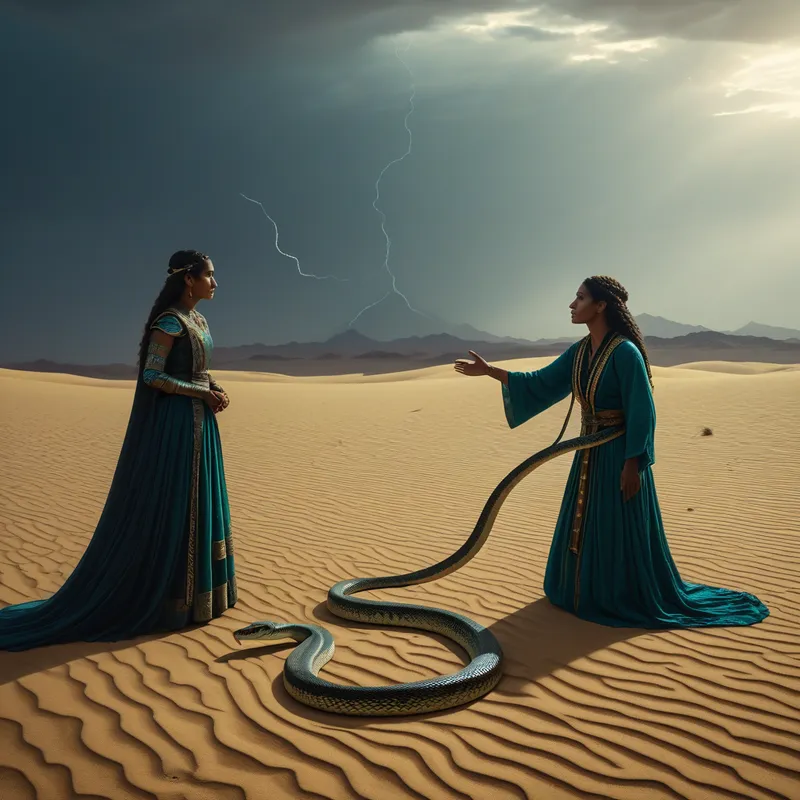
From the west came a powerful being, a woman of the Carpet Snake people. She journeyed with her sisters, their movements carving rivers, their camps forming waterholes. They carried with them sacred knowledge, the laws for living in harmony. And they carried something else: a beautiful and powerful object, a Tjurunga, of such allure it was like holding a piece of the first sunrise.
To this same place came beings from the east, the Liru, the poisonous snake men. They were mighty hunters, warriors of the red earth. When they saw the beautiful object held by the carpet snake women, a fierce desire awoke in their hearts. It was a desire not for possession alone, but a kind of hunger that clouds judgment and breaks law.
A confrontation unfolded on the plains that would become the heart of the continent. Words turned to challenges, and challenges to a terrible, magical battle. The Liru warriors attacked. The carpet snake women defended their sacred trust. The fight was not of simple tooth and claw, but of song and power. They hurled spears of intent and raised shields of ceremony. [The earth](/myths/the-earth “Myth from Hindu culture.”/) trembled. [The sky](/myths/the-sky “Myth from Persian culture.”/) darkened with the dust of their struggle.
In the climax of this conflict, a mighty Liru warrior was fatally wounded. As his life force ebbed, he rose in a final, colossal effort, his body transforming, hardening, stretching upward toward the sky. His essence fused with the earth, becoming a vast, red dome—a permanent marker of the battle’s cost. The carpet snake women, grievously wounded and mourning the violence, also transformed. Their bodies became the great rock piles nearby, the Kata Tjuta. Their blood, spilled in the fight, stained the sands and rocks forever a deep, rusty red.
The beautiful object, the cause of it all, was lost in the transformation, absorbed into the newly formed mountain. The battle ended not with a victor, but with a profound and permanent change. The beings were gone, but their spirits remained, their story etched into every crack, cave, and color band of the monumental form that now stood silent under the sun: Uluru.
Cultural Origins & Context
This story is not a mere legend of the past; it is a living chapter of the Tjukurpa for the Anangu people. The myth is part of a vast, interwoven songline—a spiritual map of the continent detailing the journeys of ancestral beings. It was and is passed down not through written texts, but through sacred song cycles, intricate dance, detailed sand drawings, and oral narration by knowledge-holders, often elders who are the custodians of specific tracts of the story.
Its function is multifaceted. It is a cosmological document, explaining the origin of a dominant geographical feature. It is a legal and ethical charter, encoding the dire consequences of breaking social law—of coveting what is not yours, of resorting to violence outside of proper ceremony. Most importantly, it is a title deed. The story of the battle and the transformation of the ancestors into the landscape is the ultimate proof of the Anangu’s sacred, unbroken connection to Uluru. The myth doesn’t just tell what happened; it explains why this place is, and who is responsible for its care.
Symbolic Architecture
At its core, the myth of Uluru is a profound narrative about the [moment](/symbols/moment “Symbol: The symbol of a ‘moment’ embodies the significance of transient experiences that encapsulate emotional depth or pivotal transformations in life.”/) desire clashes with law, and the permanent, transformative imprint that conflict leaves on the [soul](/symbols/soul “Symbol: The soul represents the essence of a person, encompassing their spirit, identity, and connection to the universe.”/) and the world.
The beautiful object, the Tjurunga, symbolizes ultimate value—be it spiritual [truth](/symbols/truth “Symbol: Truth represents authenticity, honesty, and the quest for knowledge beyond mere appearances.”/), a core [identity](/symbols/identity “Symbol: Identity represents the sense of self, encompassing personal beliefs, cultural background, and social roles.”/), a profound love, or a sacred duty. It is the “irresistible prize” that activates the [shadow](/symbols/shadow “Symbol: The ‘shadow’ embodies the unconscious, repressed aspects of the self and often represents fears or hidden emotions.”/). The Liru warriors represent the [aspect](/symbols/aspect “Symbol: A distinct feature, quality, or perspective of something, often representing a partial view of a larger whole.”/) of the [psyche](/myths/psyche “Myth from Greek culture.”/) that seeks to take, to acquire by force, driven by envy and a [hunger](/symbols/hunger “Symbol: A primal bodily sensation symbolizing unmet needs, desires, or emotional voids. It represents craving for fulfillment beyond physical nourishment.”/) for power that disregards [relationship](/symbols/relationship “Symbol: A representation of connections we have with others in our lives, often reflecting our emotional state.”/) and [covenant](/symbols/covenant “Symbol: A binding agreement or sacred promise between parties, often carrying deep moral, spiritual, or social obligations and consequences.”/). The [carpet](/symbols/carpet “Symbol: Represents the foundation upon which life experiences are built.”/) snake women represent the [aspect](/symbols/aspect “Symbol: A distinct feature, quality, or perspective of something, often representing a partial view of a larger whole.”/) that holds, protects, and nurtures sacred law and [connection](/symbols/connection “Symbol: Connection symbolizes relationships, communication, and bonds among individuals.”/).
The true battle is never for the object itself, but for the right relationship to it. To covet is to see only its separateness; to hold it in trust is to recognize it as part of a greater web.
The transformation into [landscape](/symbols/landscape “Symbol: Landscapes in dreams are powerful symbols representing the dreamer’s emotional state, personal journey, and the broader context of life situations.”/) is the ultimate [symbol](/symbols/symbol “Symbol: A symbol can represent an idea, concept, or belief, serving as a powerful tool for communication and understanding.”/). The conflict does not vanish; it is metabolized. The passions, the wounds, the very bodies of the combatants become the permanent features of [reality](/symbols/reality “Symbol: Reality signifies the state of existence and perception, often reflecting one’s understanding of truth and life experiences.”/). Uluru is not a tomb, but a testament. It is the psyche’s landscape fossilized—a constant, visible reminder of a pivotal, shaping [event](/symbols/event “Symbol: An event within dreams often signifies significant life changes, transitions, or emotional milestones.”/). The red stain is the indelible [mark](/symbols/mark “Symbol: A ‘mark’ often symbolizes identity, achievement, or a defining characteristic in dreams.”/) of consequence, the proof that actions of the [spirit](/symbols/spirit “Symbol: Spirit symbolizes the essence of life, vitality, and the spiritual journey of the individual.”/) have tangible, lasting effects.
The Dreamer’s Resonance
When this mythic pattern stirs in the modern unconscious, it may manifest in dreams of monumental, immovable obstacles or awe-inspiring natural formations that feel both alien and deeply familiar. One might dream of a giant, red rock appearing in a city street, or of discovering a vast, silent stone in one’s own backyard.
Somatically, this can feel like a heavy pressure, a grounding, or a sense of being “stuck” in a defining posture. Psychologically, this dream signals a confrontation with one’s own “ancestral battle”—a core, perhaps forgotten, conflict that shaped the foundational structures of the personality. The dream asks: What irreconcilable desires clashed in my past to form this unyielding part of me? What sacred law was broken, and what was the cost? The rock in the dream is the crystallized result of that inner conflict, now asking to be acknowledged not as a problem, but as the very architecture of [the self](/myths/the-self “Myth from Jungian culture.”/).
Alchemical Translation
The individuation process modeled here is not one of slaying a monster or retrieving a treasure, but of consciously integrating the result of a primordial clash. The modern seeker is not the warrior in the battle, but the one who comes later to read the landscape it created.
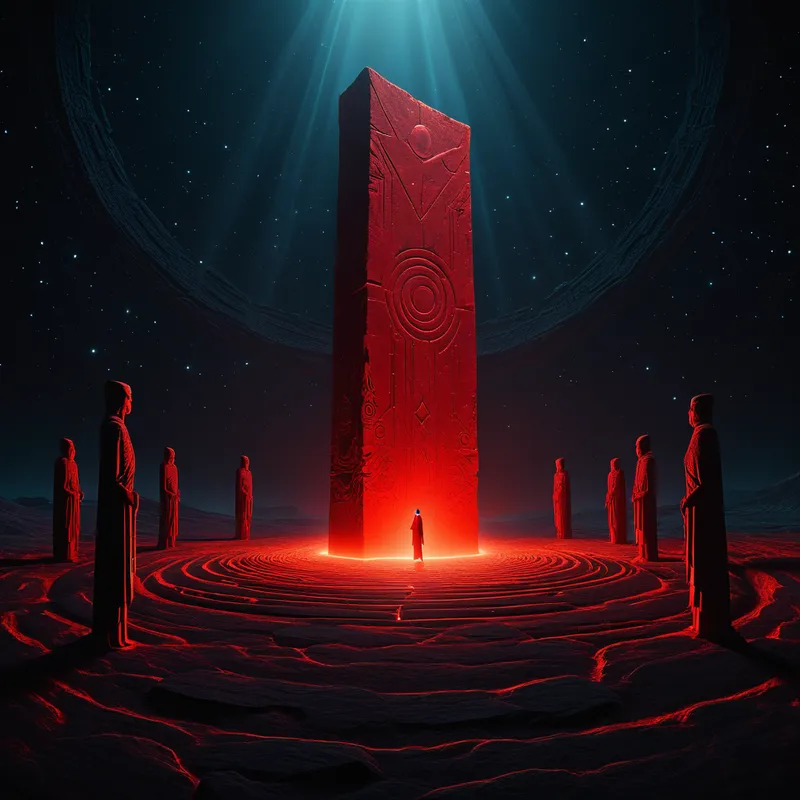
The first alchemical step is Recognizing the Stone. This is the conscious acknowledgment of one’s own “Uluru”—the massive, seemingly fixed complexes, traumas, or personality structures that define one’s inner terrain. One must stop trying to walk around it and instead approach it as sacred text.
The second step is Deciphering the Inscription. This involves using the tools of reflection, therapy, or active imagination to understand the original “battle.” What were the conflicting forces (the desire to take vs. the duty to protect, the urge for power vs. the call to relationship)? What was the “beautiful object” at the center? This is the process of finding the myth in one’s own history.
Individuation is the art of learning to dwell consciously within the landscape your battles created, transforming a prison of stone into a sanctuary of meaning.
The final, transformative step is Assuming Custodianship. This is the alchemical goal. One cannot change the rock; it is fact. But one can change one’s relationship to it. One moves from being a victim of one’s history to being the Anangu—the responsible custodian of its meaning. You learn its stories, tend its vulnerabilities, and honor its sacredness. The complex, once a blocking monolith, becomes a source of orientation, strength, and deep belonging. The bloodstain of consequence becomes the sacred ochre of identity. In this act of conscious custodianship, the psyche completes the myth: [the law](/myths/the-law “Myth from Biblical culture.”/) is restored, not by undoing the battle, but by understanding it, and in doing so, finding one’s rightful place in the eternal Tjukurpa of the self.
Associated Symbols
Explore related symbols from the CaleaDream lexicon: