Ullr Myth Meaning & Symbolism
The myth of Ullr, the silent hunter of winter, embodies the mastery of skill, the embrace of solitude, and the journey of self-reliance through the cold wilderness of the soul.
The Tale of Ullr
Hear now of the silent one, the lord of the white wilderness. When the breath of the Jötnar descends from the north, when the sun flees and the world is sheathed in glass and bone, then does his reign begin.
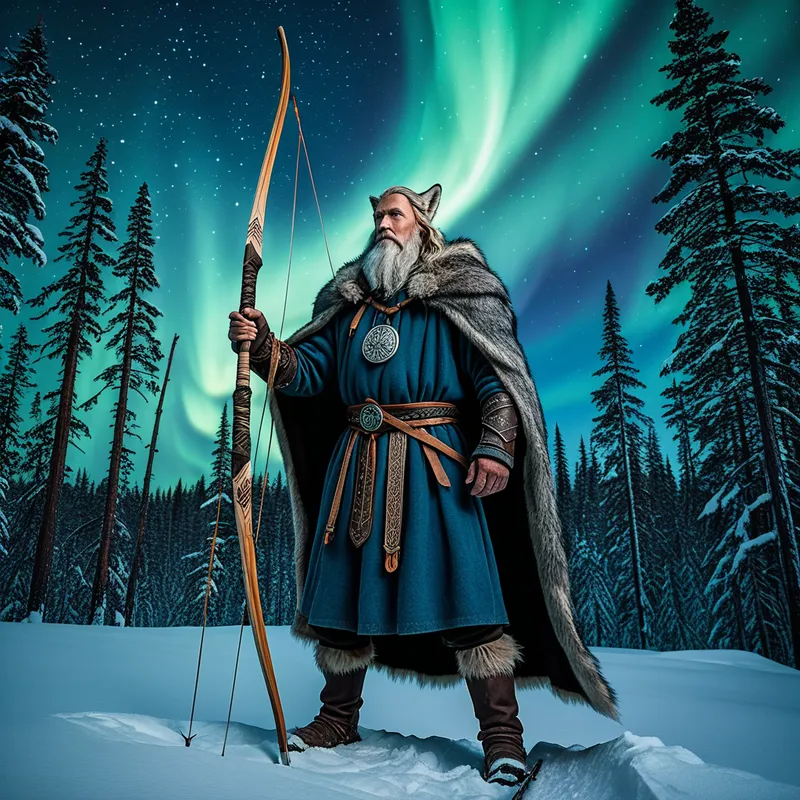
His name is Ullr. He does not dwell in the roaring halls of Valhalla, nor by the warm hearths of the gods. His hall is the endless expanse between the frosted pines, his roof the vault of winter stars, his fire the cold, clear light of the moon on snow. He moves not with thunder, but with a whisper—the whisper of ash-wood skis gliding over the crust, the whisper of a bowstring finding its rest.
In the deep of the year’s sleep, when the wolf’s hour is long and the land holds its breath, a shadow passes over the realm. It is a fear that creeps, a blight that silences even the wind. The bonds that hold the world feel thin, like ice over dark water. The gods in their golden city feel a chill that their fires cannot warm. They look to their weapons, their spells, their wisdom, and find them wanting against this formless dread. For this is a foe that cannot be met with a host, nor out-thought with cunning. It is the essence of entropy, the slow unraveling that comes from within.
They look to the north, to the trackless white. They remember the one who knows the language of the cold. A messenger is sent, stumbling through drifts, to the edge of all things. There, by a frozen mere, he finds him. Ullr stands, still as a frost-laden tree, reading the story written in the snow—the scuff of a hare, the patient circle of an owl’s wing, the deep, purposeful pad of a lone wolf. He listens, and the silence speaks volumes.
He does not nod, nor swear an oath. He simply turns his gaze from the tracks to the trembling messenger, and in his eyes is the patience of glaciers. He takes up his bow, an ancient thing of yew that remembers the sun. He straps to his feet his skis, fashioned from the bones of a great beast that knew no master. Without a word, he pushes off, becoming a swift, dark line against the white.
His journey is not a charge, but a convergence. He follows the cold to its source, a place where the snow falls upward and time pools like stagnant water. There, in a clearing that drinks the light, the formless dread takes shape—a shifting mound of hoarfrost and forgotten echoes, a mirror that shows only absence. It does not attack; it simply is, a vacuum that pulls all warmth, all purpose, into its hollow core.
Ullr does not draw his bow. He plants his ski poles in the snow and stands. He breathes the air that kills, and does not die. He meets the emptiness with the fullness of his skill, the absolute certainty of his presence. He is the arrow already flown, the hunt already complete. He is the boundary where the wild ends and the self begins. In the face of this perfected being, this entity of pure, functional existence, the dread has nothing to reflect, nothing to unravel. It has met not a chaos to consume, but an order more ancient and resilient than its own—the order of the survivor, the master of the medium. With a sound like a distant avalanche, the form unravels, not in defeat, but in recognition. The cold remains, but it is once again just the cold, clean and sharp and life-giving in its harshness.
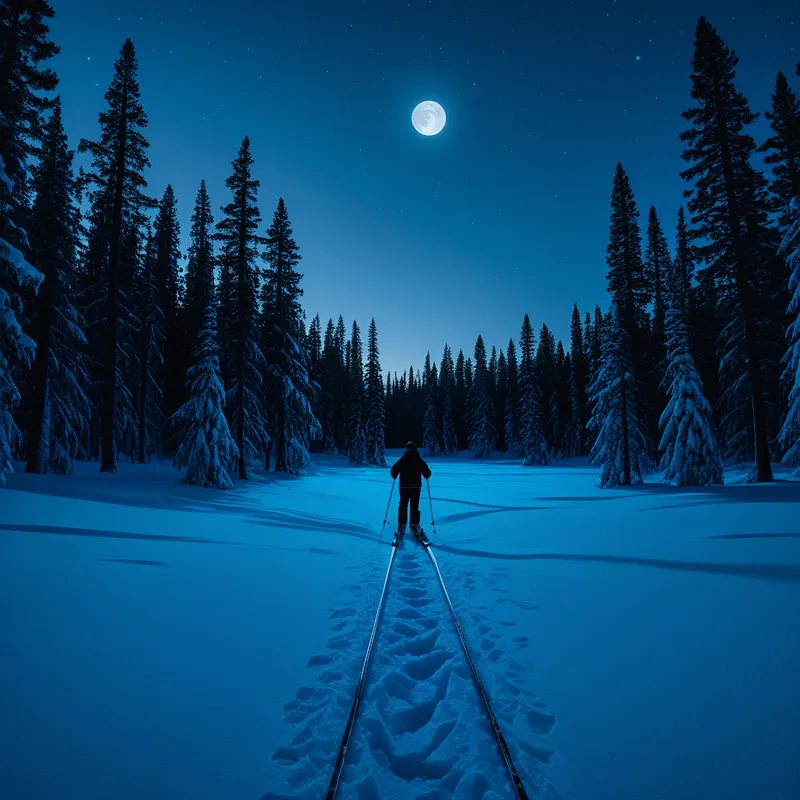
And Ullr, his task unseen and unsung, turns his skis toward the deep wood once more, leaving only a single, straight track that is soon filled with fresh, innocent snow.
Cultural Origins & Context
Ullr is a figure of profound antiquity within the Norse pantheon, likely predating the more widely known Odin-centric myths. His name is thought to be derived from a root meaning “glory” or “brilliance,” an apt title for one associated with the dazzling, terrible beauty of winter. References to him are sparse but significant, found in the Poetic Edda and Prose Edda, and etched into ancient place names across Scandinavia, particularly in Sweden, where locations like Ulleråker (“Ullr’s Field”) and Ullensaker (“Ullr’s Sacrifice”) speak to his once-widespread veneration.
He was not a god of the communal feast or the public saga. His worship was likely personal, practical, and deeply tied to survival. In a culture where the winter months were a time of immense danger, scarcity, and isolation, Ullr embodied the necessary skills to endure. He was the patron of the hunter whose success meant the difference between life and death, the guardian of the traveler who had to cross frozen wastes, and the master of the duelist who relied on skill, not brute force. His myth was not told in grand epics around the longfire, but in the quiet knowledge of the trapper checking his lines, in the focused breath of the archer, in the confident glide of the skier. His societal function was to model a specific kind of excellence: the excellence of self-reliance, of becoming so attuned to your environment and your tools that you move through crisis not as a conqueror, but as a seamless part of the landscape itself.
Symbolic Architecture
Ullr is the archetype of the Specialist, the Master of the Medium. He represents a consciousness that does not seek to dominate nature, but to achieve such a profound harmony with its laws that action becomes effortless and inevitable. His domain—winter—is the ultimate symbol of the harsh, objective, unforgiving reality of the outer world and the inner self. It strips away all that is superfluous, leaving only essential forms and the stark truth of one’s resources.
The bow is not a weapon of rage, but of geometry and patience. It is the focused application of potential energy, a perfect metaphor for cultivated skill held in reserve until the precise moment of release.
His skis, said to be made of bone, are profoundly symbolic. Bone is the structure that remains after all else has passed; it is the enduring framework of the self. To travel on bone is to move through life on the foundation of one’s own essence, on the core identity that persists through all seasons of change. His silence is not an absence, but a presence of a different order—the deep listening of the introvert, the intuitive who learns by observing the patterns of the world rather than proclaiming upon it. In the mythological vacuum where his stories might have been, we find his greatest symbol: the track in the snow. It is a mark of purposeful passage, evidence of a journey taken with competence, leaving a clear but temporary sign. It speaks of direction, skill, and the beautiful, melancholy truth that all paths are ultimately reclaimed by the ongoing life of the world.
The Dreamer’s Resonance
When the pattern of Ullr emerges in the modern psyche, it often manifests in dreams of profound solitude within a stark landscape. The dreamer may find themselves alone in a vast, snow-swept forest, on a frozen lake under a starry sky, or in a minimalist, coldly lit room. There is a quality of silence and immense clarity, often paired with a specific, tangible task: following animal tracks, fashioning a tool, or simply waiting, perfectly still.
Somatically, this dream-state correlates with a psychological process of withdrawal and consolidation. It is the soul’s winter. The dreamer is undergoing a necessary retreat from the overheated complexities of social life, from the constant output of energy. This is not depression, but a sacred hibernation. The cold in the dream is the feeling of emotional numbing that allows for a deeper focus; the solitude is the condition required to hear one’s own inner rhythms. The dream is an indicator that the psyche is focusing its resources, stripping away non-essential commitments and identities to discover the “bone structure” of the self. It is a call to cultivate a skill with deep, focused attention, to become an expert in one’s own life. The anxiety in such dreams comes not from the solitude, but from the fear of being unprepared, of not having the right “skis” or “bow” for the journey ahead.
Alchemical Translation
The alchemical journey of Ullr is the process of Psychic Cryogenesis. It is the art of using the cold, harsh realities of life—failure, loss, limitation, isolation—not as enemies to be defeated, but as the very medium through which the soul is tempered and refined.
The first stage is Congelatio: the freezing, the forced stillness. Life circumstances or inner realizations bring the warm, flowing, associative mind to a halt. Plans solidify, options narrow, and one is confronted with the bare landscape of what is.
The second is the Fabricatio: the fashioning of the tools. In this stillness, one must identify the core skills and the enduring truths (the bone) upon which survival depends. This is the time for deliberate practice, for study, for building competence from the inside out.
The final stage is Transitus: the graceful passage. This is not a fiery triumph, but a cool, silent mastery. The transformed individual moves through challenges not with explosive force, but with the effortless efficiency of a skilled skier on a perfect slope. The crisis is met not with a war, but with a demonstration of such complete adequacy that the crisis loses its power.
For the modern individual, Ullr’s path teaches that not all growth comes from expansion and connection. Some of the most vital individuation occurs in contraction and silence. It is the path of the introverted hero, whose quest is not to slay the dragon in a distant land, but to master the dragon of one’s own chaos through disciplined skill and serene acceptance of the necessary cold. We become most ourselves not in the summer of abundance, but in the winter of focus, gliding on the bones of our authentic nature toward a horizon of our own choosing.
Associated Symbols
Explore related symbols from the CaleaDream lexicon: