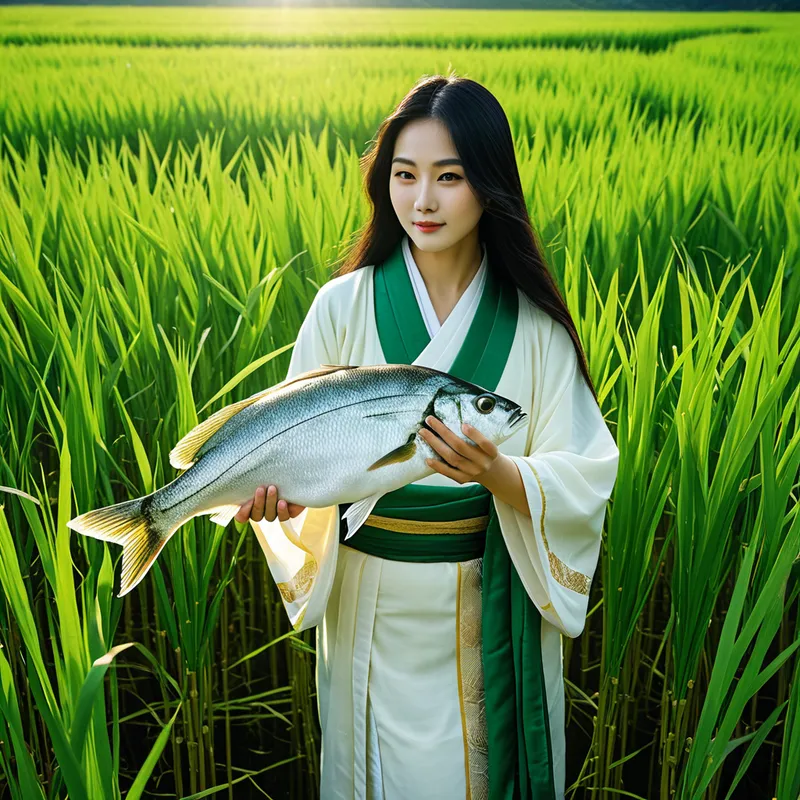
Ukemochi Myth Meaning & Symbolism
The myth of the food goddess Ukemochi, whose violent death from the moon god's disgust births the world's sustenance, embodying creation through sacrifice.
The Tale of Ukemochi
Listen, and hear the tale spun from the primal loom, a story not of conquest, but of a gift born from a terrible turning. In the High Plain of Heaven, where the air is clarity itself and the light has no shadow, the Sun Goddess, Amaterasu, held court. Her brother, the aloof and piercing Tsukuyomi, whose gaze was as cold and sharp as winter starlight, dwelt in his own celestial silence.
A feast was to be held, a divine convocation. To prepare it, Amaterasu sent Tsukuyomi as her emissary to visit the goddess Ukemochi. She was not a warrior or a weaver of fate, but a tender of the deep, moist pulse of life. She dwelled not in gleaming halls, but in a realm where soil breathed and seeds dreamed.
Tsukuyomi descended, his silver light casting long, stark shadows. He found Ukemochi in a sun-warmed clearing, a woman whose form seemed woven from fertile earth and gentle rain. She welcomed him, not with grand speeches, but with a humble, profound intent to nourish. To create the feast, she did not call for servants or conjure platters from air. She turned aside, facing the lush forest. From her mouth, she vomited a steaming pile of perfectly cooked, gleaming white rice. Tsukuyomi’s eyes narrowed, a flicker of cold distaste crossing his features.
Unperturbed, Ukemochi then turned to face the vast ocean. She opened her mouth again, and out came a torrent of fresh, silvery fish, their scales catching the light—sea bream, and others from the deep. Finally, she faced the wild mountains and plains. From her mouth now spilled a bounty of wild game: plump pheasants, rabbits, and more. She gathered these offerings, born from the very essence of her being, and laid them upon a great stone table before the moon god.
But Tsukuyomi did not see a sacred act of generation. He saw only defilement. To his sterile, ordered mind, this birth-from-the-body was foul, a revolting contamination. “The food you have prepared is unclean,” he declared, his voice like cracking ice. “You have offered me filth from your mouth.” A sacred hospitality had been shattered. In a flash of celestial rage, born of utter disgust, Tsukuyomi drew his sword and struck Ukemochi down where she stood.
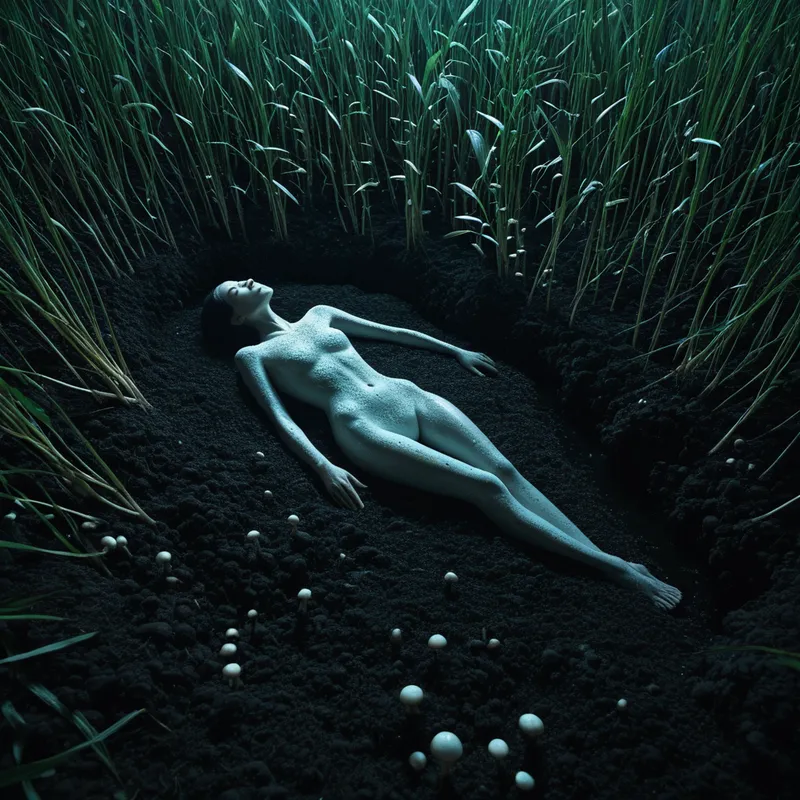
Her body did not simply fall. It collapsed into the earth with a final, generative sigh. From her forehead sprang oxen and horses. From the crown of her head, millet seeds rained down. Beans burst from her eyebrows, silkworms spun from her eyelids, and panic grass grew from her belly. Her corpse became the very body of the world’s sustenance. When Amaterasu heard of this violence, she was wracked with grief and fury. She declared she would never look upon Tsukuyomi again, forever separating the sun and the moon in the sky. And from the transformed body of the slain goddess, she took the seeds of rice, wheat, and beans, and sowed them in the dry fields of heaven, giving the gift of agriculture to the world below.

Cultural Origins & Context
This myth is recorded in Japan’s oldest chronicles, the Kojiki (712 CE) and the Nihon Shoki (720 CE). These texts were not mere storybooks; they were political and cosmological documents, crafted to establish the divine lineage of the imperial family and codify a unified Shinto worldview. The tale of Ukemochi, therefore, is not a folk fable but a foundational theogony—an explanation for the origin of food, agriculture, and the celestial order.
Its societal function was profound. It explained the sacred, yet violent, cost of sustenance. Every meal, every harvest, was understood as a gift born from a divine sacrifice. This imbued agriculture with a ritualistic, reverent quality, central to Shinto practices and the annual cycle of festivals (matsuri). The myth also established a critical cosmological principle: the separation of the pure (Amaterasu, the sun) and the impure (death, decay) and the transformative power that lies between them. Ukemochi’s act and death occupy that liminal, potent space where life emerges from what is considered taboo.
Symbolic Architecture
Ukemochi is the archetype of the generative body of the world. She is not a goddess who commands or rules, but one who is the process of creation itself. Her method—producing food from her orifices—symbolizes a raw, unmediated, and utterly physical act of giving. It represents nature in its most fecund, uncontrolled, and therefore, to a structured mind, “unclean” state.
The first gift is always a piece of the giver’s own substance, a truth both beautiful and terrifying.
Tsukuyomi represents the principle of discrimination, order, and sterile purity. His disgust is not merely personal fastidiousness, but a cosmic rejection of the messy, embodied reality of life and death. He is consciousness that fears and seeks to sever itself from its organic, decaying roots. His violent act is the ultimate rejection of the Mother, the source, because her methods violate his aesthetic of creation.
The true resolution is not in the violence, but in the transformation. Ukemochi’s death is not an end, but a dispersal. Her body undergoes a literal alchemy, transmuting into the specific staples of civilization: livestock and grains. The myth posits that our cultivated world, our very survival, is built upon the corpse of a sacred, sacrificed nature. The estrangement of sun and moon becomes the eternal rhythm of day and night, a cosmic order born from this traumatic rift.
The Dreamer’s Resonance
To dream in the pattern of Ukemochi is to feel the deep, somatic stirrings of a creative or nourishing impulse that feels somehow “unclean” or shameful. The dreamer may be a caregiver who feels their giving is taken for granted or seen as pathetic. They may be an artist whose raw, uncensored work is met with disgust or rejection by their own inner critic (the Tsukuyomi within).
Somatically, this can manifest as issues with the mouth, throat, or digestive system—a sense of being unable to “stomach” something, or of one’s words or creative output being vomited forth and rejected. The dream is the psyche’s dramatization of a profound fear: that one’s most essential, generative nature is fundamentally repulsive to the world, or to the ordered, “acceptable” part of oneself. It is the dream of the body insisting on its right to create in its own messy way, even as the mind condemns it.
Alchemical Translation
The individuation process modeled here is the integration of the “Ukemochi principle”—the raw, fertile, and taboo-shadowed creativity of the unconscious—with the “Tsukuyomi principle”—the discriminating, ordering consciousness. We all contain a Tsukuyomi, a part that recoils from the messy, emotional, instinctual products of our inner depths. We judge our own dreams, our grief, our rage, our unconventional desires as “unclean.”
The path is not to slay the Tsukuyomi (which would leave us in chaotic, undifferentiated fecundity), nor to allow him to slay Ukemochi (which leads to sterile order and spiritual famine). The alchemy occurs in the aftermath of the conflict.
Individuation requires the courage to let a part of oneself be slain, so that it may be reborn in a more integrated, nourishing form.
We must allow our old, fragile self-concepts—the idea that our creativity must be pure, orderly, and socially sanctioned—to be struck down by the truth of our nature. From that “death,” a new sustenance is born. The raw, vomited impulse (the first draft, the unprocessed emotion, the taboo desire) must be allowed to fall into the earth of the psyche. There, through conscious work (Amaterasu’s sowing), it transforms. The shame becomes a grain of wisdom. The messy emotion becomes the fuel for compassion. The rejected art becomes the seed of a unique style. We learn that our deepest nourishment, for ourselves and others, always springs from the courageous and often painful transformation of what we initially deemed unacceptable within us. We become the field where the sacrifice yields the harvest.
Associated Symbols
Explore related symbols from the CaleaDream lexicon: