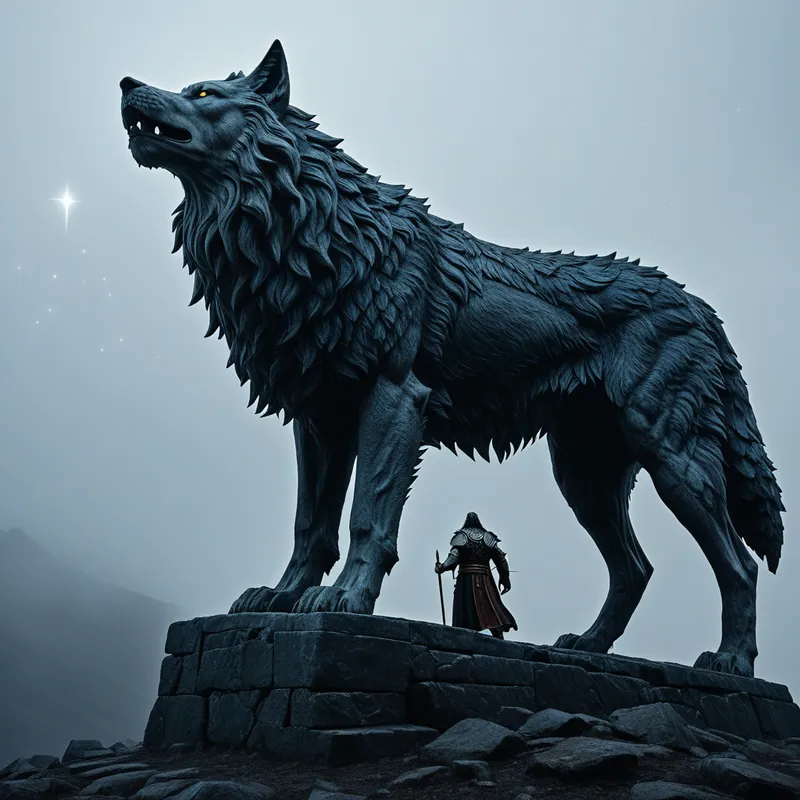
Tyr's Hand Myth Meaning & Symbolism
The god Tyr sacrifices his hand to bind the monstrous wolf Fenrir, an act of ultimate oath-keeping that secures order through willing loss.
The Tale of Tyr’s Hand
Listen, and hear a tale not of glory won in battle, but of honor sealed in loss. In the days when the world was younger and the gods walked the halls of Asgard, a shadow grew. It was the wolf, Fenrir, a creature of such terrible might and swelling rage that even the Æsir trembled. They watched him grow from a playful pup to a beast whose jaws could span the heavens, whose howl promised the unmaking of all things.
The gods knew a chain must be forged. They commissioned the cunning dwarves, who wrought from impossible things—the sound of a cat’s footfall, the beard of a woman, the roots of a mountain, the sinews of a bear, the breath of a fish, and the spittle of a bird—a fetter named Gleipnir. It was slender as a silk ribbon, smooth and soft, yet stronger than any iron forged in fire.
They brought the fetter to Idavollr and called to Fenrir with fair words. “Great wolf,” they said, “test your strength against this small band. Surely you, who broke the mighty chains Lædingr and Drómi, will snap this thread with a breath.” But Fenrir, whose heart was as sharp as his teeth, saw the trick in their eyes. The ribbon did not clank; it whispered. It held the silence of cunning, not the boast of strength.
“I see no fame in breaking so slight a band,” rumbled the wolf, his voice like grinding stones. “But if one of you will place a hand in my mouth as a pledge of good faith, a token that this is sport and not treachery, then I will submit.”
A cold silence fell upon the gods. They looked at one another, and in each face was the vision of that maw closing. Then one stepped forward. It was Týr. Not the loudest, nor the mightiest in raw strength, but the one whose word was law, whose handshake was an unbreakable covenant. He met the wolf’s burning gaze and did not flinch. Without a word, he placed his right hand—the hand of giving, of striking bargains, of wielding sword and scale—between Fenrir’s jaws.
The other gods bound the wolf with Gleipnir. The more Fenrir strained, the tighter the gentle ribbon held. He writhed, he howled a cry that cracked the sky, and understanding the betrayal, he closed his jaws. There was a sound like the snapping of a world-tree branch. Blood, dark and godly, spilled upon the earth. Tyr stood, his face a mask of agony and profound resolve, his hand severed.
The wolf was bound, dragged to a remote rock, and a sword was placed in his jaws to hold them agape. His drool formed a river of rage, Ván. Order was preserved, Ragnarök was delayed. But the cost was counted in the silence where Tyr’s hand had been, a price paid in flesh and faith by the one god brave enough to keep his word, even to the monster, even unto himself.

Cultural Origins & Context
This myth reaches us primarily through the Prose Edda of Snorri Sturluson and the older poetic fragments. It was not mere entertainment. In the harsh, honor-bound society of the Norse, an oath was the glue of the cosmos. It bound kin, sealed alliances, and structured the very relationship between humanity, the gods, and the chaotic forces of nature.
Tyr, whose name is etymologically linked to Tiwaz, a proto-Germanic sky god, had evolved into the divine embodiment of this principle. He was the god of the thing (the assembly), of law, and of righteous battle. The myth of his hand served a crucial societal function: it dramatized the ultimate consequence and necessity of oath-keeping. It taught that true order is not established through overwhelming force alone (the earlier chains failed), but through cunning (Gleipnir) and, most importantly, through the willing sacrifice of personal sovereignty for the greater good. The one who administers justice must be prepared to be its first victim. This story would have been told to reinforce the sacredness of one’s word in a world where written contracts were rare and a man’s honor was his most valuable possession.
Symbolic Architecture
At its core, the myth is a masterclass in the psychology of containment and the price of consciousness. Fenrir represents the unbounded, destructive potential of the unconscious—raw instinct, rage, and the shadow that grows if left unchecked. He is the chaos that threatens to devour the structured world of the ego (the gods of Asgard).
The binding of chaos is the first act of creation, and it always demands a payment from the one who dares to wield the binder.
Tyr is the archetypal principle of the ego that can relate to this chaos consciously. He does not deny the wolf’s power or try to destroy it outright (a futile effort). Instead, he engages with it, makes a pact, and accepts the terrible terms. His right hand is the symbol of active agency, skill, and conscious action. Its loss is not a defeat, but a sacred exchange. He trades personal wholeness for cosmic order. The hand in the mouth is the ultimate image of trust placed in the destructive power—a willingness to be wounded by the very truth one seeks to contain.
Gleipnir, forged from paradoxes, symbolizes the power of the psyche to bind immense forces with seemingly fragile, non-physical means: thought, agreement, and symbolic law. It is the power of the oath itself.
The Dreamer’s Resonance
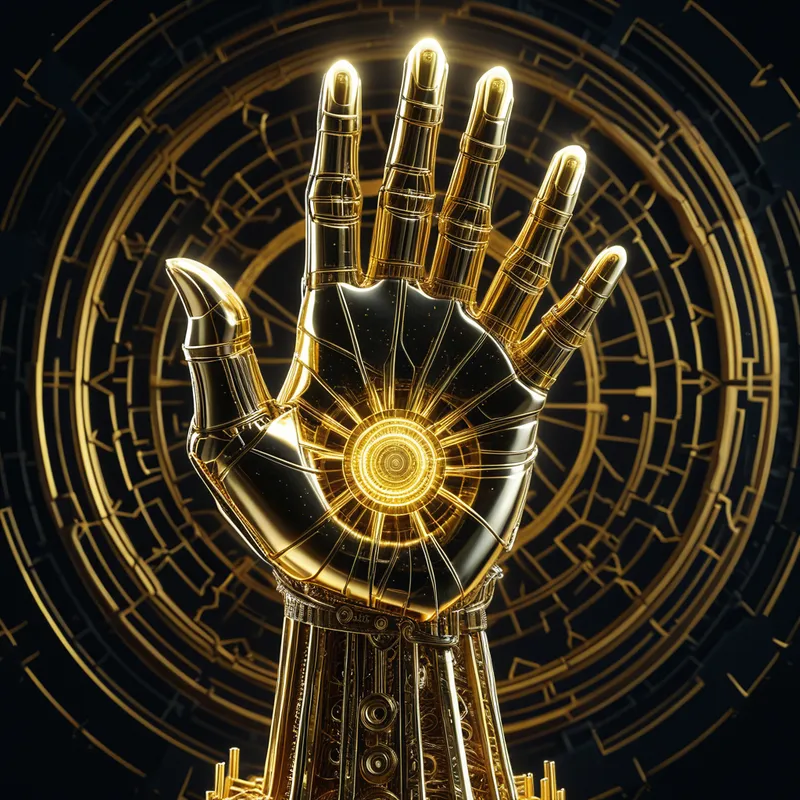
When this myth stirs in the modern dreamer, it signals a profound interior process of negotiation with a “boundless” aspect of the self. Dreaming of a sacrificed hand, or of making a terrible bargain where one part of the self must be given up, often points to the necessity of “binding” a chaotic life force.
This could manifest as the need to finally commit to a relationship (sacrificing the “hand” of unattached freedom), to impose structure on a creative or emotional outburst (binding the “wolf” of manic inspiration), or to keep a difficult promise to oneself that curtails an old, destructive habit. The somatic sensation is often one of a deep, resonant loss that is simultaneously a relief—the ache of the phantom limb alongside the stability of a conflict resolved. The dreamer is in the role of Tyr, learning that to integrate a powerful, frightening part of their nature, they must offer a piece of their conscious control as a pledge of good faith to their own unconscious.

Alchemical Translation
The alchemical journey of individuation is a process of binding disparate, often opposing, elements of the psyche into a cohesive whole. The myth of Tyr’s Hand models the critical rubedo or reddening stage—the sacrifice necessary for transformation.
First, one must acknowledge the “Fenrir” within: the untamed rage, the insatiable hunger, the capacity for destruction that feels monstrous. The ego’s initial attempts to suppress it with brute force (the iron chains) fail. The solution is more subtle, more psychological: crafting a Gleipnir from the intangible materials of awareness, acceptance, and conscious intent.
The goal is not to kill the monster, but to relate to it. The price of that relationship is always a piece of our cherished self-image.
The “alchemical translation” is the act of placing the hand in the mouth. This is the moment of supreme vulnerability where the conscious self (Tyr) willingly enters into a covenant with the destructive shadow, offering up a prized function—perhaps a rigid identity, a defensive pride, a comforting illusion—as collateral. The severing is the painful dissolution of that old structure. The binding is the new, integrated state where the chaotic force is not gone, but contained and given a place in the psychic ecology. The dreamer who undergoes this is left, like Tyr, with a “missing hand”—a permanent reminder of the cost of wholeness, and a newfound authority born not from intactness, but from proven courage and unshakeable integrity. The one-handed god becomes the true ruler, for he has traded a piece of his sovereignty to secure the sovereignty of his entire being.
Associated Symbols
Explore related symbols from the CaleaDream lexicon: