Tyr Myth Meaning & Symbolism
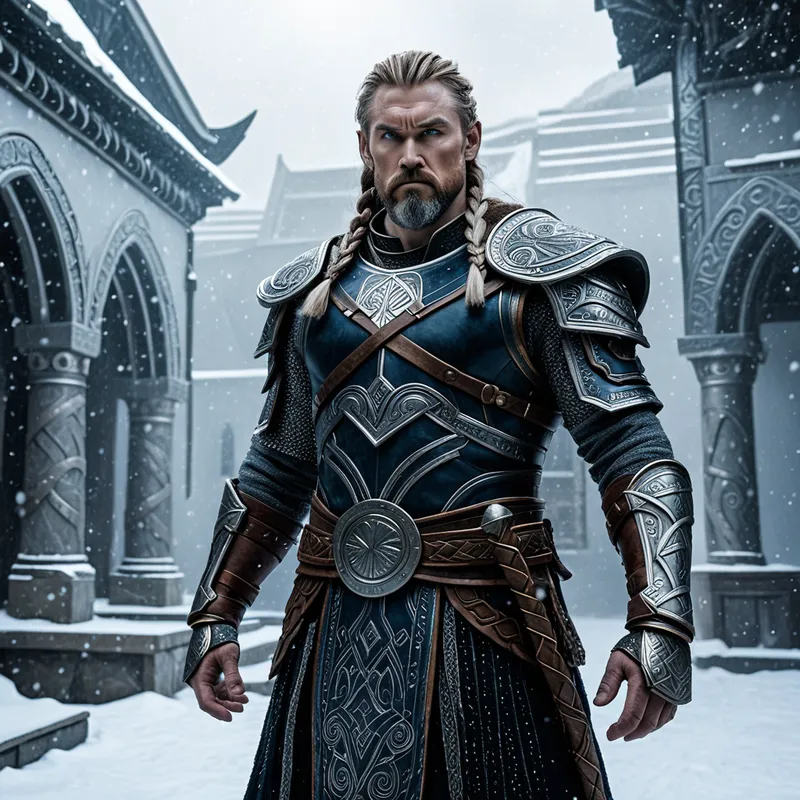
The one-handed god who bound the wolf Fenrir by placing his hand in its jaws as a pledge, embodying the ultimate sacrifice for cosmic order.
The Tale of Tyr
Listen, and hear the tale of the god who paid the price for the world’s promise. In the high halls of Asgard, a shadow grew. It was not the shadow of night, but of a prophecy whispered by the Norns at the root of the Yggdrasil: a great wolf, son of Loki, named Fenrir, would one day break his bonds and devour the sun itself. The gods watched the pup grow, not into a hound, but into a tempest of teeth and sinew, a force of pure, unbounded chaos. Fear, cold and sharp, settled in their hearts.
They decided he must be bound. Not with iron, for he snapped great chains like twigs. Not with stone, for he shattered mountains. They commissioned the cunning dwarves to forge a fetter from impossible things: the sound of a cat’s footfall, the beard of a woman, the roots of a mountain, the sinews of a bear, the breath of a fish, and the spittle of a bird. From these six impossibilities, they crafted Gleipnir, a ribbon slender and soft as a silken cord, yet stronger than any forged metal.
But Fenrir was no fool. He sensed the trickery in the gods’ smiles. “I will let this ribbon be tied upon me,” the wolf growled, his voice like grinding stones, “but only if one of you places your hand in my mouth as a pledge of good faith. So I will know this is no snare, but a test of my strength.”
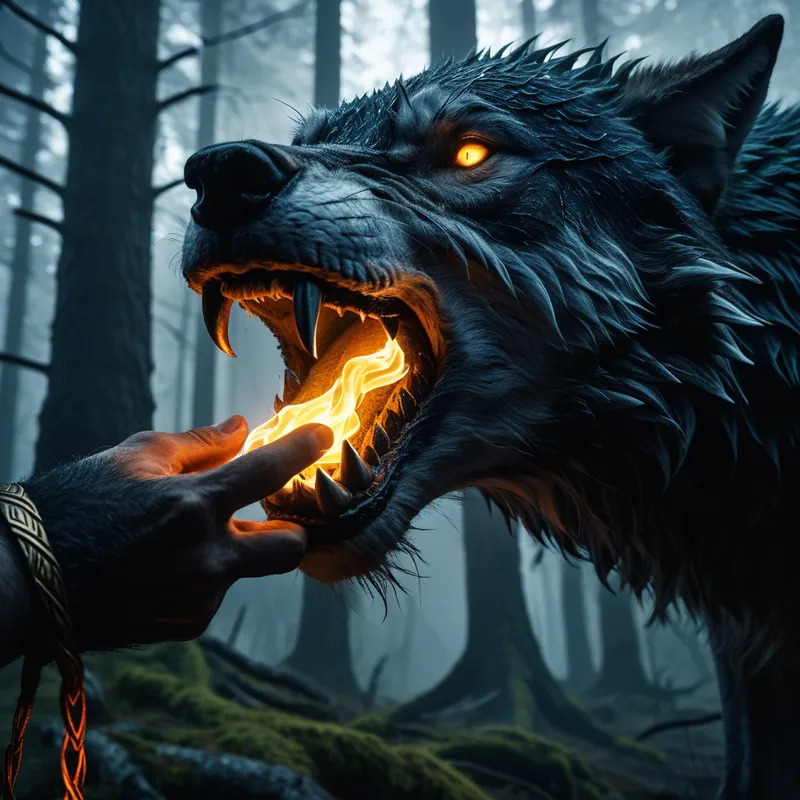
A silence fell upon the gods of Asgard. It was a silence of shame, for each looked within and found their courage wanting. Who would dare? Who would pay such a price? Then, one stepped forward. It was Týr. Not the loudest in the hall, nor the mightiest in battle, but the steadiest. The god of the thing, of oaths and right order. Without a word, he knelt before the monstrous wolf. He looked into the abyss of its maw, smelled the hot breath of primal hunger, and placed his right hand—his sword hand, his pledge hand—between its jaws.
The other gods, their hearts pounding, bound Gleipnir around the wolf. The more Fenrir struggled, the tighter the impossible ribbon became. He was trapped. Realizing the betrayal, the wolf’s eyes blazed with fury and he clamped his jaws shut. There was a sound like the snapping of a great tree branch. Týr did not cry out. He stood, his face pale but composed, as his hand was severed. The wolf howled, a sound that shook the foundations of the world, and was dragged to a desolate island, bound until the twilight of the gods. And Týr was left, his stump a testament. Not to loss, but to a covenant kept. The price of order had been paid, in flesh and faith.
Cultural Origins & Context
The myth of Týr comes to us from the rich, fragmented tapestry of pre-Christian Germanic belief, primarily preserved in 13th-century Icelandic texts like the Poetic Edda and Snorri Sturluson’s Prose Edda. While Týr appears to be an immensely ancient figure—his name is linguistically cognate with Zeus and Jupiter (from Dyēus Pḥatēr, the Proto-Indo-European sky father)—in the Norse pantheon as we know it, his role had evolved.
He was not the all-father; that was Odin’s complex domain. Instead, Týr was the god of the þing (the governing assembly), of formal justice, of oaths, and of heroic glory. His myth was not one of conquest, but of governance. In a society where a man’s word was his bond and community survival depended on agreed-upon law, Týr represented the sacred principle that makes society possible: the willingness to be bound by one’s own promise, even unto personal catastrophe. The myth was likely told not just as entertainment, but as a foundational parable. It answered the question: What holds the chaos of the world at bay? Not merely strength, but the integrity of the one who guarantees the contract, even when the cost is everything.
Symbolic Architecture
At its core, the myth of Týr is a masterclass in the symbolism of conscious sacrifice. Every element is a psychic coordinate.
Fenrir is not just a monster; he is the embodiment of unbounded, amoral potential—the raw, chaotic force of nature, instinct, and destruction that exists outside and within the psychic order. He is the shadow of pure impulse that must be integrated, not through destruction, but through binding. The impossible materials of Gleipnir signify that chaos cannot be bound by ordinary means (brute force, denial). It requires the “impossible” or paradoxical: the intangible (a sound), the contrary (a woman’s beard), the deeply rooted and hidden (mountain roots). This represents the subtle, psychological “containers” we must craft—awareness, acceptance, paradoxical thinking—to manage our own inner chaos.
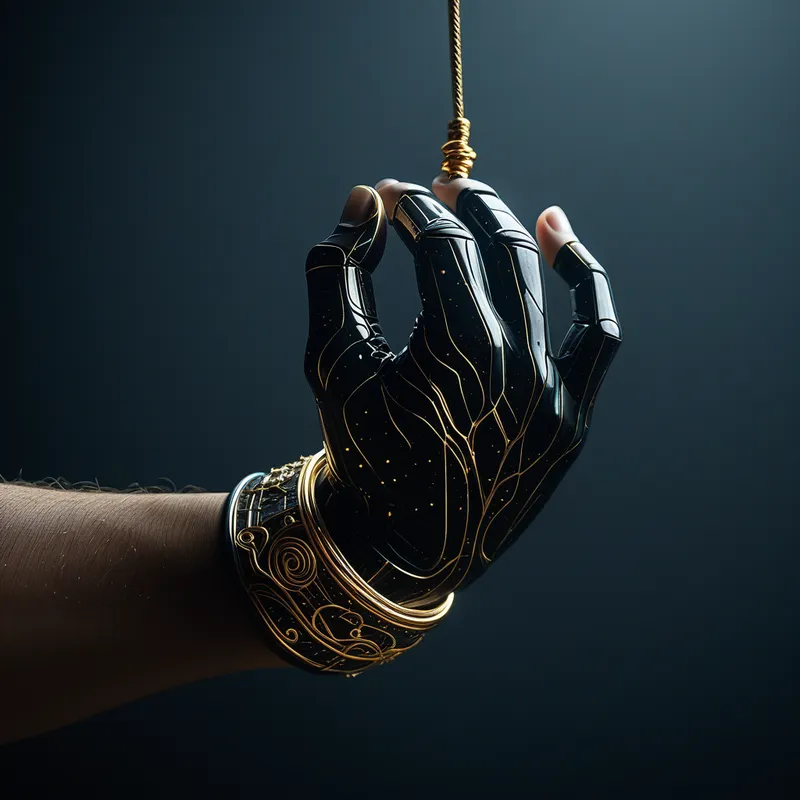
The hand is the instrument of action, of grasping, of making one’s mark upon the world. To place it voluntarily in the jaws of loss is the ultimate act of sovereign will.
Týr’s sacrifice is not a defeat, but a deliberate exchange. His right hand—symbolizing dexterity, power, and agency—is given to secure a greater good: cosmic order. He becomes the guarantor. In psychological terms, he represents the conscious ego’s capacity to submit a part of its own power and identity (a cherished ability, a familiar way of being) to a process larger than itself, for the sake of creating a stable, functional psyche. He is the archetype of integrity, where one’s word and one’s action are the same, regardless of consequence. The one-handed god is thus not a diminished god, but a god defined by his cost. His wound is his authority.
The Dreamer’s Resonance
When this myth stirs in the modern dreamer, it often manifests as a profound somatic and psychological negotiation with obligation and integrity. You may dream of voluntarily placing a part of yourself—a hand, a voice, a prized possession—into a threatening mechanism (a machine, a contract, a loved one’s demanding mouth). There is a palpable sense of dread, but also a deep, resigned certainty that this is necessary.
The somatic experience is key: the feeling of the jaws closing, the tension, the snap. This is the psyche registering the moment of irreversible sacrifice. You are not being attacked; you are participating in a binding agreement. The dream may be accompanied by feelings of profound loss, but also a strange, quiet relief—the relief of the wolf being bound, of a chaotic situation finally being contained. This dream pattern surfaces when we are at a crossroads of promise. It appears when we have given our word—to a partner, a career path, a therapeutic process, a moral stance—and the full, painful cost of keeping that word is becoming apparent. The dream is the psyche’s ritual enactment of paying that price, of moving from the idea of commitment to the血肉 (flesh-and-blood) reality of it.
Alchemical Translation
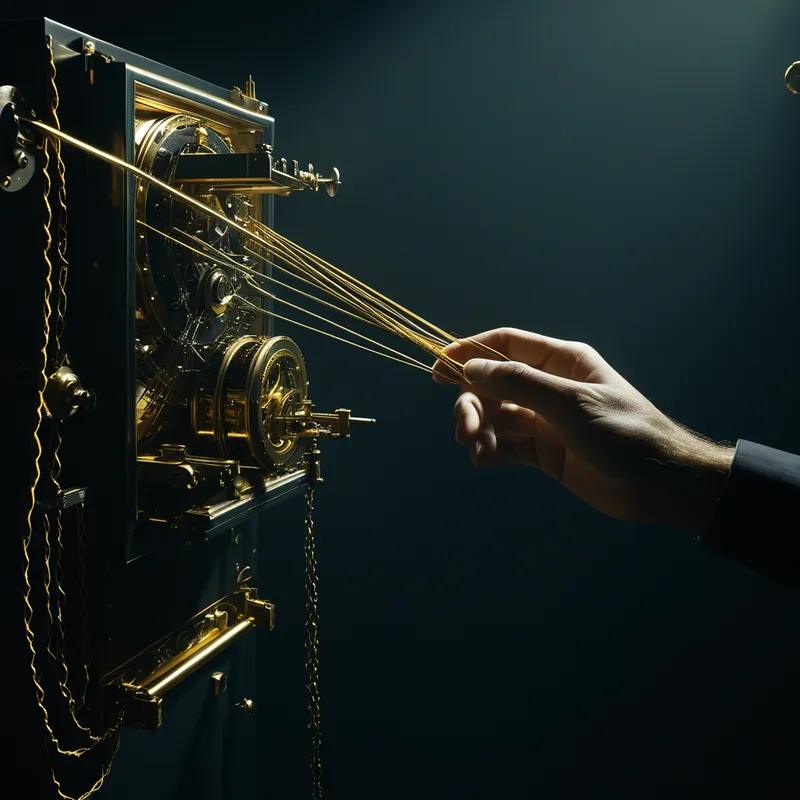
The alchemical process modeled by Týr is the transmutation of the ego through conscious limitation. In the journey of individuation, we are not tasked with becoming all-powerful, but with becoming whole. And wholeness requires acknowledging and binding the Fenrir-like forces within us—our ravenous angers, our insatiable desires, our destructive potential.
The first step is to stop trying to chain them with force (repression) or flee from them (avoidance). We must, like the gods, seek the paradoxical Gleipnir. This is the insight, the therapeutic container, the spiritual practice that holds through subtlety, not strength. But the crucible of the work is the Týr-moment: the conscious sacrifice.
Individuation is not a gathering of powers, but a sacred exchange: a piece of our untrammeled freedom for the integrity of our being.
What must we place in the jaws? Perhaps it is the ego’s demand to always be right, its need for total control, its cherished self-image as unfettered and independent. We sacrifice the “hand” that grasps for these things. In return, we bind the chaotic wolf of our unconscious compulsions. We gain not a maimed life, but a life of authority. The modern individual who has undergone this alchemy is the one-handed leader, the artist who works within form, the partner who finds freedom in fidelity, the person whose yes means yes and no means no. Their wound is not a source of shame, but the seal of their oath to reality itself. They have learned that true power lies not in having all tools at one’s disposal, but in the unwavering will to use the one hand that remains to uphold the world they have promised to help build.
Associated Symbols
Explore related symbols from the CaleaDream lexicon: