Tyche Myth Meaning & Symbolism
The story of Tyche, the elusive goddess of fortune, whose blindfold and overflowing cornucopia embody the unpredictable nature of chance and destiny.
The Tale of Tyche
Listen, and hear the whisper of the turning wheel. In the time when gods walked with mortals in the spaces between breath and stone, there was a daughter born of the deep. Some say she was a child of [Tethys](/myths/tethys “Myth from Greek culture.”/) and the Titan [Oceanus](/myths/oceanus “Myth from Greek culture.”/), sprung from the fathomless, generative dark of the primal sea. Others whisper she was a later conception, a necessary spirit for a world grown complex, a daughter of Zeus himself.
She was named Tyche. From her first breath, she was elusive. Not a goddess of the bright, ordered heavens like Athena, nor of the passionate, predictable fires of [the hearth](/myths/the-hearth “Myth from Norse culture.”/) like [Hestia](/myths/hestia “Myth from Global/Universal culture.”/). Her domain was the shimmering, uncertain space where the plans of gods and men met the chaos of the unformed. She was the sigh of the dice as they tumbled, the sudden gust that filled a limp sail or tore it to shreds, the inexplicable fertility of one field while its neighbor lay barren.
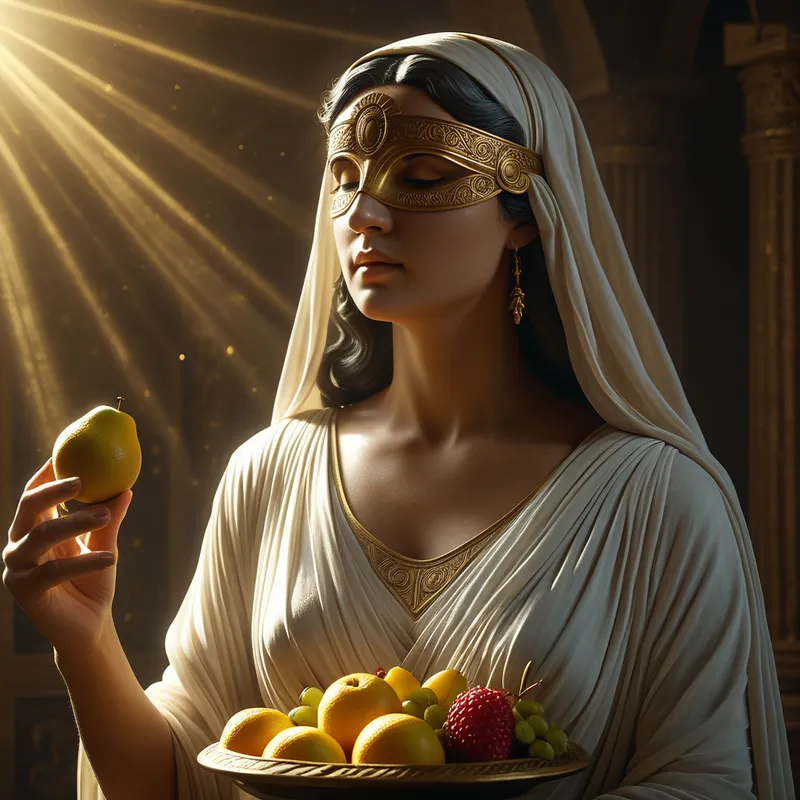
She wore a veil, not of modesty, but of impartiality—a blindfold woven from twilight. In one hand, she carried the cornucopia, its mouth spilling grapes, grain, and gold coins in an endless, generous stream. In her other hand, she held a rudder, for she steered the affairs of cities and souls. But beneath her feet, or sometimes held aloft, was her true emblem: a great, wooden wheel, its rim worn smooth by infinite turning.
The story is not one of a quest or a battle, but of a presence. A merchant, after years of careful calculation, would set sail with holds full of goods, his course charted by the stars. And Tyche would walk the waves beside his ship, unseen. With a capricious touch of her rudder, she could guide him to a harbor where his goods were coveted like life itself, filling his coffers. Or, with the same gentle pressure, she could steer him into the embrace of a storm that had no name on any map, leaving him with nothing but splinters and salt.
A city, proud and mighty, would raise towers to [the sky](/myths/the-sky “Myth from Persian culture.”/), its people secure in their walls. Tyche would stand upon its highest rampart, her wheel beginning to turn. With her cornucopia, she could bless it, making it the envy of [the world](/myths/the-world “Myth from Tarot culture.”/), a beacon of art and power. Then, with the next revolution, she could let the rudder slip. A plague would blow in on [the wind](/myths/the-wind “Myth from Various culture.”/), a rival would find a hidden weakness, and the great city would become a story told to warn others.
No one could bind her. No sacrifice guaranteed her favor, though many tried. She listened to no prayers, yet answered them all in her own way. She was the breath of chance, the embodiment of the truth that for all our plans, we stand upon a wheel that is always, always turning. To acknowledge her was to acknowledge the beautiful, terrifying fragility of every human endeavor.
Cultural Origins & Context
Tyche’s worship grew not from the epic poems of [Homer](/myths/homer “Myth from Greek culture.”/), but from the lived, anxious reality of the Hellenistic period following the conquests of Alexander the Great. In an earlier, more cosmologically ordered world, [the Moirai](/myths/the-moirai “Myth from Greek culture.”/) ([the Fates](/myths/the-fates “Myth from Greek culture.”/)) represented an inescapable, linear destiny. Tyche emerged as a complementary, and often competing, force: the personification of the unpredictable in destiny.
As Greek city-states lost their autonomy and individuals were cast into a larger, more chaotic world of empires and shifting fortunes, Tyche’s prominence soared. She was no longer just a minor daimon but a major goddess, the Tychē of a city, its divine embodiment of fortune. Cities like Antioch and Alexandria had their own specific, revered statues of their Tyche, often depicted as a crowned goddess holding her symbols, believed to hold the fate of [the polis](/myths/the-polis “Myth from Greek culture.”/) in her hands.
Her myths were less formal narratives and more a collection of understandings passed down through cultic practice, art, and philosophical discourse. Playwrights, historians, and everyday people invoked her name to explain sudden reversals of fortune—[the fall](/myths/the-fall “Myth from Biblical culture.”/) of the mighty, the rise of the obscure. She was the answer to the question “Why?” when no rational answer sufficed, a divine figure who made the chaos of experience feel named, and therefore slightly more navigable.
Symbolic Architecture
Tyche is the archetypal embodiment of [life](/symbols/life “Symbol: The symbol of ‘Life’ represents a journey of growth, interconnectedness, and existential meaning, encompassing both the joys and challenges that define human experience.”/)’s fundamental uncertainty. Her symbols form a profound symbolic [architecture](/symbols/architecture “Symbol: Architecture in dreams often signifies structure, stability, and the framing of personal identity or life’s journey.”/) for the [human](/symbols/human “Symbol: The symbol of a human represents individuality, complexity of emotions, and social relationships.”/) confrontation with [chance](/symbols/chance “Symbol: A representation of opportunities and unpredictability in life, illustrating how fate can influence one’s journey.”/).
The [blindfold](/symbols/blindfold “Symbol: A blindfold represents willful ignorance, surrender of control, or a test of trust. It can symbolize both vulnerability and inner vision.”/) is her most telling feature. It does not signify ignorance, but radical impartiality. She does not see your [status](/symbols/status “Symbol: Represents one’s social position, rank, or standing within a group, often tied to achievement, power, or recognition.”/), your [virtue](/symbols/virtue “Symbol: A moral excellence or quality considered good, often representing inner character, ethical principles, or spiritual ideals in dreams.”/), your prayers, or your sins. She distributes her gifts and her trials without [reference](/myths/reference “Myth from Global/Universal culture.”/) to human notions of [justice](/myths/justice “Myth from Tarot culture.”/) or desert.
The blindfold of Tyche is the great equalizer, reminding us that the universe is not structured like a human courtroom, but like a vast and complex game of chance.
The cornucopia and the rudder exist in eternal [tension](/symbols/tension “Symbol: A state of mental or emotional strain, often manifesting physically as tightness, pressure, or unease, signaling unresolved conflict or anticipation.”/). [The cornucopia](/myths/the-cornucopia “Myth from Global/Universal culture.”/) represents unbounded, overflowing [abundance](/symbols/abundance “Symbol: A state of plentifulness or overflowing resources, often representing fulfillment, prosperity, or spiritual richness beyond material needs.”/)—luck, prosperity, and fertile [opportunity](/symbols/opportunity “Symbol: The symbol ‘opportunity’ signifies potential for advancement, growth, and new beginnings in various life aspects.”/). The rudder represents [guidance](/symbols/guidance “Symbol: The act of receiving or seeking direction, advice, or leadership in a dream, often representing a need for clarity, support, or a higher purpose on one’s life path.”/), [direction](/symbols/direction “Symbol: Direction in dreams often relates to life choices, guidance, and the path one is following, emphasizing the importance of navigation in personal journeys.”/), and agency. Yet in Tyche’s hands, the [guidance](/symbols/guidance “Symbol: The act of receiving or seeking direction, advice, or leadership in a dream, often representing a need for clarity, support, or a higher purpose on one’s life path.”/) is capricious. She can steer [the cornucopia](/myths/the-cornucopia “Myth from Global/Universal culture.”/)’s bounty toward you or away from you, illustrating that opportunity itself is often a matter of chance alignment.
But the central [symbol](/symbols/symbol “Symbol: A symbol can represent an idea, concept, or belief, serving as a powerful tool for communication and understanding.”/) is the wheel. This is the Rota Fortunae that would pass into medieval thought. It symbolizes the cyclical, non-[linear](/symbols/linear “Symbol: Represents order, predictability, and a direct, step-by-step progression. It symbolizes a clear path from cause to effect.”/) [nature](/symbols/nature “Symbol: Nature symbolizes growth, connectivity, and the primal forces of existence.”/) of [fate](/symbols/fate “Symbol: Fate represents the belief in predetermined outcomes, suggesting that some aspects of life are beyond human control.”/). To be at the top of the wheel is to experience the cornucopia’s flow; to be at the bottom is to feel the crush of its rim. The wheel assures us that no state is permanent. This is not a comforting promise of eventual reward, but a sobering [truth](/symbols/truth “Symbol: Truth represents authenticity, honesty, and the quest for knowledge beyond mere appearances.”/) of inevitable change.
Psychologically, Tyche represents the autonomous complex of chance within the [psyche](/myths/psyche “Myth from Greek culture.”/). She is the part of our inner world that recognizes our conscious ego, with its plans and ambitions, is not the sole ruler of our life. She is the [eruption](/symbols/eruption “Symbol: A sudden, violent release of pent-up energy or emotion from beneath the surface, often representing transformation or crisis.”/) of the unexpected, the [synchronicity](/symbols/synchronicity “Symbol: Meaningful coincidences that suggest an underlying connection between events, often interpreted as guidance or confirmation from the universe.”/), the “[accident](/symbols/accident “Symbol: An accident represents unforeseen events or mistakes that can lead to emotional turbulence or awakening.”/)” that changes everything, the [lottery](/symbols/lottery “Symbol: Winning or participating in a lottery in a dream often reflects the desire for luck, chances, or sudden changes in life circumstances.”/) win, and the sudden [loss](/symbols/loss “Symbol: Loss often symbolizes change, grief, and transformation in dreams, representing the emotional or psychological detachment from something or someone significant.”/).
The Dreamer’s Resonance
When the archetype of Tyche stirs in the modern dreamer, it often manifests in dreams of profound uncertainty and shifting foundations. One does not simply dream of a goddess; one dreams her effects.
You may dream of standing before a vast, impersonal mechanism—a lottery drum, a stock ticker, a bureaucratic wheel that assigns fates. You are waiting for an outcome over which you have no control. The somatic feeling is one of suspended animation, a tightness in the chest, a mix of hope and dread. This signals a psychological state where the dreamer is confronting a life situation—a job application, a medical diagnosis, the instability of a relationship—that feels utterly subject to forces beyond their will.
Alternatively, you might dream of sudden, inexplicable windfalls or catastrophes: finding a room in your house filled with gold, or watching your home crumble into [the sea](/myths/the-sea “Myth from Greek culture.”/) for no reason. These are not dreams of earned reward or punishment, but of arbitrary fortune. They point to the psyche processing a deep-seated anxiety about the fragility of one’s constructed world, or an unconscious recognition of how much of one’s current position is built on a foundation of chance, not just effort.
Such dreams call the dreamer to a crucial internal shift: to acknowledge the role of the unpredictable, to release [the ego](/myths/the-ego “Myth from Jungian culture.”/)’s rigid insistence on total control, and to begin a relationship with the unknown.
Alchemical Translation
The alchemical work modeled by the Tyche myth is the transmutation of anxiety in the face of chance into creative relationship with fate. It is the movement from being a victim on the wheel to becoming a conscious participant in the turn.
[The first stage](/myths/the-first-stage “Myth from Alchemical culture.”/) is [Nigredo](/myths/nigredo “Myth from Alchemical culture.”/), the blackening. This is the experience of the wheel’s downward turn—the unexpected loss, the failed plan, the “bad luck.” The ego’s carefully constructed world darkens. The alchemical task here is not to deny the blow or to fruitlessly seek a “reason,” but to fully endure the dissolution, to feel the truth that not all things are subject to our will. This is the humbling that makes transformation possible.
To honor Tyche is to perform the alchemy of releasing control, thereby finding a deeper, more resilient authority within the self that can partner with uncertainty.
The second stage is Albedo, the whitening. This is the recognition symbolized by Tyche’s blindfold: the purification of our projections. We cleanse our expectation that life should be fair, that hard work must guarantee reward, that virtue will be shielded from tragedy. We see the impartial mechanism. This is not cynicism, but clarity. It is [the moon](/myths/the-moon “Myth from Tarot culture.”/)-cool realization that our narrative of cause and effect is a small story told within a vast, impersonal process.
The final stage is [Rubedo](/myths/rubedo “Myth from Alchemical culture.”/), the reddening, the creation of the philosopher’s stone. This is where we take up Tyche’s symbols for ourselves. Having accepted the turning wheel, we no longer cling to its rim in fear. We internalize the cornucopia as an attitude of openness to grace and unexpected bounty, practicing gratitude for the gifts that do come. We take hold of the rudder not to command the sea, but to skillfully adjust our sail to the winds of fortune as they blow. We engage our agency within the field of chance.
The individuated self that emerges from this alchemy is neither the master of fate nor its slave. It is the resilient sailor who respects the sea, knows the limits of his chart, but still chooses a course, able to find meaning not in controlling the journey, but in the quality of his presence upon the ever-turning wheel.
Associated Symbols
Explore related symbols from the CaleaDream lexicon: