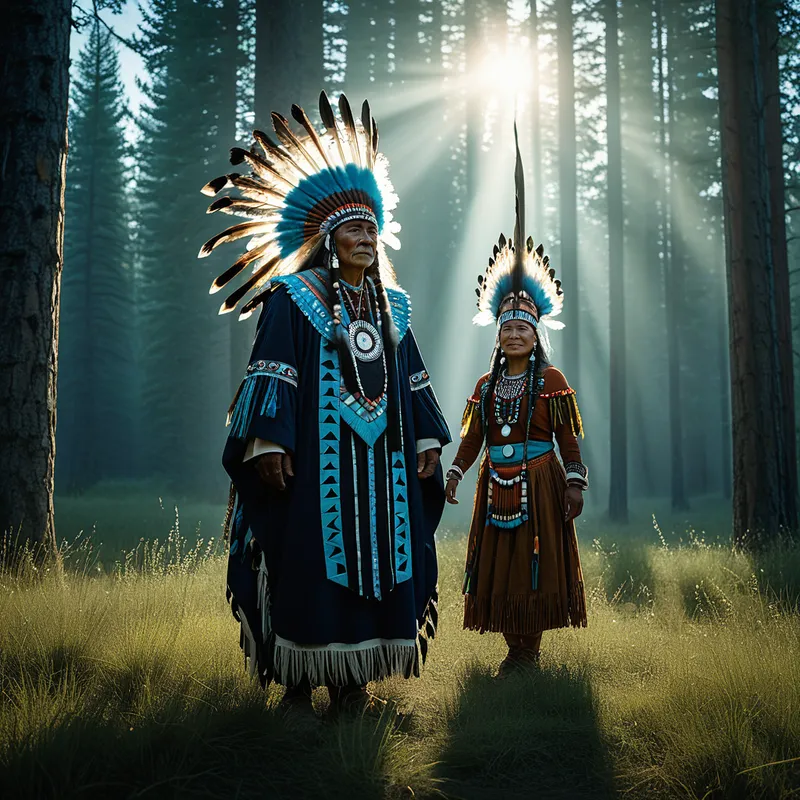
Two-Spirit People Myth Meaning & Symbolism
A sacred tradition of individuals embodying both masculine and feminine spirits, serving as bridges, healers, and visionaries in their communities.
The Tale of Two-Spirit People
Listen. Before the world hardened into its current shape, when the breath of the Creator still stirred the leaves with direct intention, the people lived in separate camps. The men hunted in the vast, sun-scorched grasslands, their songs deep as thunder. The women gathered in the shaded forests and along the singing rivers, their laughter light as rain. Each camp knew its duties, its prayers, its way of walking upon Turtle Island.
But the Great Mystery looked upon this separation and saw a potential for loneliness. A canyon of understanding lay between the two ways of being. Visions could not cross it fully; healing could be incomplete. So, the Creator called upon the trickster and teacher, Coyote, and spoke a thought into the wind.
Coyote, ever the weaver of new patterns, traveled to the place where the river meets the stone—a boundary. There, he took clay from the riverbank, moist and dark, and dust from the sun-baked plain, fine and golden. He did not mix them into a mud, but began to braid them, strand by strand, into a single human form. As he worked, he sang two songs at once: the hunting song of the buffalo and the planting song of the three sisters.
He breathed into the figure’s mouth, and not one, but two breaths entered—one from the east, carrying the gentle, nurturing spirit of the dawn, and one from the west, carrying the strong, providing spirit of the setting sun. The figure opened its eyes. One eye held the deep, patient knowing of the earth; the other held the sharp, far-seeing gaze of the eagle.
This first Two-Spirit person stood up, and where they walked, flowers bloomed on one side of their path and medicinal herbs on the other. They could speak with the men of strategy and with the women of dreams. They could craft a bow with a father’s precision and decorate it with a mother’s intricate, symbolic beadwork. The people were at first silent, then curious. They brought this person to the council fire.
“Who are you?” asked the chief. “I am the bridge,” the person replied, their voice both melody and rhythm. “I walk in both camps. I hold the space in between.”
And so it was. This person became a sacred go-between, a translator of visions, a healer who understood illness from both its physical root and its spiritual blossom. They were given honored roles: keepers of the lodge during war, namers of children, advisors in council. They were not man or woman, but a unique, third gender, a living testament to the Creator’s desire for wholeness. From that first braided being, the spirit would choose to dwell in certain children in each generation, a sacred gift to remind the people that true strength lies in balanced completeness.
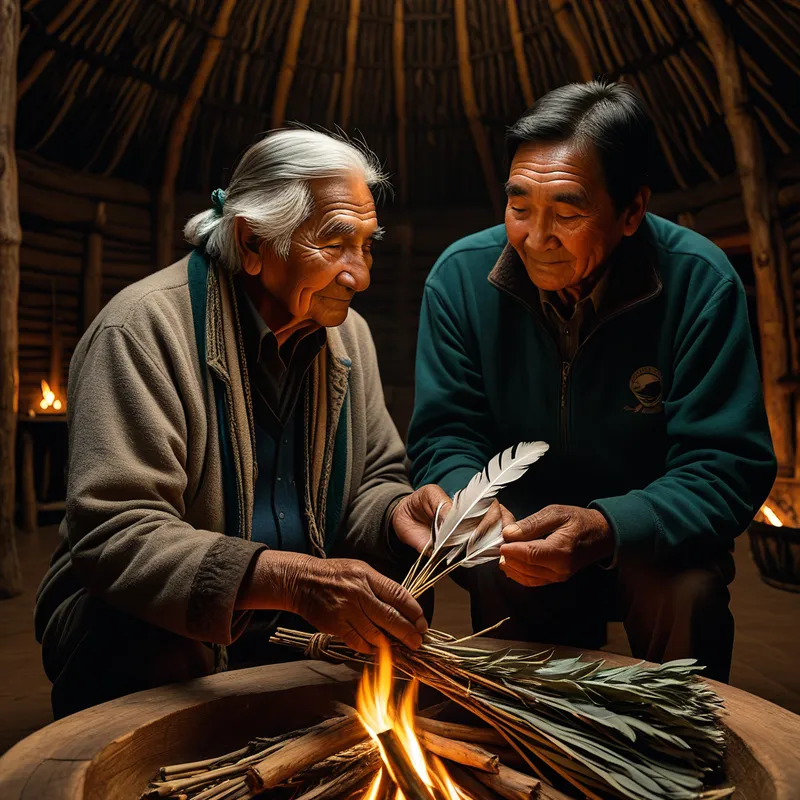
Cultural Origins & Context
The term “Two-Spirit” is a contemporary, English-language umbrella term adopted in 1990 to respectfully describe a reality found in hundreds of distinct Indigenous nations across North America. Each nation has its own specific, ancient term in its language—like the Lakota wíŋkte, the Navajo nádleehé, or the Cheyenne heemaneh—and its own understanding of the role.
These understandings were not uniform but shared a common thread: Two-Spirit people were traditionally seen as a distinct, third or fourth gender, blessed by the spirit world. Their identity was not primarily about sexual orientation, but about spiritual vocation and social role. They were often the historians, the ceremonialists, the mediators, and the artists. Their ability to encompass dualities made them natural bridges—between genders, between the physical and spiritual worlds, and even between tribes in diplomacy. This knowledge was passed down not as a single, frozen myth, but as a living, integrated part of oral tradition, societal structure, and spiritual practice, recognized through a child’s dreams, inclinations, and visions.
Symbolic Architecture
At its core, the Two-Spirit archetype is a profound symbol of sacred integration. It represents the transcendence of binary opposition in favor of a more complex, complete wholeness.
The bridge does not belong to one bank or the other; its power and purpose exist in the connection it makes possible.
Psychologically, it embodies the resolution of the tension between what Carl Jung termed the Anima and Animus—the inner contrasexual elements within each individual. The myth does not advocate for the eradication of masculine or feminine, but for their conscious, respectful, and harmonious co-existence within a single vessel. The Two-Spirit person is a living mandala, a model of the Self that has reconciled its inner divisions. They symbolize the coniunctio oppositorum—the alchemical marriage of opposites—resulting not in bland neutrality, but in a potent, creative third thing: the integrated psyche capable of greater vision, empathy, and healing.
The Dreamer’s Resonance
When this mythic pattern stirs in the modern dreamscape, it often signals a profound somatic and psychological process of self-recognition and reconciliation. One might dream of finding a room in their house they never knew existed, furnished with objects that belong to a forgotten part of themselves. Or they may dream of wearing clothing that feels simultaneously familiar and foreign, and being met not with scorn, but with deep recognition by dream figures.
These dreams point to the emergence of qualities, energies, or ways of knowing that the conscious personality has disowned, repressed, or deemed incompatible with its chosen identity. The somatic feeling is often one of expansion, a loosening of an old, constrictive armor, accompanied by anxiety and relief. The psyche is dreaming itself toward greater wholeness, attempting to heal the artificial rift between “this” and “that” within. It is the soul’s innate impulse to reclaim its full territory.
Alchemical Translation
For the modern individual navigating a world still obsessed with binaries, the Two-Spirit myth provides a powerful model for psychic transmutation, or individuation. The process begins with the recognition of the inner “other”—the softness in the stoic, the assertiveness in the gentle. This is the gathering of the “clay” and the “dust.”
The conflict arises from the internalized voices of the collective, which demand we choose a side. The alchemical work is the braiding, not the mixing. It is to consciously hold the tension of the opposites without collapsing into one or violently rejecting the other. This is the nigredo, the dark night of the soul where old identities dissolve.
The goal is not to become genderless, but to become spirit-full—to allow the full spectrum of one’s human experience to inform a wiser, more compassionate consciousness.
The resolution is the emergence of a new, guiding function from within—the inner bridge-builder. This is the sage-like capacity to mediate between our own inner conflicts, to translate fear into curiosity, and to see the world through a dual lens. The individual becomes a vessel of greater creative potential and deeper relational understanding. They become, in a psychological sense, a healer of their own fragmented world, embodying the sacred truth that wholeness was never about addition, but about integration. The ultimate triumph is living from the center where all spirits meet.
Associated Symbols
Explore related symbols from the CaleaDream lexicon: