Two of Pentacles Myth Meaning & Symbolism
A myth of the eternal juggler, dancing between two worlds, mastering the rhythm of chaos and order in the great marketplace of the soul.
The Tale of Two of Pentacles
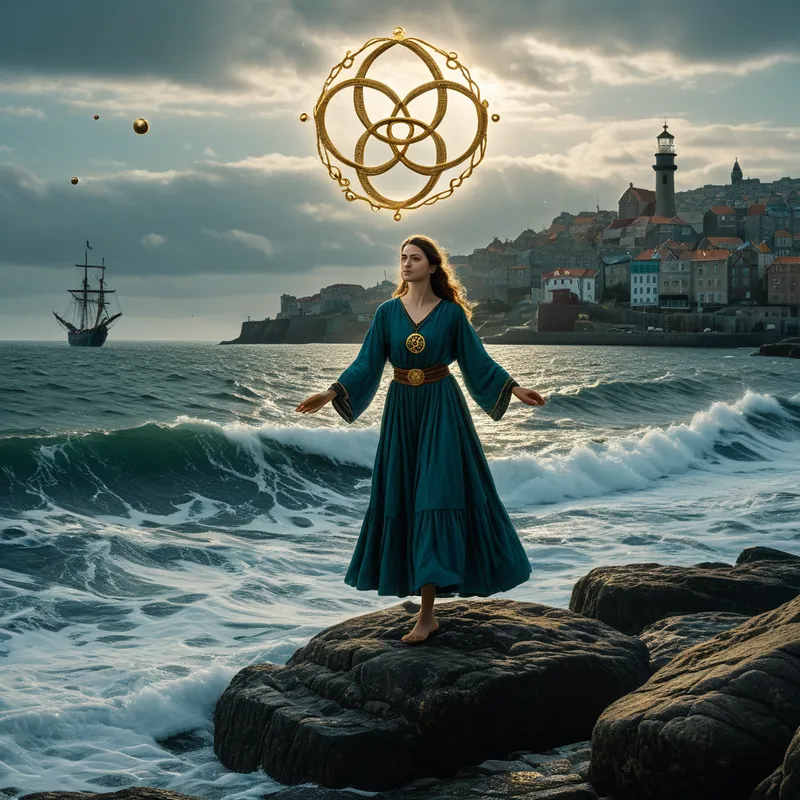
Hear now the rhythm beneath the world’s noise. In the harbor city where the cobblestones are worn smooth by ten thousand footsteps, where the salt air carries the cries of gulls and the promises of merchants, there walks a figure who is the city’s secret heartbeat. They are known only as the Dancer of the Threshold.
Watch them. They do not stride with purpose to the docks nor hurry with ledgers to the counting house. They move with a fluid, almost careless grace to the very edge of the stone quay, where the firm land gives way to the restless sea. The wind here is a capricious spirit, one moment a gentle sigh, the next a roaring giant trying to pluck the very cloak from their shoulders. The sea itself is a study in contradiction—to the left, the water churns in violent, white-capped fury against the breakwater; to the right, within the sheltered bay, it lies as calm and placid as a silver mirror, reflecting the safe lights of home.
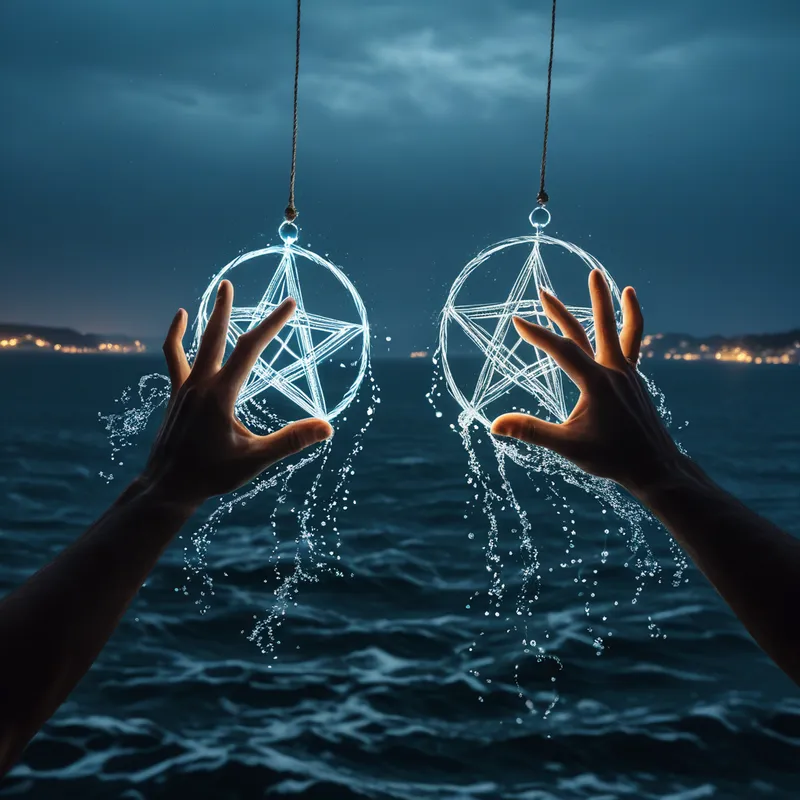
And then, the Dancer begins. From within their cloak, they draw forth two Pentacles, discs of burnished gold inscribed with the sigil of the five-pointed star. They are not heavy, yet their weight is the weight of worlds. One Pentacle holds the chaos of the stormy deep—the risk, the voyage, the unknown treasure. The other holds the order of the sheltered port—security, routine, the known ledger.
With a breath that syncs with the crash of a wave, they toss the first disc skyward. As it spins, catching the wild light, they send the second after it. And so begins the dance. The Pentacles orbit each other in a lopsided ellipse, a gravitational ballet dictated by the Dancer’s wrists, their hips, their entire being. They lean into the gale as a disc flies high, and sway back toward the calm as it descends. Their feet are never still, performing a subtle, ceaseless step upon the wet stones, never losing balance, never ceasing the flow.
A merchant pauses, his anxious face softening as he watches the perfect, looping rhythm. A sailor, tense from navigating the harbor mouth, feels his shoulders drop, his breath deepen in time with the toss and catch. The Dancer does not conquer the wind or the sea. They do not choose one Pentacle over the other. They become the living conduit between the two forces, the fulcrum point where chaos and order, risk and stability, future and present, are held in a perpetual, creative tension. The myth is not in a final victory, but in the endless, elegant, impossible juggle itself—the moment where all dualities are suspended in motion, and for a breath, the world is in perfect, dynamic balance.
Cultural Origins & Context
The imagery of the Two of Pentacles finds its roots not in a single ancient epic, but in the collective soil of Renaissance Europe, where the Tarot emerged as a fusion of art, philosophy, and popular symbolism. This card, typically numbered within the suit of Coins or Pentacles, spoke directly to the lived experience of a burgeoning mercantile class. It was the world of the Venetian trader, the Florentine banker, the shipmaster of Genoa—individuals whose entire existence was a calculated dance between investment and return, venture and security.
The card was a visual proverb, passed hand to hand not by bards in halls, but by card players in taverns and market squares. Its “myth” was immediate and practical. The juggler on the card was every person trying to manage household and business, love and duty, the pressing debt and the promised income. In a culture increasingly aware of Fortune’s wheel, the image served as both a warning and a guide: life is turbulent, forces are in motion, and your survival and success depend not on rigid resistance, but on agile adaptation. It encoded a very real, street-level wisdom about navigating the uncertainties of a material world in flux.
Symbolic Architecture
Psychologically, the Two of Pentacles maps the ego’s essential task of managing the tension of opposites. The two discs represent any binary that demands our attention: work and life, self and other, saving and spending, commitment and freedom, the inner world of feeling and the outer world of action.
The mastery lies not in choosing one pole and annihilating the other, but in developing the psychological dexterity to keep both in play.
The churning and calm seas symbolize the uncontrollable external circumstances and the internal emotional states between which we must constantly navigate. The figure’s dance is the symbol of consciousness itself—the observing ego that must allocate attention and energy, shifting weight and focus to maintain equilibrium. The infinity sign often woven into the juggler’s movement is the key: this is not a problem to be solved, but a process to be inhabited. It represents the dynamic, ongoing nature of psychological balance, which is never a static achievement but a continuous, living adjustment.
The Dreamer's Resonance
When this myth stirs in the modern dreamscape, it rarely appears as a literal juggler. Instead, the dreamer finds themselves in its essence. They dream of trying to answer two phones ringing simultaneously, of driving a car where the steering wheel controls one wheel and the brakes control another. They stand at a crossroads where both paths are equally compelling and terrifying, feeling their very self split down the middle. The somatic experience is one of low-grade, pervasive anxiety, a feeling of being “stretched thin” or perpetually behind. There’s a frantic energy, a sense of racing to keep plates spinning.
This dream pattern signals that the psyche is actively, and often laboriously, engaged in a core process of adaptation. The conscious mind is struggling to coordinate competing demands that feel existential. The dream is the unconscious dramatizing the strain of the juggle, but also hinting at the potential for rhythm. It asks the dreamer: Where are you rigid? Where are you refusing to move your feet? What two “worlds” are you trying to hold apart that are asking to be brought into a single, flowing motion?
Alchemical Translation
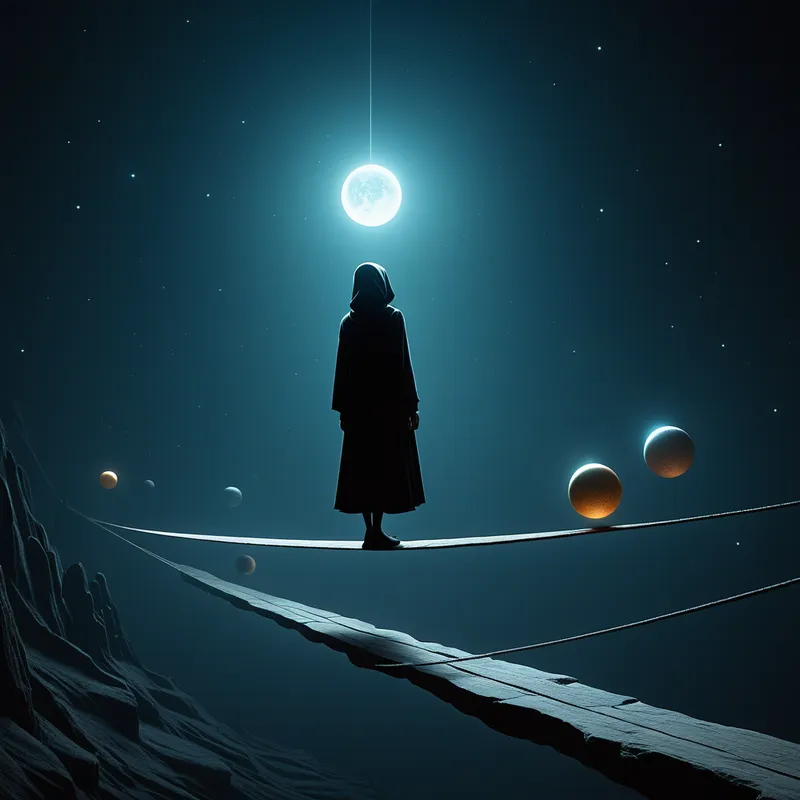
In the alchemical journey of individuation, the Two of Pentacles represents the crucial stage of Solution, following the initial separation of components (the awareness of the opposites). Here, the rigid, conflicted elements of the psyche are not yet united, but they are brought into a shared, dynamic field of motion.
The ego’s task is to become the juggler, not the conqueror. This requires a sacrifice of the desire for final, static solutions and the perfectionist’s demand to “get it right and be done.” One must learn the somatic arts of the soul: flexibility, timing, rhythm, and the trust in momentum.
The alchemical gold is not found in one pentacle or the other, but in the kinetic energy generated between them—the creative spark that only exists in the state of managed tension.
To translate this myth is to embrace life as a dynamic system. It is to understand that balancing the books of the soul is a daily practice, not a quarterly audit. The triumph modeled is the development of a resilient, responsive consciousness that can ride the waves of change without losing its core rhythm, finding a peculiar and profound joy in the very act of navigation itself. The individual becomes, like the harbor, a place where storm and sanctuary can coexist, where the ship of the self can be provisioned for both journey and homecoming.
Associated Symbols
Explore related symbols from the CaleaDream lexicon: