Two of Cups Myth Meaning & Symbolism
A myth of two souls drawn across a void, their meeting a sacred covenant that forges a vessel for the divine.
The Tale of Two of Cups
Listen, and let [the veil between worlds](/myths/the-veil-between-worlds “Myth from Celtic culture.”/) grow thin. In a time when the boundary between earth and symbol was but a whisper, there existed a garden not of geography, but of essence. It was a place of twilight potential, where the first waters of emotion had not yet found their banks. Here wandered two figures, not yet whole. One carried the Solar spark, a restless seeking. The other held the Lunar tide, a deep, patient knowing. Each was a cup—a chalice of longing—but a cup that could only ever be half-full, echoing with the memory of a thirst it could not name.
They moved through the silent groves, circles within circles, feeling the pull of an absence more profound than any presence. The air was thick with the perfume of unnamed flowers, and the only sound was the solitary drip of [water](/myths/water “Myth from Chinese culture.”/) from an unseen source into their own solitary vessels. This was [the world](/myths/the-world “Myth from Tarot culture.”/) before [the word](/myths/the-word “Myth from Biblical culture.”/) “and.”
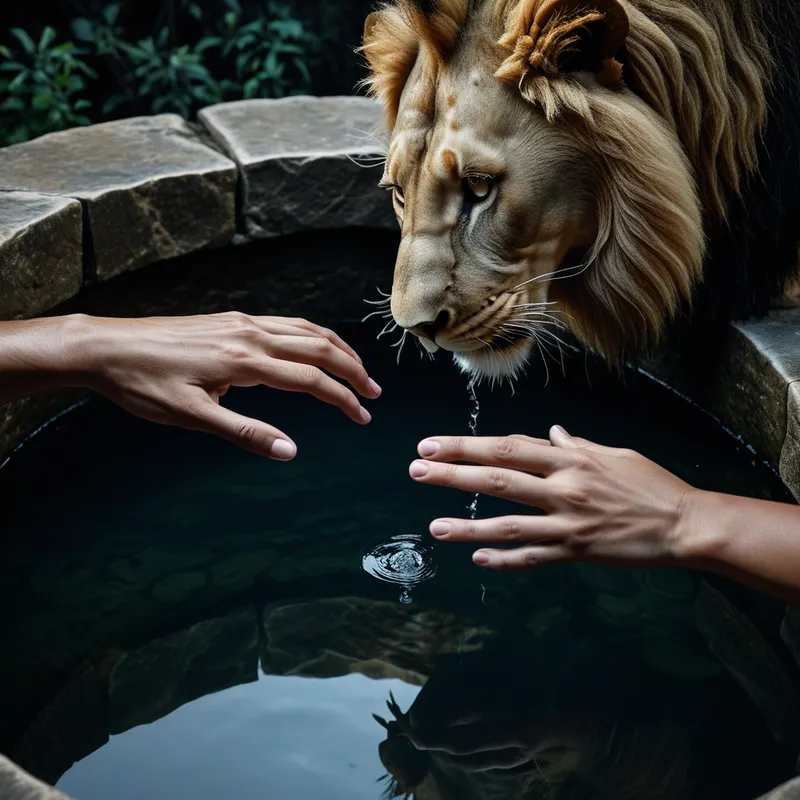
Then, a shift. Not a sound, but a resonance. As if the very frequency of the garden had changed. One figure paused by an ancient well, carved with the visage of a lion, its mouth the source of the living water. As they gazed into the dark, reflective pool, they did not see only their own face. Another reflection coalesced beside it. They turned.
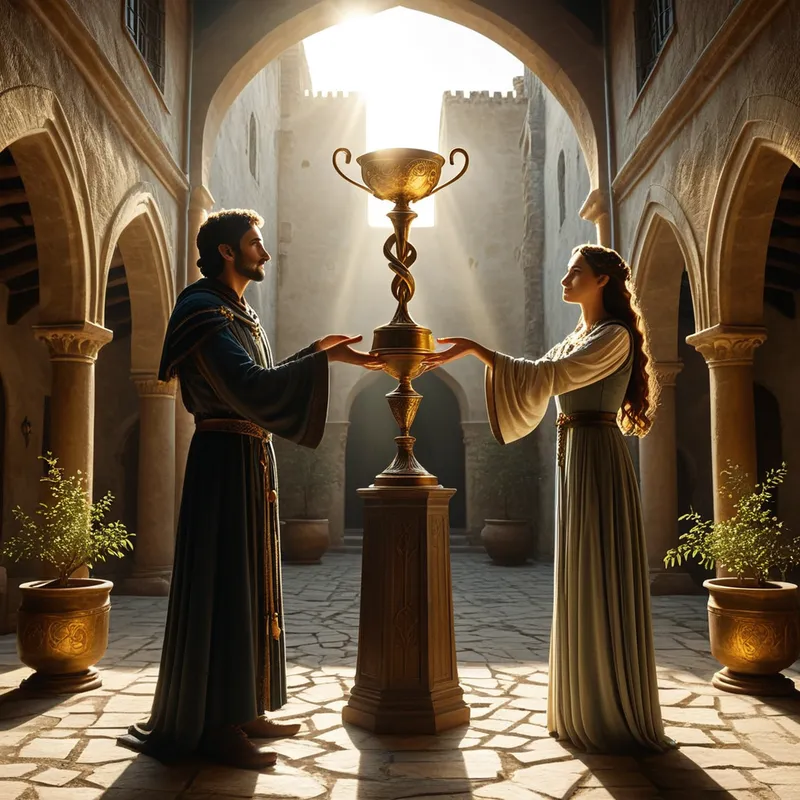
Across the courtyard, beneath an arch woven with ivy and rose, the other stood. The space between them was not empty distance; it was a charged field, a tension waiting to resolve. No words passed. Words were for later. This was a language older than tongue—a recognition in the bones, a remembering in the blood. Slowly, as if moving through a shared dream, they stepped forward.
Their eyes met, and in that meeting, the two halves of a silent prayer found each other. Each extended a hand, not in greeting, but in offering. And as their hands reached across the sacred space, something miraculous was born not between them, but from them. From the heart of the tension, a form emerged: a staff of intertwined serpents, crowned with wings and a radiant sun—the Caduceus. It rose, a living axis, between their two hearts. And in their other hands, their cups, once solitary, now overflowed. The water from one fed the other in an endless, reciprocal stream. The garden, once a place of twilight, was now illuminated by the dawn of a single, shared light. The covenant was sealed not with a promise, but with a fact of being: I am, because we are.
Cultural Origins & Context
The narrative of the Two of Cups is not a myth preserved on ancient scrolls, but one encoded in the iconography of the Tarot, specifically within the suit of Cups, which governs the realm of emotion, relationship, and the unconscious. Emerging from the [ferment](/myths/ferment “Myth from Alchemical culture.”/) of Renaissance Europe, the Tarot’s Minor Arcana, including this card, synthesized a vast stream of esoteric thought: Alchemy, Kabbalah, astrology, and classical mythology.
The card’s imagery—the two figures, [the caduceus](/myths/the-caduceus “Myth from Greek culture.”/), the lion-headed fountain—acts as a pictorial folktale. It was a story told not by bards to a village, but by artists and cartomancers to the individual seeker. Its societal function was introspective and diagnostic. In a culture where marriages were often transactions, the Two of Cups presented an idealized, soul-centric model of union. It served as a mirror, asking the viewer: Where in your life do you experience this level of authentic recognition? Where is your emotional water being exchanged freely? It was a symbolic anchor for the deepest human yearning for a connection that transcends utility, a map for the geography of the heart.
Symbolic Architecture
The myth’s power lies in its stark, elegant [symbolism](/symbols/symbolism “Symbol: The use of symbols to represent ideas or qualities, often conveying deeper meanings beyond literal interpretation. In dreams, it’s the language of the unconscious.”/). The two figures are not merely a man and a woman, but representations of the fundamental polarities of [consciousness](/symbols/consciousness “Symbol: Consciousness represents the state of awareness and perception, encompassing thoughts, feelings, and experiences.”/): active and receptive, conscious and unconscious, self and other. Their meeting is the [birth](/symbols/birth “Symbol: Birth symbolizes new beginnings, transformation, and the potential for growth and development.”/) of [relationship](/symbols/relationship “Symbol: A representation of connections we have with others in our lives, often reflecting our emotional state.”/) as a third [thing](/myths/thing “Myth from Norse culture.”/), a new entity that is the relationship itself, symbolized by the [caduceus](/symbols/caduceus “Symbol: A winged staff entwined by two serpents, symbolizing healing, commerce, and divine messenger status.”/).
The Caduceus is the spine of the myth. Where two solitudes meet in truth, a divine current is generated, forging a living conduit between heaven and earth, between one soul and another.
The cups themselves are the individual psyches, the vessels of feeling and experience. In [isolation](/symbols/isolation “Symbol: A state of physical or emotional separation from others, often representing a need for introspection or signaling distress.”/), they are containers. In communion, they become channels. The [lion](/symbols/lion “Symbol: The lion symbolizes strength, courage, and authority, often representing one’s inner power or identity.”/)’s head, often seen on the [fountain](/symbols/fountain “Symbol: A symbol of purification, renewal, and abundance, fountains evoke themes of life-giving water and wisdom flowing freely.”/) in the card’s [background](/symbols/background “Symbol: The background in a dream can reflect context, environment, and underlying influences in the dreamer’s life.”/), is the [symbol](/symbols/symbol “Symbol: A symbol can represent an idea, concept, or belief, serving as a powerful tool for communication and understanding.”/) of raw [passion](/symbols/passion “Symbol: Intense emotional or physical desire, often linked to love, creativity, or purpose. Represents life force and deep engagement.”/), instinct, and vitality (Leo). It signifies that this sacred union is not a sterile, intellectual pact, but one fed by the deep, [life-giving waters](/symbols/life-giving-waters “Symbol: Life-giving waters symbolize sustenance, nurturing, and the cyclical nature of life and death, serving as a vital resource for survival.”/) of the primal self. The act of exchange is the core psychological [mechanism](/symbols/mechanism “Symbol: Represents the body’s internal systems, emotional regulation, or psychological processes working together like a machine.”/): to be truly filled, one must first offer one’s contents.
The Dreamer’s Resonance
When this myth stirs in the modern dreamscape, it rarely appears as a literal scene from a Tarot card. Instead, it manifests as the sensation and architecture of profound connection. A dreamer might find themselves in a vast, empty hall, hearing a specific piece of music that they know, instinctively, is also being heard by another dreamer somewhere else. They might dream of discovering a door in their home that opens directly into another person’s living space, not as an intrusion, but as a natural fact.
Somatically, these dreams are often accompanied by feelings of warmth, expansion in the chest, or a profound sense of calm resolution. Psychologically, they signal a process of recognition and integration. The “other” in the dream—whether a stranger, a known person, or an archetypal figure—represents a disowned or unintegrated part of the dreamer’s own [psyche](/myths/psyche “Myth from Greek culture.”/) coming forward to be acknowledged. The dream is the psyche’s ritual of the Two of Cups, performing the sacred exchange internally. It marks a moment where an inner split is healed, where the longing self finally meets the fulfilling self, and a new, more complete internal partnership is forged.

Alchemical Translation
In the alchemical work of individuation—the process of becoming one’s true, whole self—the Two of Cups models the Coniunctio, or [sacred marriage](/myths/sacred-marriage “Myth from Alchemy culture.”/). This is not merely about romantic love, but the fundamental psychic operation of reconciling opposites within the individual.
The journey begins with the [separatio](/myths/separatio “Myth from Alchemical culture.”/): the feeling of being a solitary cup, a vessel of unmet potential. The seeker feels their own incompleteness. The myth then guides the next step: not a desperate search outward, but a cultivation of inner readiness. One must fill their own cup with self-knowledge, with feeling, with the “water” of authentic experience.
The alchemy of connection demands that you first become a substance worth combining. A cup must contain something before it can be offered in exchange.
The moment of “meeting” is the Symbolic Recognition. This is when a projected inner quality (e.g., one’s own unexpressed creativity, strength, or tenderness) is seen and accepted in another person, or in a work of art, a vocation, or a spiritual practice. The caduceus rises in that moment—it is the axis of a new understanding, the birth of a transcendent function that can hold the tension of opposites. The ongoing exchange of water is the process of relationship, dialogue, and integration that transmutes leaden loneliness into golden communion. For the modern individual, the [triumph](/myths/triumph “Myth from Roman culture.”/) of this myth is the realization that wholeness is not a solitary achievement, but a dynamic, relational state. We are forged in the sacred space between “I” and “Thou.”
Associated Symbols
Explore related symbols from the CaleaDream lexicon: