Tupã Thunder God Myth Meaning & Symbolism
A myth of the primordial voice that carved the world from chaos, bringing order, life, and the sacred breath of spirit to the heart of the forest.
The Tale of Tupã Thunder God
In the time before time, there was only Nhanderuvuçu, the Great Father, existing in the vast, silent potential of Yby. There was no up or down, no green or blue, only a deep, murmuring darkness and a great, sleeping water. The spirits of all things that could be—the jaguar, the anaconda, the kapok tree, the hummingbird—drifted as formless dreams in this warm, watery womb. They had no shape, no voice, no place to call home. The world was a held breath, a seed waiting for the first crack of light.
And then, Nhanderuvuçu summoned his son. From the very substance of his own being, from the intention to speak, he called forth Tupã. Tupã did not arrive as a man, but as a presence—a gathering pressure, a vibration in the soul of the void. He was the sound before the sound. He descended from the highest reaches of potential, not walking, but resonating, his essence a coalescing storm.
He stood upon the chaotic waters, and his form was of cloud and might. His beard was the trailing rain, his eyes the flash that splits the sky. In his hand, he did not hold a weapon, but a instrument: a bolt of pure, white lightning, humming with the frequency of genesis. He looked upon the formless dream of Yby and knew his purpose. He raised his lightning.
The first thunderclap was not a sound of destruction, but of midwifery. RUMMMMBLLLLL! The voice of Tupã tore through the warm gloom. It was a wordless, profound command that vibrated to the core of the primordial soup. Where the sound-wave touched the waters, the waters fled, carving great gashes in the darkness. These became the riverbeds, the valleys, the deep places. The land, Yby, rose from the retreating chaos, wet and dark and new.
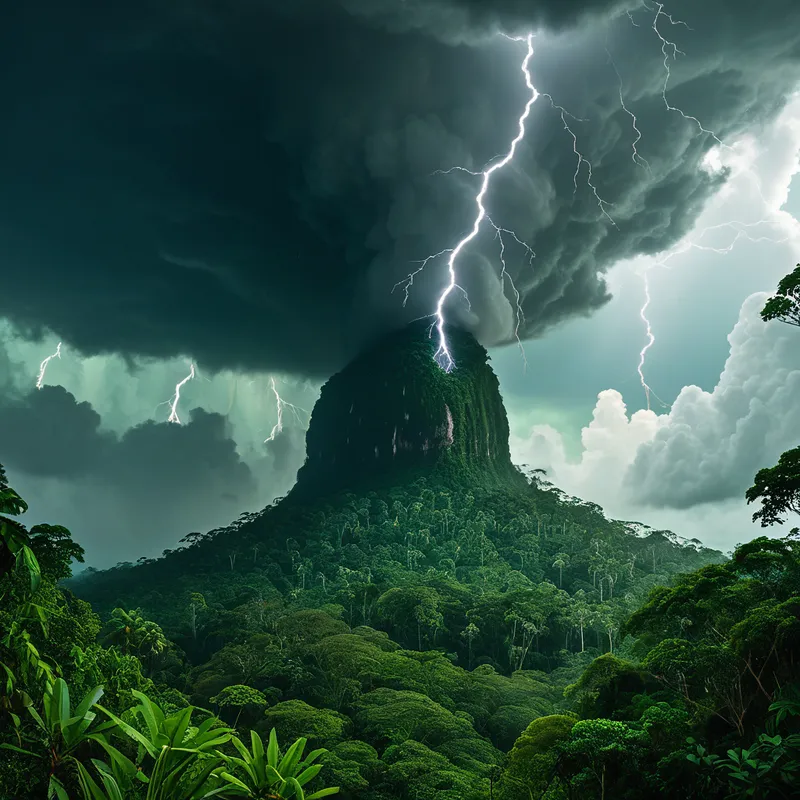
Again, Tupã spoke. KA-RACK-BOOM! This voice was sharper, a clarifying strike. It sent shivers through the newly risen earth, pushing up mountains to scrape the sky and shaping hills where the spirits of the tapir and the deer might one day run. With each peal, each reverberating shout, the world gained definition. The chaos was not destroyed, but organized; the dreams were given a stage.
Then, Tupã took the lightning in both hands and thrust it into the rich, dark soil. The earth convulsed. But from the points of contact, life erupted. Where the energy seared, great Sumaúma trees burst forth, their roots digging into the underworld and their crowns becoming the first canopy. Vines unfurled, ferns uncurled, and the first flowers opened their faces to a sky now clearing of mist. Finally, Tupã breathed upon the world. His breath was the first wind, the trade wind that brings the rain. It swept across the newborn forest, and where it touched the dreaming spirits in the water and the earth, it gave them form and breath. The jaguar found its fur, the anaconda its scales, the hummingbird its iridescent feathers. The world was alive, resonant, and singing with the echo of the creator’s voice.
Cultural Origins & Context
The myth of Tupã originates from the Tupi-Guarani linguistic and cultural families, whose territories span vast regions of what is now Brazil and neighboring countries. It is crucial to understand that “Amazonian” here refers not to a monolithic culture, but to a profound cosmological thread woven through many distinct peoples of the rainforest. This is not a story confined to a single tribe, but a foundational narrative that speaks to a shared understanding of the world’s origin.
The myth was not written but breathed. It was passed down through generations by Pajés (shamans) and elders, often during sacred rituals or in the intimate space of community storytelling as the fire died to embers. Its function was multifaceted: it was a map of the cosmos, explaining the origin of landscapes and species; a sacred charter that established the natural order; and a moral reminder of the creative, organizing power of the sacred that stands against entropy. The thunderstorm was not merely weather—it was a re-enactment of creation, a time when Tupã’s voice could be heard again, cleansing and renewing the world.
Symbolic Architecture
At its core, the myth of Tupã is about the [emergence](/symbols/emergence “Symbol: A process of coming into being, rising from obscurity, or breaking through a barrier, often representing birth, transformation, or revelation.”/) of [Cosmos](/symbols/cosmos “Symbol: The entire universe as an ordered, harmonious system, often representing the totality of existence, spiritual connection, and the unknown.”/) from [Chaos](/symbols/chaos “Symbol: In Arts & Music, chaos represents raw creative potential, uncontrolled expression, and the breakdown of order to forge new artistic forms.”/). Tupã is not a [warrior](/symbols/warrior “Symbol: A spiritual archetype representing inner strength, discipline, and the struggle for higher purpose or self-mastery.”/)-god who slays a [monster](/symbols/monster “Symbol: Monsters in dreams often symbolize fears, anxieties, or challenges that feel overwhelming.”/) of [chaos](/symbols/chaos “Symbol: In Arts & Music, chaos represents raw creative potential, uncontrolled expression, and the breakdown of order to forge new artistic forms.”/), but a [creator](/symbols/creator “Symbol: A figure representing ultimate origin, divine power, or profound authorship. Often embodies the source of existence, innovation, or personal destiny.”/)-god whose very voice is the [instrument](/symbols/instrument “Symbol: An instrument symbolizes creativity, communication, and the means by which one expresses oneself or influences the world.”/) of [differentiation](/symbols/differentiation “Symbol: The process of distinguishing or separating parts of the self, emotions, or identity from a whole, often marking a developmental or psychological milestone.”/).
The first act of consciousness is not to observe, but to resonate—to send a vibration into the void of the unconscious that begins to create form.
Tupã’s primary [symbol](/symbols/symbol “Symbol: A symbol can represent an idea, concept, or belief, serving as a powerful tool for communication and understanding.”/), the [thunderclap](/symbols/thunderclap “Symbol: A sudden, powerful sound from the sky, often associated with divine intervention, abrupt change, or overwhelming force in nature.”/), represents the Logos—the creative [word](/symbols/word “Symbol: Words in dreams often represent communication, expression, and the power of language in shaping our realities.”/), the defining [idea](/symbols/idea “Symbol: An ‘Idea’ represents a spark of creativity, innovation, or realization, often emerging as a solution to a problem or a new outlook on life.”/), the shock of [insight](/symbols/insight “Symbol: A sudden, deep understanding of a complex situation or truth, often arriving unexpectedly and illuminating hidden connections.”/) that brings [clarity](/symbols/clarity “Symbol: A state of mental transparency and sharp focus, often representing resolution of confusion or attainment of insight.”/) from [confusion](/symbols/confusion “Symbol: A state of mental uncertainty or disorientation, often reflecting internal conflict, lack of clarity, or overwhelming choices in waking life.”/). The [lightning](/symbols/lightning “Symbol: Lightning symbolizes sudden insights or revelations, often accompanied by powerful emotions or disruptive change.”/) bolt is the focused, penetrating [application](/symbols/application “Symbol: An application symbolizes engagement, integration of knowledge, or the pursuit of goals, often representing self-improvement and personal development.”/) of that creative force, the flash of inspiration that ignites potential into being. The primordial waters of Yby symbolize the unconscious, teeming with all possibilities but lacking [structure](/symbols/structure “Symbol: Structure in dreams often symbolizes stability, organization, and the framework of one’s life, reflecting how one perceives their environment and personal life.”/). Tupã’s [action](/symbols/action “Symbol: Action in dreams represents the drive for agency, motivation, and the ability to take control of situations in waking life.”/) is the archetypal process of the psyche giving shape to its own contents, moving from passive dreaming to active creation.
The Dreamer’s Resonance
When this myth stirs in the modern soul, it often manifests in dreams of overwhelming, yet creative, chaos. One might dream of being in a flood (the primordial waters), in a fog of confusion, or amidst a cluttered, meaningless mess. Then, a sudden, shocking event occurs—a deafening crack of thunder, a blinding flash of light, or a powerful, resonant sound. This is the psyche’s Tupã moment.
Somatically, the dreamer may awaken with a start, heart pounding, a literal shock to the system. Psychologically, this signals a critical point where the unconscious is pressing a massive, formless content—a life transition, a repressed trauma, a nascent talent—towards consciousness. The “thunder” is the sometimes-violent but necessary rupture of the old, undifferentiated state. It is the psyche’s attempt to use a burst of archetypal energy to carve out a new psychic landscape, to define boundaries (rivers, mountains) where there were none, and to give form to what was only a vague feeling or potential.

Alchemical Translation
The alchemical journey mirrored in Tupã’s myth is the Prima Materia being acted upon by the Anima Mundi (the world soul, or creative spirit). For the individual, the “primordial chaos” is the raw, unprocessed material of one’s life experience and innate potential—the Nigredo stage of confusion and dissolution.
Individuation begins not with a gentle nudge, but with a thunderclap that declares, “This shall be different.”
Tupã’s descent represents the ego’s alignment with a greater creative archetype (the Creator). The act of raising the lightning is the courageous focusing of one’s will and attention on the chaotic problem. The thunderous voice is the act of naming—giving clear, forceful expression to what was inchoate. “This is my pain.” “This is my calling.” “This ends here.” This naming carves out psychic space.
Finally, plunging the lightning into the earth is the integration of this shocking insight into the grounded reality of one’s life. It is often a painful, convulsive process (the earth shaking), but it yields the greening of the world—the Viriditas, or greening power, of new growth, new structures, and a life that feels authentically, resonantly one’s own. The individual becomes, like the world after Tupã, a coherent landscape born from chaos, continually nourished by the breath (spirit) of the process itself.
Associated Symbols
Explore related symbols from the CaleaDream lexicon:
- Thunder — The primordial voice of creation and definition, representing the shocking insight or declaration that brings order from psychic chaos.
- Water — The formless, primordial unconscious, teeming with all potential life and emotion before it is shaped and directed.
- Lightning — The focused, penetrating flash of creative inspiration or traumatic clarity that ignites potential and divides one state of being from another.
- Forest — The lush, complex, and interconnected reality that grows from the organized chaos, symbolizing the mature psyche teeming with life.
- Sky — The realm of spirit, potential, and the descending creative force that interacts with the earthly chaos to generate form.
- Earth — The grounded reality, the material of the self, which receives the creative shock and transforms it into tangible growth and structure.
- Chaos — The necessary, fertile, but terrifying state of undifferentiation that precedes all genuine creation and rebirth.
- Order — The cosmic and psychic principle established by the sacred voice, creating the structures and boundaries within which life can meaningfully exist.
- Creation — The fundamental act of bringing the latent into the manifest, which is the core action of the myth and the goal of the individuation process.
- Voice — The empowered expression of spirit or self that has the power to shape reality, mirroring Tupã’s world-defining thunder.
- Mountain — The enduring, defining structures carved out of the formless mass by the creative force, representing established truths or aspects of the self.
- River — The pathways for life and consciousness carved by the retreat of chaos, symbolizing the directed flow of energy and emotion in a now-organized psyche.