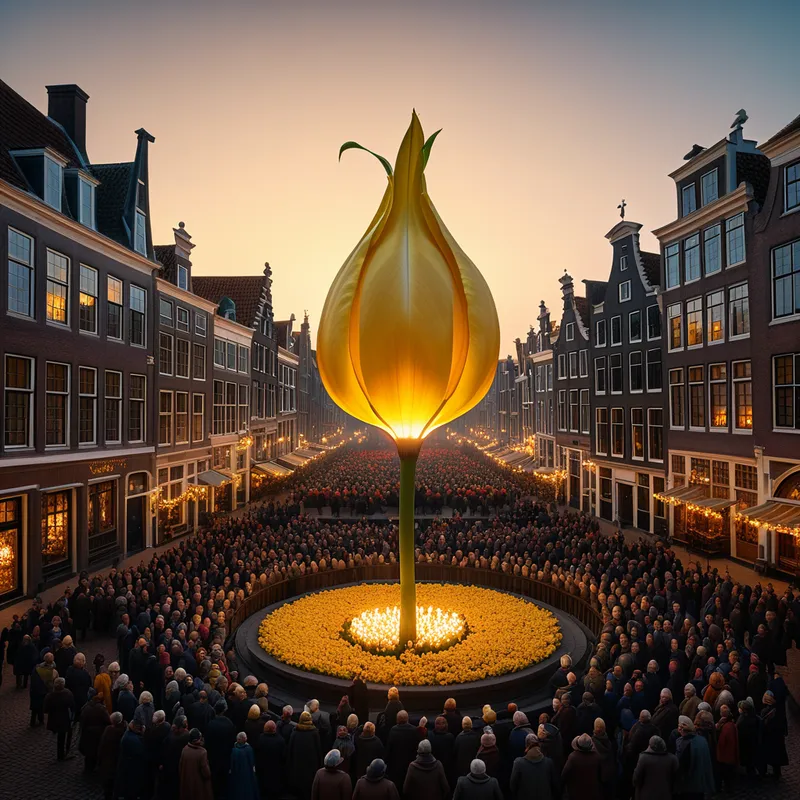
Tulip Mania Myth Meaning & Symbolism
A myth of a society enchanted by a flower's beauty, driven to financial ruin by its own insatiable desire, mirroring the soul's perilous inflation.
The Tale of Tulip Mania
Listen, and hear the tale not of gods on high, but of a fever that walked among mortals. It began not with a thunderclap, but with a whisper—a sigh of breath upon a petal. In the damp, prosperous lands of the Dutch Golden Age, where water was held at bay by will and wind filled the sails of fortune, a new sun dawned. It was not in the sky, but in the earth. A merchant, returning from distant, sultry lands, bore a corm, a humble bulb. When planted, it did not give wheat, nor barley. It gave a cup of fire.
The first tulip was a modest, crimson flame. But then came the Semper Augustus, a blossom that held the dawn and a bleeding sunset in its petals. It was the Admirael van der Eijck, a standard of impossible hues. These were not mere flowers; they were captured fragments of the sky’s own palette, alchemized into velvet and stem. Their beauty was a silent, piercing song that bypassed the mind and spoke directly to the hungry heart.
At first, only the learned men of means, the botanists and patricians, traded them in quiet gardens. But the song spread. The cobbler heard it in the clink of a rare bulb sold for more than his yearly toil. The fisherman heard it in the tavern tales of a single aas of a bulb trading for a canal-side house. The market squares, once filled with the smell of herring and cheese, now hummed with a different scent—the electric tang of potential. Paper promises, windhandel, fluttered from hand to hand like sacred scrolls. A man could trade his homestead, his ship, his daughter’s dowry, for a scrap of paper that promised a bulb still sleeping in the black soil.
The world inverted. The solid brick of Amsterdam, the reliable dike, the prudent ledger—all seemed to melt before the radiant, non-negotiable truth of the tulip’s worth. It was a collective dream, a waking trance where value was no longer in things that fed, housed, or clothed, but in the sheer, breathtaking fact of beauty possessed. The entire country stood on tiptoe, reaching for a petal.
And then, as all fevers must, it broke.
No one remembers who cast the first doubtful glance. Perhaps it was a buyer who asked to see the actual bulb, not the promise. Perhaps it was a frost that threatened the spring blooms. The song, so all-consuming, faltered by a single note. A trade failed to complete. A whisper of “perhaps not” slithered through the taverns. And like a vase tipped from a windowsill, the dream shattered on the cobblestones. The paper promises became mere paper, sodden and worthless. The bulbs in the ground were just bulbs again. The houses traded for them were gone. The fortune was a phantom, leaving behind the cold, grey light of a morning after, and the hollow silence where the enchanting song had been.

Cultural Origins & Context
This is not a myth from the misty age of heroes, but a financial and social parable born from the very specific, pressurized vessel of the 1630s Netherlands. The “Tulip Mania” narrative functions as the foundational cautionary tale of modern capitalism, passed down not by bards but by economists, historians, and moralists. Its primary tellers were the pamphleteers and satirists in the immediate aftermath, who crafted dramatic, often exaggerated accounts of the craze to warn against folly, greed, and the abandonment of sober Dutch virtue.
The society that birthed this story was one of unprecedented worldly success. The Dutch Republic was a mercantile empire, a nation built on global trade, precise calculation, and Calvinist discipline. Yet, beneath this surface of rational control lay a potent tension: a deep Protestant suspicion of worldly vanity alongside an immense accumulation of worldly wealth. The tulip, an exotic import from the Ottoman Empire, became the perfect symbol for this tension. It was a luxury, a vanity, yet its cultivation required meticulous skill and knowledge—a marriage of beauty and order. The myth, therefore, served a critical societal function: it was a cultural immune response. It dramatized the peril of letting the passionate, desiring, and speculative part of the soul (the desiderium animi) overwhelm the disciplined, communal, and pragmatic self. It reaffirmed, through the shock of collective trauma, the boundaries of acceptable pursuit.
Symbolic Architecture
At its core, the myth is not about flowers or finance, but about the psychology of value and the intoxicating power of collective belief. The tulip bulb is the ultimate symbol of the numinous object—a mundane thing (a seed) that becomes a container for transcendent meaning (beauty, status, divine favor, infinite potential). It represents the human capacity to project soul, to ensoul the material world.
The tulip is the mirror. In its petals, a society does not see a flower, but the magnified, radiant image of its own desire.
The frenzied trading, the windhandel, symbolizes the detachment of psychic energy from its source. It is the trade of potential for substance, of fantasy for reality, long before the fantasy has been made real. The entire mania is an allegory for psychic inflation—a state where a part of the psyche (here, the desire for transformation and transcendence) swells to such a degree that it consumes the entire personality, blotting out reason, proportion, and connection to the ground of being.
The catastrophic collapse represents the necessary, painful deflation. It is the moment when the projected soul is withdrawn from the object, returning to the individual and the collective with a shock of recognition. The tulip is just a tulip. The paper is just paper. The inflation is a dream from which one must awaken, however harsh the awakening.

The Dreamer’s Resonance
When this myth pattern stirs in the modern dreamer, it signals a profound engagement with themes of valuation, desire, and identity. To dream of feverishly bidding on a priceless, glowing object in a crowded, chaotic market is to experience the somatic reality of psychic inflation. The body in the dream may feel electric, frantic, elevated—a somatic high of limitless potential.
Conversely, to dream of the crash—of holding a wilted flower or worthless paper as the crowd disperses in silence—is to embody the somatic state of deflation: the hollow gut, the leaden limbs, the crushing weight of shame or disillusionment. This dream is not merely about financial anxiety. It is about the collapse of a cherished self-concept, the bursting of a romantic bubble, or the failure of a project into which one had poured their entire sense of worth. The dream is the psyche’s theater, staging the full cycle of enchantment and disenchantment, forcing the dreamer to feel the consequences of investing their core identity in a transient, external value.
Alchemical Translation
The alchemical journey mirrored in Tulip Mania is the perilous path of sublimatio—the spiritualization of matter—gone awry, resulting in a corrosive inflammatio (inflation) that must be corrected by a humbling mortificatio (death/ collapse) and a return to prima materia (the original, worthless matter).
For the individual seeking individuation, the myth is a master lesson in the integration of desire. The initial attraction to the tulip (the beautiful idea, the exalted goal, the transformative object) is not wrong; it is the call of the Self towards something beyond the ego. The error lies in the possession of the symbol, the literalization of the metaphor. The psyche attempts to own the transcendent, to trade the whole self for a single, dazzling part.
The alchemical gold is not found in the possession of the Philosopher’s Stone, but in the sustained, humble work of the opus. The crash is the furnace that burns away the fantasy of a shortcut.
The true alchemical translation of this myth is the movement from speculation to cultivation. After the crash, the tulip does not disappear. It returns to the garden. The individuation process requires us to take back the projected energy—the “value” we placed in the external object—and plant it within the soil of our own being. We must cultivate the bulb of potential with patience, attend to it through seasons of growth and dormancy, and appreciate the flower when it blooms without believing it is the sole source of our worth. The triumph is not in avoiding the mania, for the soul is drawn to beauty and transformation. The triumph is in surviving the crash with the wisdom to tend a quieter, deeper, and more personal garden.
Associated Symbols
Explore related symbols from the CaleaDream lexicon: