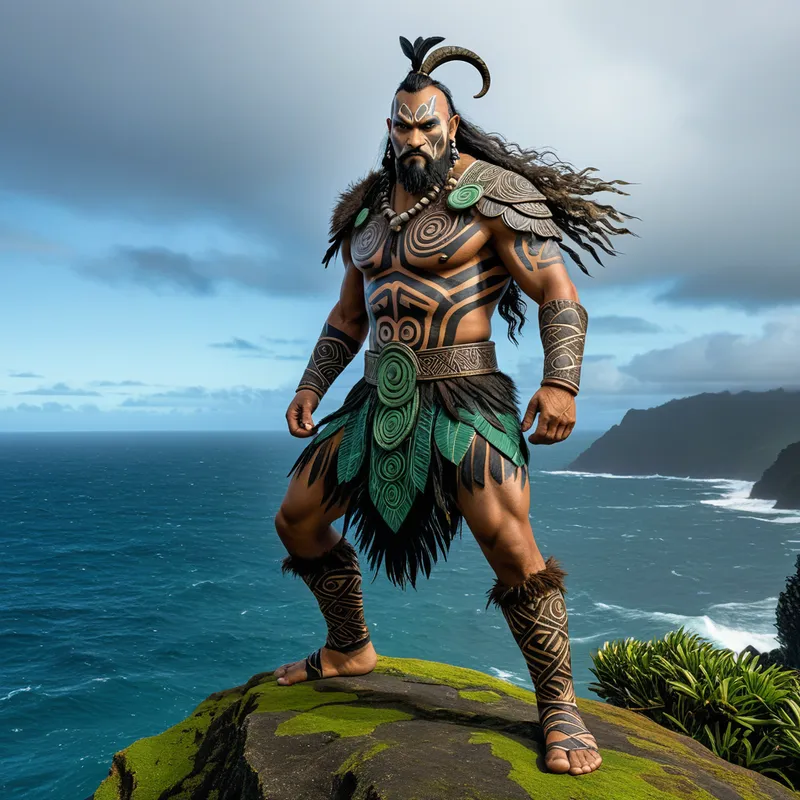
Tu God of War Myth Meaning & Symbolism
The myth of Tu, the Maori god of war, tells of divine conflict, sacrifice, and the forging of order from primal chaos through necessary violence.
The Tale of Tu God of War
In the time before time, when the world was a womb of darkness, there was only [Ranginui](/myths/ranginui “Myth from Maori culture.”/) and Papatūānuku, locked in a tight, suffocating embrace. Their children, the gods, lived in the cramped gloom between them, yearning for light, for space, for life. The air was thick with the scent of damp earth and the sound of their parents’ sighs. For an age, they endured this twilight prison.
But a restless energy grew. It was Tāne who first pressed his strong back against his father, pushing with all his might to create room. Others joined, heaving and straining. Yet one son did not push for separation. He watched. He waited. He was [Tūmatauenga](/myths/tmatauenga “Myth from Maori culture.”/), known as Tū. His heart beat not with a desire for light, but with a simmering fire for resolution. He saw not a family to be parted, but a problem to be solved.
The separation was achieved. Light flooded in. But with light came choice, and with choice, discord. The brothers, now free, turned their divine powers to their own realms. Rongo tended his kūmara. Tangaroa ruled the waves. Tāwhirimātea raged in the skies, furious at the separation. And Tū? He walked the new earth, a solitary figure. He built a house, a whare, but it was empty. He sought food from his brothers.
He went to Rongo. “Brother, give me of your cultivated foods.” Rongo offered only plants, the fruits of peace. Tū tasted them and found them wanting—they did not fill the fierce hunger in his belly. He went to Tangaroa. “Brother, give me of the bounty of the sea.” Tangaroa offered fish. They were good, but they were not enough. He went to [Haumia-tiketike](/myths/haumia-tiketike “Myth from Maori culture.”/), god of uncultivated food, and to Tāne, god of the forests. Each offered their gifts: fern root, birds. Each gift was accepted, yet each was, in Tū’s eyes, a form of dependency, a debt to their specialized domains.
A cold resolve settled in Tū’s spirit. He gathered his brothers. His voice was not a shout, but a low, terrible clarity. “Your gifts are not gifts. They are excuses. You each hold a piece of the world, and you hoard it. You make me a beggar at your separate doors. There is no unity here, only division. If you will not provide for me as a brother, then I will take. And I will use what I take.”
Then came the rising action, not as a single battle, but as a grim, inevitable harvest. Tū did not wage war on his brothers directly. He waged war on their children, on the very manifestations of their domains. He fashioned nets from flax, the child of Tāne, and caught the fish of Tangaroa. He sharpened spears from the wood of Tāne and hunted the birds of the forests. He dug for the fern root of Haumia. He cultivated the gardens of Rongo, but now with a weapon in hand to defend them. He did not create; he appropriated. He turned the gifts of his brothers into the tools of his own sovereignty.
The resolution was not a victory celebration, but a terrible, silent fact. Tū stood amidst his whare, which was no longer empty. It was furnished with the products of his conquests. He had food, tools, weapons. He had asserted his domain over all things fierce, hard, and necessary. He became the patron of the human race, who would follow his example—hunters, warriors, those who must take life to sustain life. The other gods remained, but their relationship was forever changed. Tū had defined the terms of engagement in a world of separate realms. He became the embodiment of the necessary violence that underpins existence, the force that confronts, takes, and in doing so, establishes a harsh, undeniable order.
Cultural Origins & Context
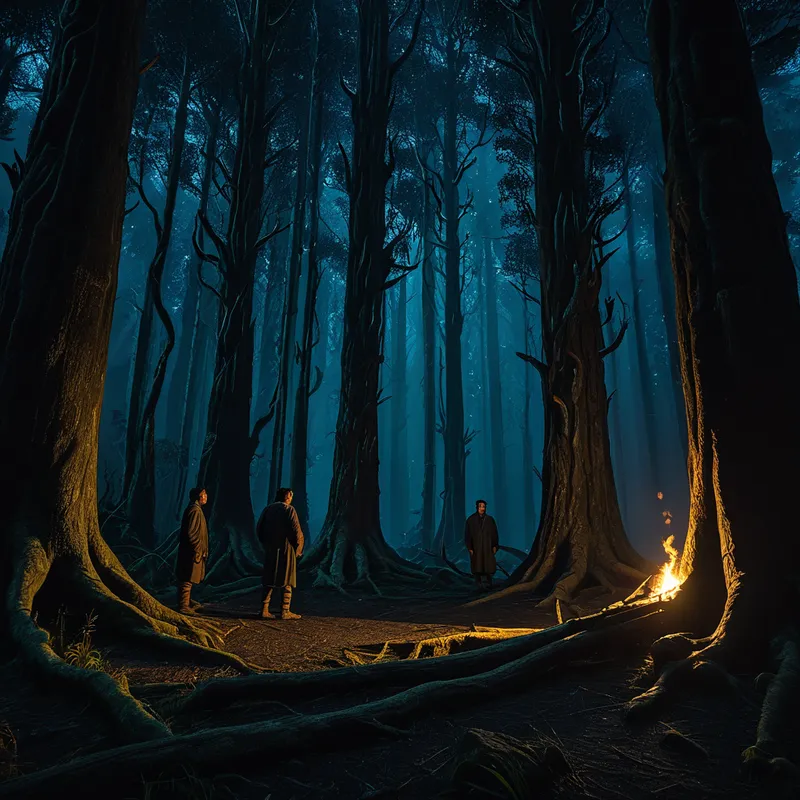
This myth is part of the foundational whakapapa and pūrākau of the Māori world. It was not merely a story but a cosmological map and a social charter. Passed down orally by tohunga and skilled orators, its recitation was a sacred act, connecting the present community to the primal past. The tale of Tū functioned on multiple levels. Cosmologically, it explained the origin of human nature—our capacity for conflict, craftsmanship, and survival. Societally, it validated the role of the warrior (toa) and the arts of war (te whare tu taua) as necessary, divinely ordained aspects of a balanced community. It provided a theological explanation for why humans must kill and eat other beings, framing it within the original familial conflict of the gods. The myth served as a reminder that peace (Rongo) and cultivation are always shadowed by the potential for conflict (Tū), and that a society must acknowledge and ritualize this fierce aspect to maintain its mana and integrity.
Symbolic Architecture
At its core, the myth of Tū is about the psychological [birth](/symbols/birth “Symbol: Birth symbolizes new beginnings, transformation, and the potential for growth and development.”/) of the conscious ego from the undifferentiated unity of the unconscious (the embrace of Rangi and Papa). Tū is the archetypal principle of [differentiation](/symbols/differentiation “Symbol: The process of distinguishing or separating parts of the self, emotions, or identity from a whole, often marking a developmental or psychological milestone.”/) through [opposition](/symbols/opposition “Symbol: A pattern of conflict, duality, or resistance, often representing internal or external struggles between opposing forces, ideas, or desires.”/).
The ego does not emerge gently; it must often declare war on the complacencies of the unconscious, seizing the resources it needs to become an individual.
Tū’s initial state is one of lack and [resentment](/symbols/resentment “Symbol: A deep-seated emotional bitterness from perceived unfairness or injury, often festering silently and poisoning relationships.”/) in the new world. He represents that part of the psyche which feels that the specialized functions (the other gods)—our inner peacemaker, nurturer, [dreamer](/symbols/dreamer “Symbol: The dreamer represents the self, the conscious mind engaging with subconscious thoughts and feelings during dreaming.”/)—are insufficient for facing the harsh realities of an independent existence. His “war” is the psychic act of claiming [authority](/symbols/authority “Symbol: A symbol representing power structures, rules, and control, often reflecting one’s relationship with societal or personal governance.”/). He does not invent new things; he takes the raw materials provided by other archetypes (the [forest](/symbols/forest “Symbol: The forest symbolizes a complex domain of the unconscious mind, representing both mystery and potential for personal growth.”/), the sea, the garden) and transforms them into tools for self-definition and survival. The myth symbolizes the often painful but necessary process of asserting one’s will, setting boundaries, and accepting the burden of [responsibility](/symbols/responsibility “Symbol: Responsibility in dreams often signifies the weight of duties and the expectations placed upon the dreamer.”/) that comes with conscious [action](/symbols/action “Symbol: Action in dreams represents the drive for agency, motivation, and the ability to take control of situations in waking life.”/). Tū is the [shadow](/symbols/shadow “Symbol: The ‘shadow’ embodies the unconscious, repressed aspects of the self and often represents fears or hidden emotions.”/) of the harmonious [family](/symbols/family “Symbol: The symbol of ‘family’ represents foundational relationships and emotional connections that shape an individual’s identity and personal development.”/) of gods, the one who says “no” to passive belonging and “yes” to self-reliance, even if it means internal conflict.
The Dreamer’s Resonance
When this mythic pattern stirs in the modern dreamer, it often manifests as dreams of confrontation, being armed for a fight, or taking something by force. One might dream of forging a weapon, standing one’s ground against a formidable opponent (often a sibling or parental figure symbolizing an internalized authority), or finally claiming a resource that has been “hoarded” by another part of the self.
Somatically, this can feel like a gathering of tension in the solar plexus and jaw, a readiness for action. Psychologically, the dreamer is likely at a crossroads where passivity or dependency is no longer sustainable. The “Tū process” is the psyche’s preparation for a necessary conflict—perhaps setting a firm boundary, leaving a stifling situation, or confronting a deep-seated fear. The dream is not necessarily advocating for external violence, but for an internal warrior’s stance: the courage to engage with life aggressively, to fight for one’s psychic space, and to accept the guilt or isolation that may come from asserting one’s needs against the “family” of internalized expectations.
Alchemical Translation
The alchemical journey modeled by Tū is the opus contra naturam—the work against nature, or more precisely, against the initial, undifferentiated state. It is the process of psychic transmutation where the base metal of raw, undirected potential (the cramped existence between the parents) is forged into the iron will of the conscious individual.
Individuation requires a sacred violence—a willing engagement with the shadow to separate the essential self from the collective mass.
First, there is the separatio: the painful but essential breaking of the primal unity (leaving the parental embrace). Then comes the nigredo: the dark time of resentment and isolation, where the ego feels alienated from the other psychic functions. Tū’s declaration of war is the pivotal mortificatio—a symbolic death of the old identity as a dependent child of the unconscious. His subsequent actions represent coagulatio: giving solid, tangible form to the self. He builds a house (a defined psyche), makes tools (skills and defenses), and secures sustenance (self-sufficiency). The final stage is not a return to peace, but an integration of the warrior principle. The modern individual undergoing this transmutation learns to honor their inner Tū—not to let it run rampant, but to recognize that the capacity for fierce defense, clear boundaries, and decisive action is a sacred, necessary component of a whole Self. One becomes, like Tū, the sovereign of one’s own inner realm, responsible for its order and defense.
Associated Symbols
Explore related symbols from the CaleaDream lexicon:
- Warrior — The archetype embodied by Tū, representing the psychological capacity for focused will, confrontation, and the defense of one’s boundaries and values.
- Sacrifice — The foundational act of the myth, where the unity of the primal parents is sacrificed for the birth of the world, and where life is taken to sustain other life.
- Forest — The domain of Tāne, symbolizing the raw, untamed resources of the unconscious and the natural world that Tū harvests to build his conscious identity.
- Blood — The inevitable consequence of Tū’s path, representing the life force spent in conflict, the price of separation, and the tangible bond of kinship even in strife.
- Father — Represented by Ranginui, the Sky Father, whose separation initiates the world of conflict and against whose authority (and the authority of the brothers) Tū must rebel to define himself.
- Weapon — The mere or spear fashioned by Tū, symbolizing the focused application of will, the tool of differentiation, and the means of transforming resource into power.
- Order — The harsh, pragmatic structure Tū imposes through his actions, representing the ego’s need to create stability and hierarchy from the chaos of undifferentiated potentials.
- Shadow — Tū himself acts as the shadow of his peaceful brothers, the repressed force of aggression and self-assertion that must be integrated for wholeness.
- Ritual — The myth itself, as a recited pūrākau, serves as a ritual container for understanding and channeling the fierce, necessary energies Tū represents.
- Death — The constant companion to Tū’s actions, symbolizing the end of dependency, the killing of old ways, and the acceptance of mortality as a condition of sovereign life.