
Tsuru Myth Meaning & Symbolism
A wounded crane transforms into a woman, weaving a miraculous cloth from her own feathers, until a broken vow reveals her true nature and she must return to the sky.
The Tale of Tsuru
Listen, and let the wind carry you to a time when the world was thinner, and the veil between the human realm and the spirit world was but a sigh. In a remote mountain village, where winter’s breath clung long to the pines, there lived a young woodcutter. He was a man of simple heart, whose kindness was as steady as the rhythm of his axe.
One bitter evening, as dusk bled into violet night, he heard a cry of pure anguish pierce the silence—a sound not of this earth, but of the sky in torment. Following the sound deep into the marshlands, he found a sight that cleaved his heart: a magnificent tsuru, its wing cruelly pierced by a hunter’s arrow, its white feathers stained with crimson life. Without a thought for the cold or the dark, the woodcutter knelt. With hands gentle as spring thaw, he drew out the arrow, cleansed the wound, and, tearing a strip from his own humble robe, bound the creature’s wing. The great bird regarded him with a depth of understanding that shook him, then, with a beat of its good wing, lifted into the star-flecked sky and was gone.
Weeks passed. The snow fell thick. One night, a soft knock came at his door. There stood a woman of breathtaking beauty, her skin pale as the moon, her eyes dark pools of quiet mystery. She wore a simple kimono, and though she said little, her presence filled his lonely hut with a warmth he had never known. “I am Yuki,” she whispered. “I am lost. May I stay?” The woodcutter, his heart overflowing, could only nod.
They were married under the bare branches of an ancient tree. Yet, a shadow lingered in Yuki’s eyes. One day, she approached her husband with a solemn air. “I wish to weave for us,” she said. “To make something beautiful. But you must promise me this: never, under any circumstance, look upon me while I am at the loom. This vow is sacred. Do you swear it?” Moved by her intensity, he swore.
She asked for a separate weaving room. Once it was built, she entered and closed the door. For days, the only sound was the rhythmic, hypnotic clack-clack-clack of the shuttle. When she emerged, she was pale, exhausted, but in her hands she held a length of cloth more magnificent than any silk from the capital. It shimmered with a light of its own, patterns woven into it that seemed to shift like clouds. She bade him take it to the market. It sold for a king’s ransom.
Their life grew comfortable, but soon, greed whispered in the ears of the merchants. They demanded more. Pressured, the woodcutter begged his wife to weave again. Reluctance heavy upon her, Yuki agreed, repeating her sacred condition. He swore again. She entered her room. The weaving began.
But this time, the silence from the room felt different—strained. A terrible, muffled sound, like a sob of pain, slipped through the door. The woodcutter’s heart clenched with fear. Was she ill? In danger? His love, his worry, and the gnawing curiosity planted by the merchants’ greed became a storm within him. The sacred vow shattered in his mind. He crept to the door and slid it open, just a crack.
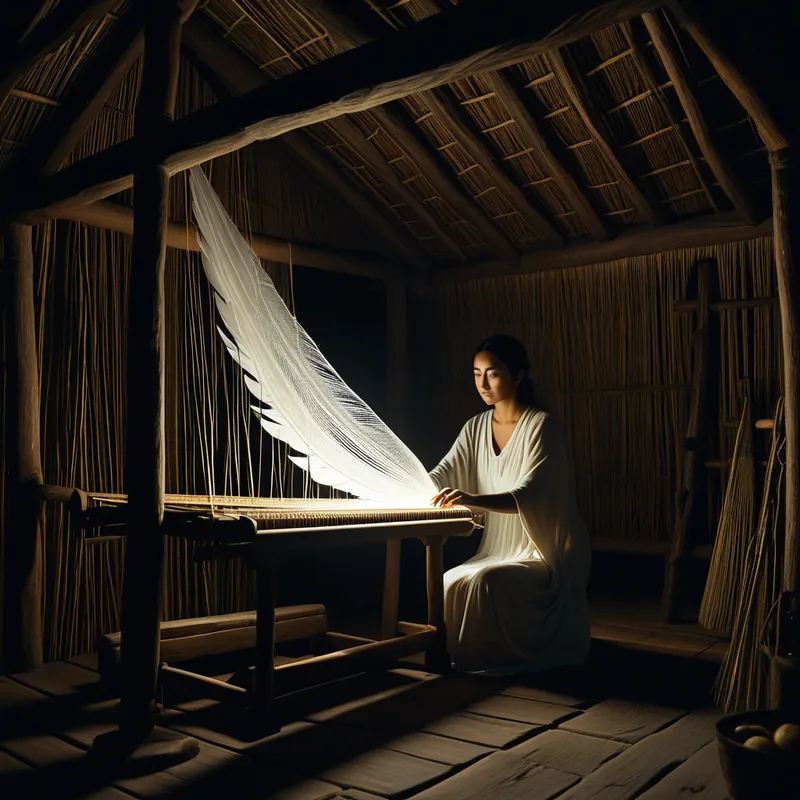
The sight within stole his breath and broke his world. There was no woman at the loom. Instead, the great crane he had saved stood in the center of the room, plucking its own feathers with its beak. With each painful tug, it wove the radiant, downy filaments into the cloth on the loom. Its side was bare and raw where feathers had been torn away. The cloth glowed with the very essence of its being.
The clack of the loom ceased. The crane turned its long neck. Its dark eyes met his—not with anger, but with an infinite, heartbreaking sorrow. The vow was broken. The magic was undone.
“My love,” her voice came, though her beak did not move, “you have seen me. I am the tsuru. I cannot stay.”
As he watched, weeping and paralyzed, her form began to change. The beautiful woman faded like mist, and the crane, now whole and feathered again, stood before him. It gave one last, lingering look, filled with all the love and tragedy of their brief life. Then, with a powerful beat of its wings, it burst through the roof of the hut and ascended into the gray winter sky, leaving behind the half-woven cloth, the silent loom, and a man forever gazing into an empty heaven.
Cultural Origins & Context
This poignant tale, known widely as Tsuru no Ongaeshi (The Crane’s Repayment), is a cornerstone of Japanese folklore. It belongs to the rich oral tradition of mukashibanashi, stories told by the hearth to convey cultural values, warnings, and the mysterious logic of the world. Its origins are diffuse, with variations found across Japan, from the snowy regions of Hokkaido to the coastal villages, suggesting it speaks to a universal human anxiety within the specific context of agrarian and coastal communities where nature’s gifts were both vital and capricious.
The societal function of the myth is multifaceted. On one level, it is a stark lesson in the ethics of reciprocity and the sacredness of promises. The crane repays a debt (ongaeshi) with the ultimate gift—her very self—but the transaction exists within a framework of spiritual rules. The husband’s violation is not merely one of curiosity, but a failure to respect the boundary between the human and the takai, the other world. The story warns against greed, ingratitude, and the human compulsion to unveil mysteries that must remain veiled for harmony to persist. It also reflects the Shinto-infused worldview where animals, particularly those like the crane, are seen as kami-like, capable of crossing realms and possessing their own will and dignity.
Symbolic Architecture
The myth’s power lies in its dense weave of symbols. The tsuru itself is the central hieroglyph. Across East Asia, it symbolizes longevity, fidelity, and good fortune. Yet here, its symbolism is deepened into paradox: it is a creature of the sky (spirit, freedom, the transcendent) who descends into the earthly realm of form, relationship, and vulnerability.
The crane’s feather is not merely a material; it is condensed spirit, the soul made visible. To weave with it is to enact creation through sacred sacrifice.
Her weaving is the act of creation itself—not from external material, but from her own substance. The loom becomes the axis where spirit is translated into form, where the intangible (gratitude, love) is made tangible (the cloth, a home). The husband’s broken vow represents the ego’s rupture of a sacred container. His look is not one of love, but of possessive curiosity and fear, the human mind’s inability to tolerate the mystery of the creative source. It demands to see the how, and in doing so, destroys the why. The inevitable departure of the crane signifies that when the sacred contract is broken, the numinous withdraws, leaving only the husk of the miracle—the material wealth—and the ache of loss.
The Dreamer’s Resonance
When this myth stirs in the modern dreamscape, it often signals a profound somatic and psychological process related to the integrity of the Self. To dream of being the weaving crane is to feel the core self being plundered—giving away one’s essence (time, energy, creativity, love) to sustain a relationship or a life structure that may not honor the sacredness of that gift. The dreamer may feel a deep, inarticulate exhaustion, a sense of being “frayed” or “plucked bare.”
Conversely, to dream as the woodcutter, peering through the door, is to confront one’s own shadow of curiosity-turned-violation. This may manifest in waking life as guilt over crossing a boundary, the anxiety of having “seen too much” in a relationship or situation, or the fear that one’s own needs have shattered something beautiful and fragile. The dream is a somatic alarm: the psyche’s container has been breached. The feeling upon waking is often one of profound regret and loneliness, a somatic echo of the crane’s departure—a literal “heartache” for a lost connection to something transcendent that once dwelled within the ordinary.
Alchemical Translation
For the modern individual navigating the path of individuation—the process of becoming a whole, integrated Self—the myth of Tsuru is a precise alchemical manual. The initial stage is the nigredo: the wounded crane in the marsh. This is the encounter with one’s own wounded, instinctual, spiritual nature, often repressed or “shot down” by the demands of conventional life. The woodcutter’s compassionate act represents the ego’s first conscious engagement with this deep Self, tending to its injuries.
The marriage is the albedo, the sacred marriage (hieros gamos) between the conscious ego (the woodcutter) and the anima/animus (the crane-woman), the soul-image. This creates a fertile, creative period where the soul weaves its magic into life.
The broken vow is the critical crucible. It is not a failure, but a necessary rupture in the individuation process. The ego cannot forever remain passive; its nature is to seek, to know. This “fall” into curiosity is the catalyst for the next transformation.
The climax—the witnessing of the raw, self-sacrificing process—is the rubedo. It is the painful, luminous realization of the cost of creation and the true nature of the soul: it is not a passive resource, but a being that gives of its very essence. The crane’s return to the sky is not merely a loss, but a re-integration. The transcendent function (the crane) returns to its realm, but the ego is forever changed. It is left not with the numinous itself, but with its memory, its half-woven lessons, and a permanent, aching orientation toward the sky. The individuated person is the one who has seen the crane weave, who bears the sorrow of that vision, and who learns to honor the unseen loom within, without demanding to break its sacred solitude. The gift is no longer the cloth, but the transformed capacity to see the world as a place where cranes might descend, and to act with a reverence that makes their brief stay possible.
Associated Symbols
Explore related symbols from the CaleaDream lexicon: