Tsurezuregusa Myth Meaning & Symbolism
The myth of Tsurezuregusa, the spirit of idle moments, teaches that profound wisdom and psychic renewal are found in the spaces between purposeful action.
The Tale of Tsurezuregusa
Listen. There is a story whispered not in the clamor of the marketplace, nor in the solemn chants of [the temple](/myths/the-temple “Myth from Jewish culture.”/), but in the quiet spaces between heartbeats. It is the story of Tsurezuregusa.
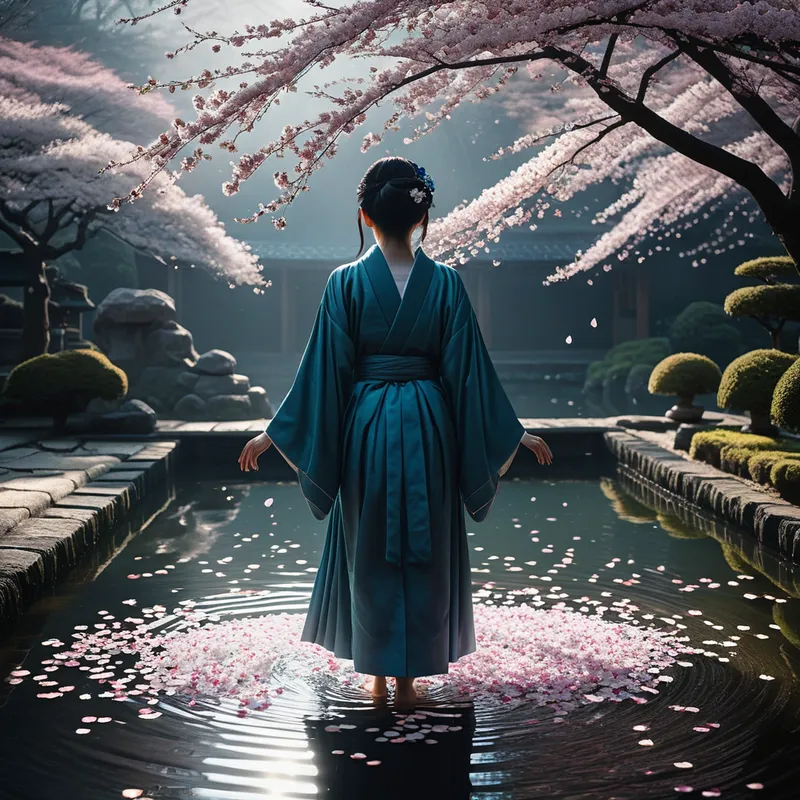
In a time when [the world](/myths/the-world “Myth from Tarot culture.”/) was measured by the strict meter of duty and the precise brushstroke of form, there lived a profound emptiness. It was not a void of lack, but a fertile, humming silence. From this silence, she was born. She had no grand palace, for her domain was the overlooked: the long afternoon after all tasks are done, the moment of staring at rain-streaked [shoji](/myths/shoji “Myth from Japanese culture.”/), the pause between writing one line of poetry and the next. Her form was ever-shifting—sometimes a wisp of mist caught in bamboo, sometimes the feeling of a forgotten memory brushing against the soul.
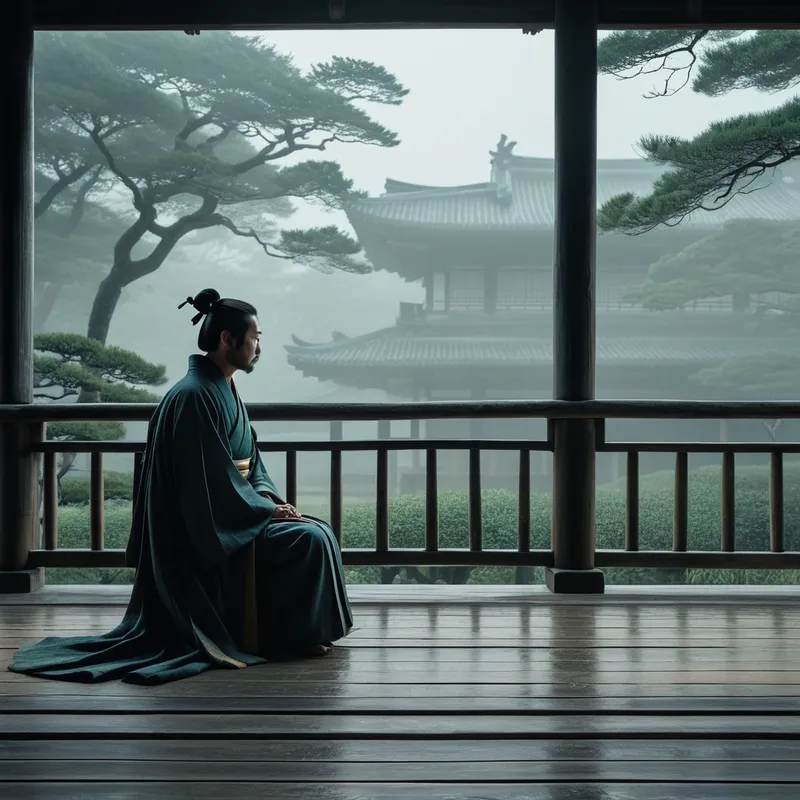
The people of the world, busy with the weaving of their destinies, feared her realm. They called it mu—nothingness—and rushed to fill it with noise and motion. They saw only idleness, a thief of productivity. But Tsurezuregusa watched with eyes like still ponds. She saw the scholar, his mind knotted with doctrine, who finally threw down his brush in frustration. In that moment of surrender, as he gazed blankly at the garden, she breathed upon him. The tangled knot loosened. A thought, clear and bright as a dragonfly, darted into his mind—an understanding no amount of striving could have produced.
She visited the warrior, weary from maintaining a facade of strength. In the quiet of his own courtyard, in the tsurezure of dusk, she allowed his armor to feel heavy, his spirit to sag. And in that sagging, that honest fatigue, he touched the soft earth of his own humanity beneath the hard shell of his role.
Her greatest work was with a heartbroken poet, who believed her muse had deserted her. For days, the poet sat, brush dry, paper empty, lost in the vast desert of tsurezure. She despaired. But Tsurezuregusa settled around her like a soft cloak. In the emptiness, the poet heard not silence, but the subtle symphony of the world: the scrape of a cricket’s leg, the sigh of a pine bough, the distant laughter of children that carried the ghost of her own childhood joy. The emptiness filled not with forced verse, but with raw, unfiltered life. When the poet finally picked up her brush, she did not write about the world; she let the world write through her. The poem was not crafted; it was received.
Thus, the myth tells us, Tsurezuregusa does not act. She allows. She is the necessary pause in the music, the ma between notes without which there is only noise. Her conflict is with the human obsession with perpetual doing; her resolution is the revelation that in non-doing, the deepest doing—the work of the soul—can finally begin.
Cultural Origins & Context
The figure of Tsurezuregusa is deeply rooted in the Japanese aesthetic and philosophical principle of [mono no aware](/myths/mono-no-aware “Myth from Japanese culture.”/). While not a deity of a formal, institutionalized [pantheon](/myths/pantheon “Myth from Roman culture.”/) like the kami of Shinto, she is a personification born from literary and contemplative tradition. Her most famous namesake is the 14th-century essay collection Tsurezuregusa by Yoshida Kenkō, a work that itself meanders through thoughts on life, death, beauty, and transience, embodying the very spirit it describes.
She was passed down not by priests, but by poets, monks, and artists—those who courted the creative void. In the Heian court, with its rigid protocols, and later in the [samurai](/myths/samurai “Myth from Japanese culture.”/) culture of duty and honor, her myth served as a vital cultural counterweight. She represented the sanctioned, even sacred, space for private reflection, melancholy, and the cultivation of an inner life separate from public role. Societally, her “myth” functioned as a permission slip for introspection, validating the psychological need for fallow periods as essential to a whole and sensitive human being, crucial for the creation of art and the practice of zazen.
Symbolic Architecture
Psychologically, Tsurezuregusa is the archetypal embodiment of the numinous void. She represents the [psyche](/myths/psyche “Myth from Greek culture.”/)’s essential need for dormancy, for the conscious ego to release its compulsive grip on [direction](/symbols/direction “Symbol: Direction in dreams often relates to life choices, guidance, and the path one is following, emphasizing the importance of navigation in personal journeys.”/) and control.
She is the psychic soil that must lie fallow so it may once again bear fruit. To rush to replant is to guarantee a meager harvest.
Her domain—the idle [moment](/symbols/moment “Symbol: The symbol of a ‘moment’ embodies the significance of transient experiences that encapsulate emotional depth or pivotal transformations in life.”/)—symbolizes the liminal [space](/symbols/space “Symbol: Dreaming of ‘Space’ often symbolizes the vastness of potential, personal freedom, or feelings of isolation and exploration in one’s life.”/) between conscious complexes. It is the gap between the [persona](/symbols/persona “Symbol: The social mask or outward identity one presents to the world, often concealing the true self.”/) of the [worker](/symbols/worker “Symbol: The symbol ‘Worker’ represents effort, productivity, and the role of individuals within a broader societal framework.”/) and the [anima](/symbols/anima “Symbol: The feminine archetype within the male unconscious, representing soul, creativity, and connection to the inner world.”/)/[animus](/symbols/animus “Symbol: In Jungian psychology, the masculine inner personality in a woman’s unconscious, representing logic, action, and spiritual guidance.”/) of the [lover](/symbols/lover “Symbol: A lover in dreams often represents intimacy, connection, and the emotional aspects of relationships.”/), between [the ego](/myths/the-ego “Myth from Jungian culture.”/)’s plans and [the Self](/myths/the-self “Myth from Jungian culture.”/)’s [purpose](/symbols/purpose “Symbol: Purpose signifies direction, meaning, and intention in life, often reflecting personal ambitions and core values.”/). The fear of her [realm](/symbols/realm “Symbol: The symbol of ‘Realm’ often signifies the boundaries of one’s consciousness, experiences, or emotional states, suggesting aspects of reality that are either explored or ignored.”/) is the fear of the unconscious itself: a formless, potentially overwhelming [space](/symbols/space “Symbol: Dreaming of ‘Space’ often symbolizes the vastness of potential, personal freedom, or feelings of isolation and exploration in one’s life.”/) where our constructed identities dissolve. The gifts she bestows—sudden [insight](/symbols/insight “Symbol: A sudden, deep understanding of a complex situation or truth, often arriving unexpectedly and illuminating hidden connections.”/), emotional [truth](/symbols/truth “Symbol: Truth represents authenticity, honesty, and the quest for knowledge beyond mere appearances.”/), creative flow—are symbols of the transcendent function, the psyche’s innate [ability](/symbols/ability “Symbol: In dreams, ‘ability’ often denotes a recognition of skills or potential that one possesses, whether acknowledged or suppressed.”/) to generate new, healing perspectives from the [tension](/symbols/tension “Symbol: A state of mental or emotional strain, often manifesting physically as tightness, pressure, or unease, signaling unresolved conflict or anticipation.”/) of opposites, but only when given the silent [space](/symbols/space “Symbol: Dreaming of ‘Space’ often symbolizes the vastness of potential, personal freedom, or feelings of isolation and exploration in one’s life.”/) to do so.

The Dreamer’s Resonance
When Tsurezuregusa visits modern dreams, she rarely appears as a figure. Instead, she manifests as the atmosphere of the dream. One dreams of being utterly, peacefully lost in a familiar city, with no urgency to find [the way](/myths/the-way “Myth from Taoist culture.”/). One dreams of sitting in a room as daylight changes, feeling a profound, non-anxious emptiness. Or one dreams of a task—writing, building, speaking—where the tools become heavy and useless, forcing a stop.
These dreams signal a somatic and psychological process of necessary decompression. The conscious mind, overloaded with the demands of hyper-productivity, is forcing a shutdown through the imagery of the myth. The body in the dream feels heavy, slow, or floaty—a direct somatic expression of the nervous system moving from sympathetic (fight-or-flight) to parasympathetic (rest-and-digest) dominance. Psychologically, the dreamer is undergoing an ego-relativization. The dream says: “Your identity as a ‘doer’ is suspended. You are simply being. Allow it.” Resistance to this dream-state often manifests as anxiety within the dream, a frantic search for purpose in the purposeless landscape, mirroring our cultural resistance to true rest.

Alchemical Translation
The alchemical process modeled by the myth of Tsurezuregusa is [solutio](/myths/solutio “Myth from Alchemical culture.”/)—the dissolution. In [the laboratory](/myths/the-laboratory “Myth from Alchemical culture.”/) of the soul, this is not a destruction, but a merciful breaking down of hardened, crystallized attitudes—the rigid [persona](/myths/persona “Myth from Greek culture.”/), the compulsive life patterns—into a fluid state.
The modern individual, identified with their career, productivity, and constant self-optimization, is [the prima materia](/myths/the-prima-materia “Myth from Alchemical culture.”/) in this operation. The “conflict” is the creeping sense of burnout, meaninglessness, or creative block—the call of Tsurezuregusa. The heroic act is not to fight harder, but to consciously and courageously submit to the idle moment. This is the [nigredo](/myths/nigredo “Myth from Alchemical culture.”/), the dark night where one feels useless and adrift.
The alchemical gold is not found in the ore of endless striving, but precipitated from the solution of conscious surrender.
By willingly entering the tsurezure, one allows the psychic structures to soften. In this state, the unconscious contents—repressed emotions, forgotten talents, intuitive knowings—can stir and recombine. The “resolution” of the myth is the coagulatio: the formation of a new, more authentic solidity. The insight that arises, the poem that writes itself, the deep sense of peace—these are the new forms that coalesce from [the void](/myths/the-void “Myth from Buddhist culture.”/). They are integrated not as more tasks for the ego, but as qualities of being. The individual is no longer just a human doing; through the grace of the idle moment, they remember themselves as a human being, realigned with the slow, deep rhythms of the Self. The transmutation is complete: leaden fatigue becomes golden awareness, all within the sacred, empty hands of a moment spent doing nothing at all.
Associated Symbols
Explore related symbols from the CaleaDream lexicon: