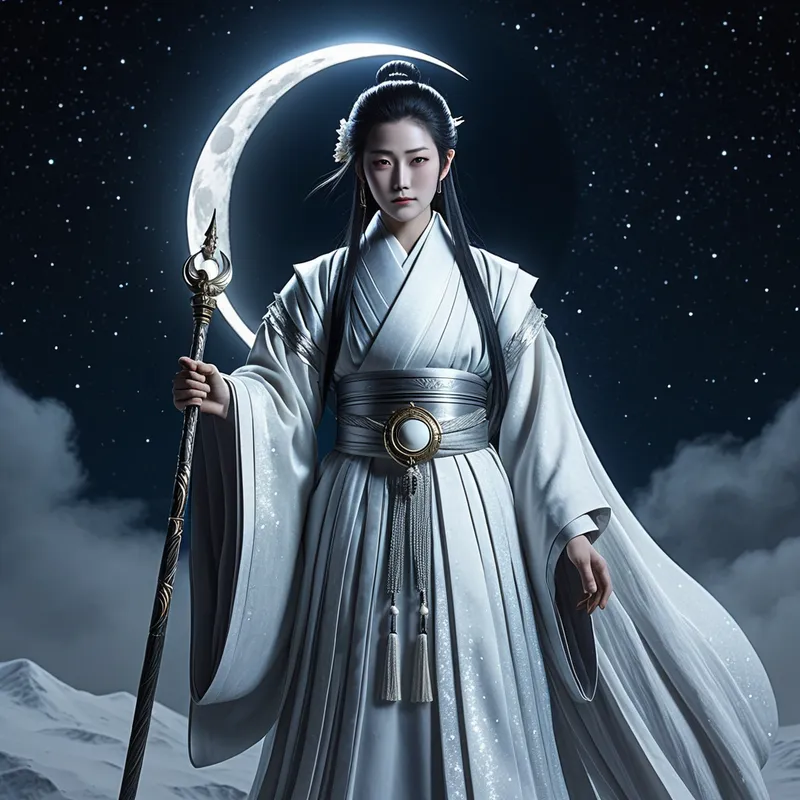
Tsukuyomi-no-Mikoto Myth Meaning & Symbolism
The myth of the Moon God who slays the Goddess of Food, creating an eternal rift between night and day, sun and moon.
The Tale of Tsukuyomi-no-Mikoto
In the high plain of heaven, Takamagahara, the air was not air but the breath of creation itself. Here, the Three Precious Children were born from the ritual purification of the great progenitor, Izanagi-no-Mikoto. From his right eye was born Amaterasu-Ōmikami, whose radiance wove the fabric of day. From his left eye was born Tsukuyomi-no-Mikoto, whose cool light ordered the realm of night. From his nose sprang Susanoo-no-Mikoto, whose wild spirit would churn the seas.
For a time, the sun and moon moved in harmonious orbit, their light a balanced rhythm over the nascent world. Amaterasu, in her boundless generosity, once sent her brother Tsukuyomi as her representative to a feast hosted by the goddess Uke Mochi. The food goddess welcomed the celestial envoy with great honor. The hall was silent, save for the rustle of her silks.
Then, Uke Mochi began her sacred work. She turned her head to the vast sea and coughed forth a bounty of salt-sea bream. She faced the dense forest and from her mouth came plump game, pheasants and deer. She looked toward a rice paddy and vomited forth bowls of perfect, steaming rice. This was her divine providence, the miraculous generation of sustenance from her own body.
But Tsukuyomi-no-Mikoto did not see a miracle. He saw defilement. He saw a repulsive, unclean act performed in this pristine heavenly realm. His face, usually as placid and unmoved as the moon’s surface, darkened with a cold, unforgiving wrath. “How dare you serve me filth from your mouth?” his voice cut through the feast-hall like shards of ice. Before Uke Mochi could utter a word in her defense, Tsukuyomi drew his sword and struck her down where she knelt.
As the life fled from the food goddess, her body did not simply fall. It transformed. From her forehead sprang oxen and horses. From the top of her head grew millet. From her eyebrows, silkworms emerged. From her eyes, panicle seeds. From her genitals, wheat and beans, and from her rectum, soybeans. The very substance of her being became the staples of the mortal world.
When Tsukuyomi returned to the sunlit halls and recounted his deed to Amaterasu, her light did not warm him. It flared in horror and then retreated into a cold, hard glare. “You are a wicked deity,” she declared, her voice trembling with a fury that made the heavens shake. “I will not look upon you. Never again shall we share the same sky.” From that moment, day and night were forever separated. The sun and the moon, once siblings in synchronous dance, became eternal exiles from each other’s presence. Tsukuyomi was condemned to rule his solitary, silent domain, a perpetual reminder of the judgment that cleaved unity in two.
Cultural Origins & Context
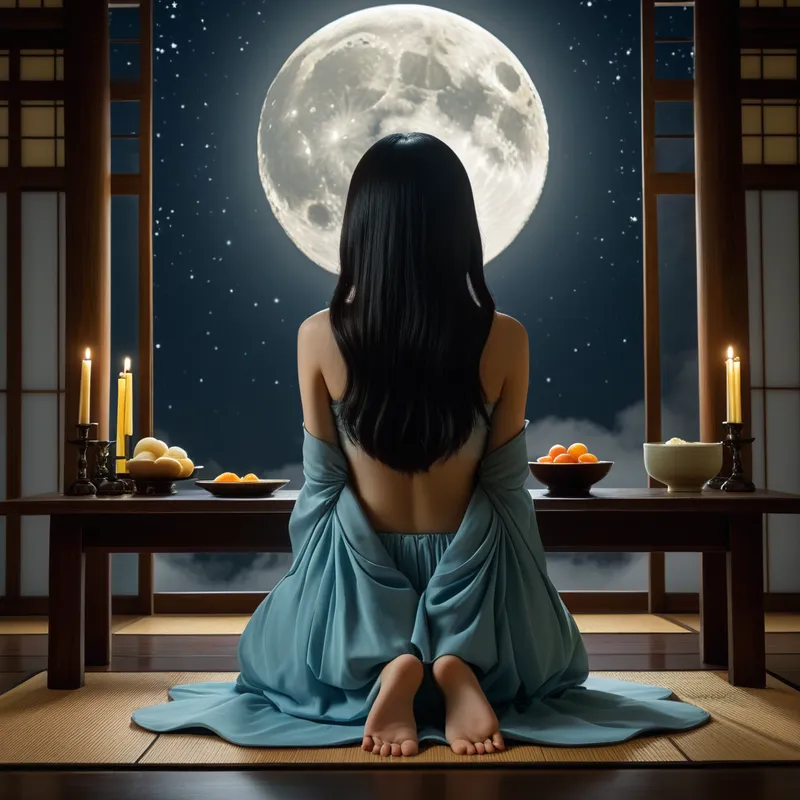
The myth of Tsukuyomi is recorded in Japan’s oldest chronicles, the Kojiki (712 CE) and the Nihon Shoki (720 CE). These texts were not mere storybooks but political and cosmological foundations for the nascent Japanese state, compiled under imperial auspices to establish a divine lineage for the ruling family, descended from Amaterasu.
The myth’s transmission was oral long before it was written, carried by kataribe. Its societal function was multifaceted. It provided an etiological explanation for the fundamental cosmic order: why the sun and moon are never in the sky together. More profoundly, it established a moral and ritual framework. The story underscores the Shinto emphasis on purity (harae) and the severe consequences of kegare, even when perceived, not intended. Tsukuyomi’s violent reaction to Uke Mochi’s method, though it produced life, highlights a celestial intolerance for processes deemed chaotic or impure. This reinforced the need for strict ritual protocol in a culture where harmony with the kami was essential for agricultural and social stability.
Symbolic Architecture
Tsukuyomi represents the archetype of the discerning, ordering principle. He is consciousness itself—cold, observational, and analytical. His light is not the warm, fecund light of the sun that nurtures life, but the cool, revealing light of the moon that exposes form, creates shadow, and measures boundaries.
The light of the moon does not create; it reveals. In its stark clarity, it sees not the miracle of generation, but the mechanics of process, and in that seeing, it passes a sentence of eternal isolation.
The central conflict is not between good and evil, but between two irreconcilable modes of being: generative, embodied creativity (Uke Mochi/Amaterasu) and sterile, disembodied judgment (Tsukuyomi). Uke Mochi creates from within her own body, a messy, organic, and intimate act. Tsukuyomi, the ultimate outsider, views this intimacy as contamination. His sword is the sword of discrimination, so sharp it severs the connection between the source and the gift, the process and the product. The tragic outcome—the eternal separation of sun and moon—symbolizes the psychic cost of absolute judgment. It creates order, but it is the order of a perfect, lonely cell.
The food that springs from Uke Mochi’s corpse is the final, poignant symbol. Life and sustenance are born from the very act of destruction and rejection. The things that nourish the mortal world are born of a celestial crime, suggesting that our earthly existence is fundamentally rooted in a broken wholeness, fed by a divine schism.
The Dreamer’s Resonance
When this myth pattern constellates in the modern psyche, it often manifests in dreams of profound, aesthetic disgust. One might dream of discovering that their favorite, nourishing meal was prepared in a horrifically “unclean” way. Or of a loved one transforming, in a moment of intimacy, into something viscerally repulsive, causing the dreamer to recoil in a shock that feels both righteous and deeply shameful.
Somatically, this is the process of the psyche drawing a boundary so severe it becomes a wall. It is the body feeling the shock of rejection—a cold clenching in the gut, a rigidity in the spine. Psychologically, the dreamer is encountering their own inner Tsukuyomi: a part of the self that holds itself aloof, that judges creative impulses, emotional needs, or bodily instincts as beneath it, as messy and contaminating. This is not the critical thinking of the ego, but the god-like judgment of a complex that believes it exists above the organic processes of life. The dream signals a dangerous polarization occurring within, where a part of the psyche is preparing to “murder” a vital, nourishing function (an instinct, a relationship, a creative endeavor) because its method of giving life offends a sterile ideal.

Alchemical Translation
The individuation process modeled here is not one of integration, but of conscious recognition and containment of the isolating, judging function. We cannot “heal” the rift between sun and moon in the macrocosm of the psyche; they are destined to rule separate domains. The alchemical work is to acknowledge Tsukuyomi’s necessity while refusing his ultimate sovereignty.
The task is not to make the moon warm, but to understand that its cold light is what allows us to see the shape of our own darkness, and to navigate by it.
First, one must recognize the “Tsukuyomi complex”: that inner voice that, in the name of purity, order, or high principle, severs connections and rejects nourishment. This is the critic that kills the creative act by fixating on its imperfect origins. The translation is to honor its discriminating light—we need boundaries and discernment—but to dethrone it from its position as sole ruler of the night. We must consciously invite other energies into the domain of our introspection: the compassion of Amaterasu’s rejected warmth, the fertile chaos of Uke Mochi’s transformed body.
The ultimate alchemical goal is to become the vessel that holds the eternal separation within itself. To accept that the part of us which judges and the part of us which creates from the mess of life may never be fully reconciled. We learn to let the sun of our vitality shine by day, and by night, to use the moon’s cold light for reflection—not to condemn what we see, but to map the terrain of a self that is, and will always be, both the severed sibling and the lonely god, forever weaving the world from that irreducible tension.
Associated Symbols
Explore related symbols from the CaleaDream lexicon: