Tsukuyomi Myth Meaning & Symbolism
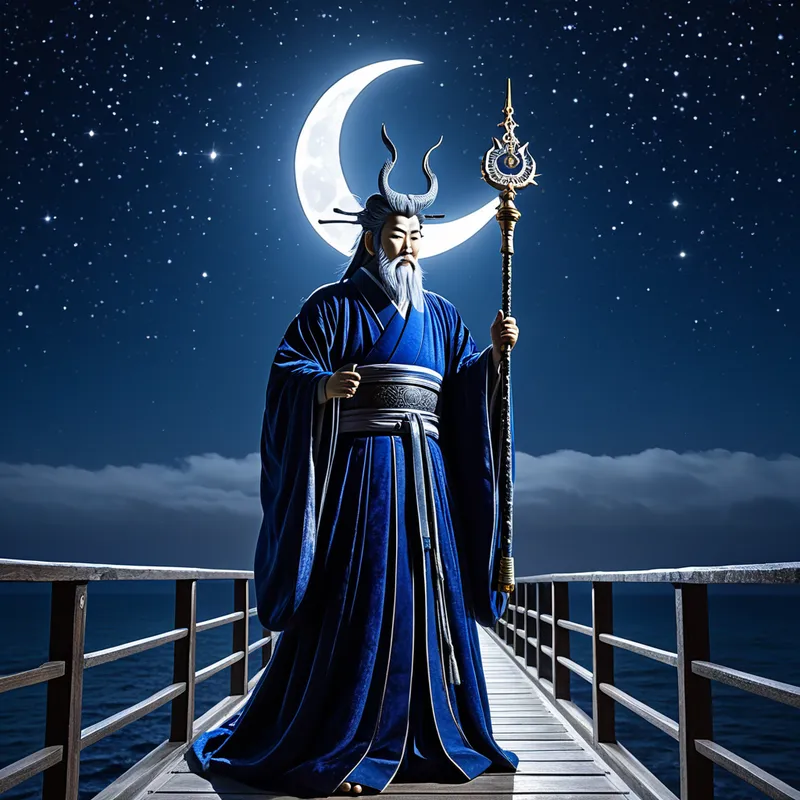
The moon god Tsukuyomi, born from Izanagi's right eye, brings eternal separation by slaying the food goddess Uke Mochi, becoming the lonely lord of the night.
The Tale of Tsukuyomi
In the time before time, when the world was still a formless, oily brine, the first gods stirred. From the ritual purification of the creator Izanagi, three radiant children were born to rule the heavens. From the washing of his right eye sprang forth a being of such cool, silent majesty that the very darkness of the sky parted to make room for him. This was Tsukuyomi-no-Mikoto, the Lord of the Moon, his essence the silver light of contemplation, his domain the orderly passage of the night.
The Amaterasu, born from Izanagi’s left eye, shone with a warm, life-giving brilliance. For a time, the siblings shared the sky, a perfect balance of day and night, of warmth and coolness, of action and rest. Their reign brought rhythm to the nascent world below.
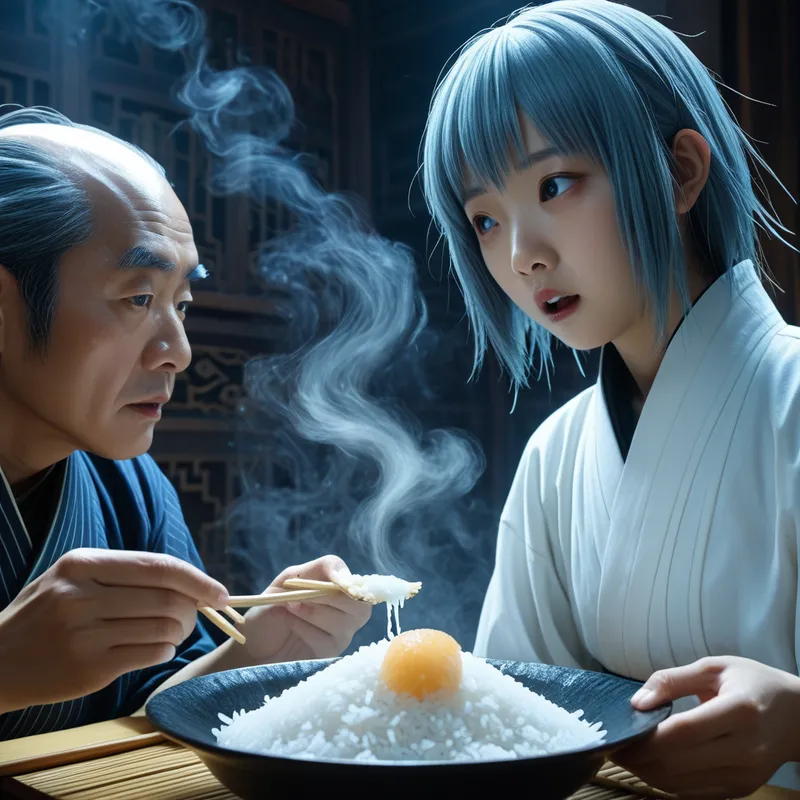
But harmony, in the realm of the gods, is a fragile vessel. Amaterasu, in her grace, sent her brother Tsukuyomi as her envoy to the earthly goddess Uke Mochi. He descended a bridge of moonbeams to a verdant plain where Uke Mochi waited to host him. With a smile, she began the ritual of hospitality. Yet her method was one of shocking, visceral creation. She turned her head to the side and vomited a steaming pile of perfectly white rice. She faced the sea and spewed forth a bounty of silvery fish. She looked toward the mountains and expelled game of every kind. From her very body, she generated a feast meant to honor the celestial guest.
Tsukuyomi watched. His silver eyes, accustomed to the clean, silent geometries of the night sky, witnessed this act of generation not as a gift, but as a profound defilement. To him, the process was filthy, an unholy mingling of the sacred and the profane. A cold fury, pure and absolute, crystallized within him. This was not order; this was chaos masquerading as bounty. In a flash of righteous judgment, he drew his sword—the very symbol of his divine authority—and cut Uke Mochi down where she stood.
Her body fell to the earth, and from it sprang new wonders: from her head came the silkworm, from her eyes grew millet, from her ears sprouted millet, and from her nose arose red beans. But Tsukuyomi saw only the corpse. He gathered the food she had produced and returned to the High Plain of Heaven, presenting it to his sister. “Behold,” he said, his voice like frost on stone, “the sustenance from the defiled one.”
When Amaterasu learned how this bounty was obtained, a horror greater than any darkness seized her. This was not justice; it was a violation of the sacred bond of hospitality, a murder of a generous spirit. The warmth of her light recoiled from the coldness of his act. “You are a wicked god,” she declared, her radiance dimming with grief and rage. “I cannot bear to look upon you. From this moment, you shall dwell apart from me. We shall never share the sky again.”
And so, the great schism was sealed. Day and night, which had once danced together, were forever divorced. Amaterasu turned her face from her brother, and he was exiled to his solitary dominion. Tsukuyomi, the Lord of the Moon, became the eternal ruler of the lonely night, his light a silent, cold witness to a world from which he is forever separated by his own unwavering judgment.
Cultural Origins & Context
The myth of Tsukuyomi is preserved in Japan’s oldest chronicles, the Kojiki (712 CE) and the Nihon Shoki (720 CE). These texts were not mere storybooks but political and theological documents, compiled to establish the divine lineage of the Yamato imperial line, which claimed descent from Amaterasu. Within this framework, Tsukuyomi’s tale serves a critical cosmological function: it explains the fundamental separation of night from day.
Unlike the rich cults and temples dedicated to Amaterasu or the storm god Susanoo, Tsukuyomi received remarkably little direct worship in ancient Japan. He is a god of absence, of distance. His myth was likely told not to inspire devotion, but to instill awe for the natural order and to illustrate a profound theological principle: that certain acts of purity, when taken to an extreme, can create irrevocable alienation. The story was passed down by court scribes and ritualists, a cautionary note woven into the fabric of the national mythos about the dangers of absolute judgment and the tragic cost of broken relational harmony (wa).
Symbolic Architecture
Tsukuyomi embodies the archetype of the discerning intellect divorced from the heart. He is consciousness in its most rarified form: observing, judging, and separating. His birth from the right eye of Izanagi is deeply symbolic; the right side is often associated with masculinity, authority, and the rational principle. He is not the chaotic darkness, but the light that reveals the contours of darkness—a light that is analytical, cold, and sterile.
The moon does not create life; it illuminates the form of what already exists. Tsukuyomi is the god of that illuminating gaze, which can bless with clarity or curse with isolation.
His fatal encounter with Uke Mochi represents the ultimate clash between two divine principles. Uke Mochi is the goddess of immanence, of fertility that emerges directly from the body of the world—messy, organic, and cyclical. Tsukuyomi represents transcendence, a purity that cannot tolerate the mess of biological process. His slaying of her is not an act of evil, but of fastidiousness. He chooses perfect order over generative chaos, eternal principle over life-giving relationship. The consequence is not damnation, but the most profound loneliness: to be right, and to be utterly alone because of it. He becomes the symbol of the cost of absolute purity, the sage who gains the world of knowledge but loses the community of being.

The Dreamer’s Resonance
When the pattern of Tsukuyomi stirs in the modern psyche, it often manifests in dreams of profound isolation within a social or professional setting. The dreamer may find themselves in a beautiful, orderly place—a pristine office, a silent gallery, a geometrically perfect garden—but feel a chilling separation from others present. They may witness an act of creative, passionate, or messy emotional expression (the Uke Mochi figure) and feel a surge of cold disgust or a compulsive need to “clean up” or correct the scene, leading to a dramatic rupture.
Somatically, this can feel like a tightening in the chest, a coldness in the limbs, or a sensation of being behind a pane of glass. Psychologically, it signals a point where the individual’s inner critic or hyper-developed sense of order has severed a vital connection. It is the dream of the perfectionist who has just sabotaged a collaboration, the intellectual who has alienated a lover with relentless analysis, or the spiritual seeker who has pursued purity at the expense of human warmth. The dream is a mirror held up to the cost of judgment, showing the self-imposed exile that follows.

Alchemical Translation
The individuation process modeled by Tsukuyomi is not one of integration with the shadow in a typical sense, but of consciously bearing the weight of one’s own discerning nature. The first step is the recognition of the sword—acknowledging one’s own capacity for cold judgment that can cut off sources of nourishment (relationship, creativity, embodied life). The myth does not suggest Tsukuyomi was wrong in his perception; Uke Mochi’s act was shocking. His error was in believing that the appropriate response to the messy, generative nature of life was annihilation.
The alchemical work is to transmute the sword of judgment into the mirror of reflection. To use one’s clarity not to destroy the “impure” other, but to see one’s own isolation reflected in the cold light.
The modern individual must ask: Where have I, in my pursuit of truth, principle, or perfection, severed a nourishing connection? The goal is not to become like Uke Mochi, but to accept that life’s bounty often comes in forms that offend the sterile intellect. The psychic transmutation involves learning to receive nourishment without disgust, to tolerate ambiguity, and to understand that one’s light—however pure—is meant to illuminate, not to sterilize. To become whole is not to revoke one’s discernment, but to mourn the separations it has caused, and to learn to shine one’s lonely light without the bitter hope that it will ever fully merge with the sun. One becomes the conscious ruler of one’s own night, finding a solemn beauty in the solitary watch.
Associated Symbols
Explore related symbols from the CaleaDream lexicon: