Tsukubai Myth Meaning & Symbolism
A myth where a proud deity is humbled at a stone basin, teaching that true purity flows from acknowledging one's own lowly position and receiving grace.
The Tale of Tsukubai
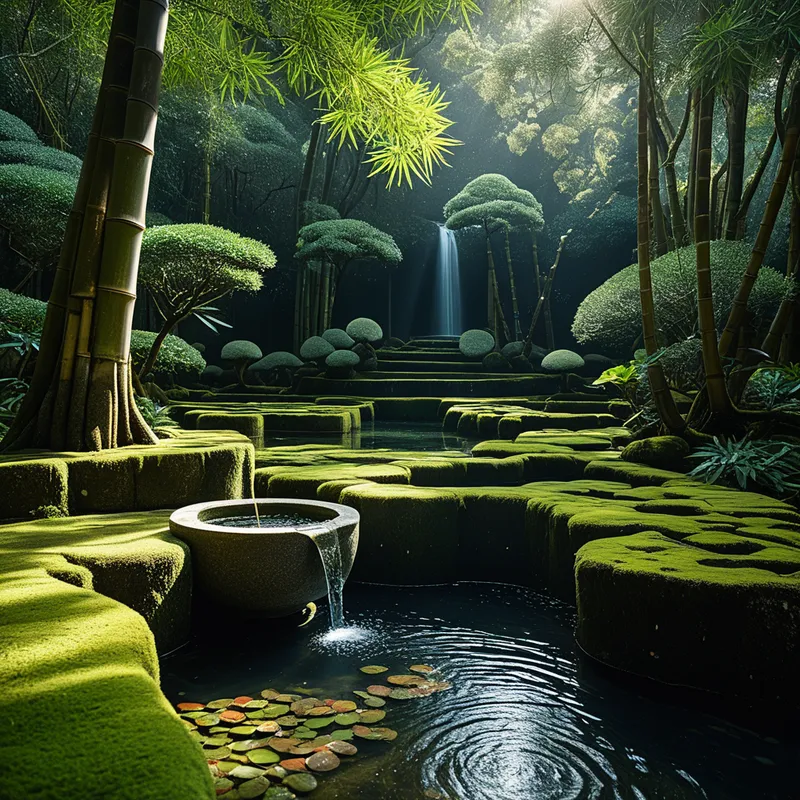
Listen, and let the mist of the mountains carry you back. In the age when the kami walked the earth as plainly as the fox walks through the bamboo grove, there was a place of profound stillness. It was not a grand shrine of gold and crimson, but a humble clearing where the world held its breath. Here, a simple stone basin, a tsukubai, waited. Its water, fed by a hidden spring, was a mirror to the sky, cold enough to startle the soul awake.
To this place came a great and radiant kami. His name is lost to the whispering pines, but his pride was a known thing, a brilliance that cast long shadows. He moved through the world as one who owned the very light, and the lesser spirits bowed as he passed. His journey brought him to the clearing, his throat parched from travel. He saw the basin, this low, unadorned stone vessel, and he bent—a gesture so foreign it seemed to crack the air.
But as he reached for the water, a voice, soft as moss yet firm as bedrock, arose. It was the spirit of the place, the guardian of the spring. “Great one,” the spirit murmured, “the water is pure, but to receive it, you must bow lower still. The basin is made for humility. To drink, you must become smaller than the stone.”
The kami froze, his hand hovering. Indignation, hot and bright, flared within him. To be instructed by a mere place-spirit? To bow before a common rock? The conflict was a silent storm. The rising action was the trembling of his own divine will against the immutable truth of the basin. The clearing grew colder; the water seemed to recede. He could command the water to rise, but that would not be receiving. It would be taking.
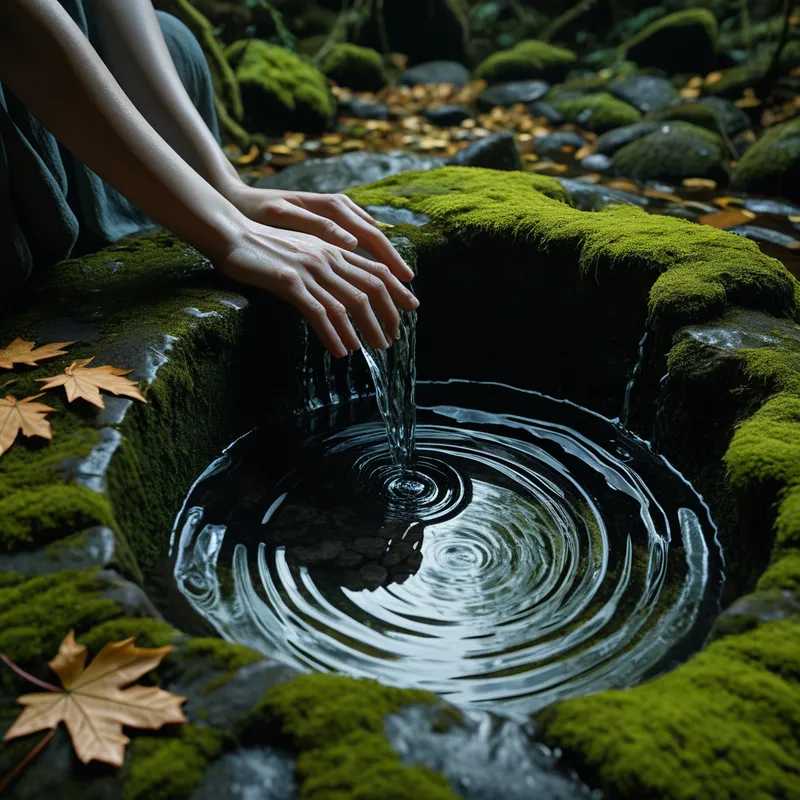
And so, the proud deity knelt. Not the graceful bend of a lord, but the true, deep kneel of a supplicant. His knees pressed into the damp earth, his spine curved, his proud head lowered until his face was level with the basin’s rim. In that posture, the world changed. The sky in the water was vaster. The sound of the dripping bamboo pipe was a sacred chant. He cupped his hands, broke the surface, and brought the cold, living water to his lips.
The resolution was not a shout, but a sigh that stirred the leaves. In the act of bowing lower than the gift, he received not just water, but understanding. The purity was not in the water alone, but in the posture of receiving it. He rose, not diminished, but filled with a quiet, radiant grace he had never known. He left the clearing, and the tsukubai remained, a silent teacher for all who would come after.
Cultural Origins & Context
The story of the tsukubai is less a formal, canonical myth recorded in texts like the Kojiki or Nihon Shoki, and more a living, etiological tale—a story that explains the meaning and purpose of a sacred object. It originates from the profound synthesis of Shinto animism and Zen Buddhist practice, finding its home in the karesansui and tea gardens of temples.
Its primary tellers were the tea masters and Zen monks, for whom the tsukubai was not merely a utilitarian object but a central tokonoma of spiritual instruction. The tale was passed down orally, often in the quiet moments before or after the chanoyu. Its societal function was deeply pedagogical. In a culture with intricate social hierarchies, the myth served as a profound leveler. It taught that before the sacred—be it the tea kami, a guest, or one’s own inner truth—all must assume a posture of humility. The physical act of bending low to use the basin became a somatic rehearsal of this psychological and spiritual principle, integrating the myth directly into bodily practice.
Symbolic Architecture
At its core, the tsukubai myth is an allegory of ego dissolution and the paradoxical source of true power. The stone basin itself is the ultimate symbol. It is low, unchanging, and receptive. It does not elevate itself; it exists to be lower than the user, inverting the expected hierarchy. The water represents the flow of life, spirit, clarity, and grace—a gift that is always present but cannot be seized by a grasping hand.
The basin teaches that the vessel must be lower than the source to be filled. So too must the psyche be lowered to receive insight.
The proud kami represents the untamed, inflated consciousness—the ego that believes it is the source of its own light. His journey is one of necessary thirst, a spiritual dryness that drives him to seek. The conflict at the basin is the critical moment of kenshō, where the ego’s assumptions are confronted by a deeper, impersonal truth. The act of kneeling is the symbolic death of pride; the drinking is the rebirth into a state of connectedness. The myth encodes the sacred law of reciprocity: grace flows only to those who position themselves correctly to receive it.
The Dreamer’s Resonance
When this myth stirs in the modern unconscious, it often manifests in dreams of constrained spaces, low doorways, or seeking water that is just out of reach. The dreamer may find themselves in a beautiful garden but fixated on a simple, mossy fountain. They may feel a profound thirst, yet every glass they pick up is empty or shatters.
Somatically, this points to a process of necessary humiliation—not humiliation by another, but the ego’s humbling before the Self. The psyche is orchestrating a confrontation with an inflated self-image. The dreamer may be clinging to a position of intellectual pride, professional arrogance, or spiritual one-upmanship. The dream-tsukubai presents the solution: you must bend. The psychological process is one of deflation, where the psychic energy trapped in maintaining a lofty self-concept is released, creating a vacuum. This vacuum then naturally draws in the nourishing “water” of authentic feeling, intuitive wisdom, or forgiven vulnerability. The dream is an invitation to surrender a posture that is causing inner drought.
Alchemical Translation
The alchemical journey modeled by the tsukubai myth is the transmutation of leaden pride into golden humility—a core stage in the individuation process. The proud kami is the initial state of the psyche, identified with its own brilliance (the nigredo or blackening, here manifest as the shadow of arrogance). The journey to the clearing is the conscious recognition of a lack, a spiritual thirst that worldly achievements cannot quench.
The confrontation at the basin is the mortificatio—the symbolic death. The ego, faced with an immutable law of the soul, must “die” to its former self-importance.
The act of kneeling is the solutio—the dissolving of rigid structures in the waters of the unconscious. The ego dissolves so the Self can emerge.
Finally, drinking the water is the coniunctio—the sacred marriage where the humbled conscious mind is united with the nourishing waters of the deep unconscious. The individual is no longer a proud, isolated deity, but an integrated part of the flowing whole. For the modern seeker, this translates to practical alchemy: before any true growth can occur, one must consciously and willingly assume a posture of learning, of not-knowing, of receptive silence. Whether in therapy, meditation, or creative work, we must “bow lower than the basin”—to approach our own inner truth, our pain, or our art with a humility that allows it to speak, and in speaking, to fill us. The gift is always there, flowing from the eternal spring. The myth asks only that we make ourselves low enough to receive it.
Associated Symbols
Explore related symbols from the CaleaDream lexicon: