Tsukimi Pavilion Myth Meaning & Symbolism
A myth of a mortal who builds a pavilion to capture the moon's reflection, forging a fragile bridge between the human world and the eternal.
The Tale of Tsukimi Pavilion
Listen, and let the veil between worlds grow thin. In an age when the mountains were younger and the rivers sang clearer songs, there lived a noble of profound and melancholy heart. His name is lost to the whispering pines, but his longing remains, etched into the very air of a certain remote peak. This man was a prisoner of beauty, and his jailer was the moon.
Each night, as Tsukuyomi-no-Mikoto’s silver chariot climbed the vault of heaven, a sickness would seize him. It was not a sickness of the body, but of the soul—a piercing desire to hold, to commune with, that cool, distant perfection. The moon’s light was a balm and a torment. It illuminated the transient beauty of the cherry blossoms in his garden, only to remind him that they, and he, would fade. He built viewing platforms, composed countless poems, yet the moon remained aloof, a sovereign queen in her cold palace of stars.
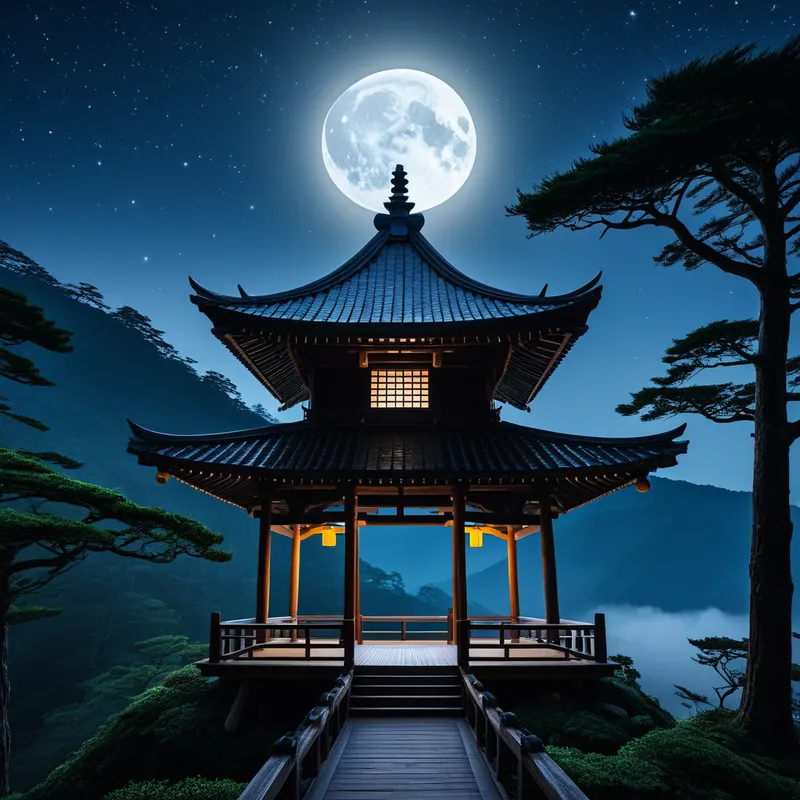
Then, a vision was born from his despair. He would not merely watch; he would invite. He commanded the finest artisans, woodworkers who could hear the soul of the cypress, to journey to a sacred, isolated mountainside. There, they were to construct not a palace, but a pavilion—a single, perfect room open to the sky. Its specifications were divine geometry: the pillars were to be placed so that on the night of the harvest moon, the lunar orb would rise precisely within the frame of its eastern opening. The roof was to be thatched so thinly that moonlight would filter through, dappling the floor. At the pavilion’s center, a shallow basin of the clearest spring water was set, waiting to become a second, captive sky.
The night of completion arrived. The world held its breath. The noble ascended the mountain, his heart a drum of hope and fear. He entered the Tsukimi-dono and knelt by the basin. As the first sliver of light breached the distant ridge, a miracle unfolded. The moon, as if honoring a solemn pact, sailed silently into the open archway. Its brilliance did not just fill the sky; it poured into the pavilion, and there, in the still water, lay its perfect, complete reflection—a twin, closer and more intimate than the distant original.
For a timeless moment, he held communion. He was no longer a man looking at the moon, but a soul residing within a sacred junction where heaven met earth. He poured sake as an offering, whispered poems that were not words but pure feeling. That night, the boundary dissolved. But as the night waned, so did the miracle. The moon continued its silent journey, sliding from the wooden frame. The reflection in the water trembled, distorted, and vanished with the first grey hint of dawn. The pavilion stood empty, a beautiful, aching vessel. The noble descended, carrying not the moon, but the memory of its touch—a bittersweet treasure that both fulfilled and eternalized his longing.
Cultural Origins & Context
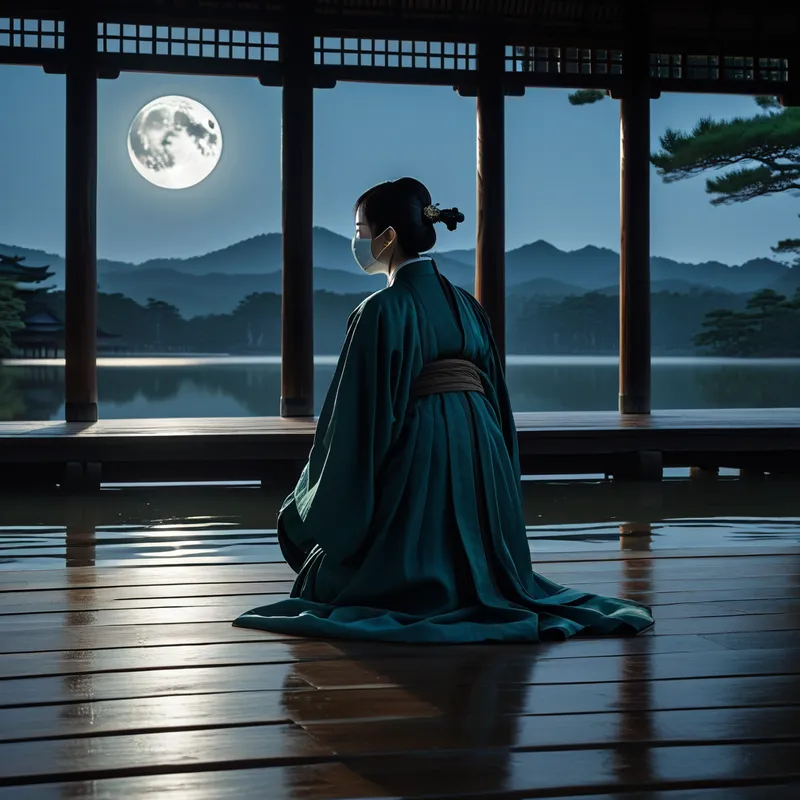
This myth, while not codified in a single canonical text like the Kojiki, is woven from the very fabric of Heian-period (794-1185) aesthetic and spiritual sensibility. It is a mono no aware narrative par excellence—a story profoundly aware of the poignant beauty of impermanence. The practice of tsukimi itself was elevated to an art form during this era, influenced by Chinese Mid-Autumn Festival traditions but refined into a uniquely Japanese expression of poetic melancholy and spiritual observation.
The tale likely circulated among courtiers and poets, told not as a religious doctrine but as an exemplary legend that gave narrative form to a shared cultural feeling. It served a societal function of modeling refined sensitivity (miyabi) and illustrating the ultimate, beautiful failure of the human attempt to possess the transcendent. The pavilion is a physical manifestation of the Heian ideal: creating a controlled, artistic space (oku) to frame and engage with nature’s sublime power, acknowledging both connection and eternal separation.
Symbolic Architecture
The Tsukimi Pavilion is not merely a building; it is a psychic blueprint. The noble represents the human ego-consciousness, which feels itself separate from the source of beauty, meaning, and the eternal—symbolized by the moon. His longing is the engine of the soul’s development.
The pavilion is the constructed self, the conscious personality built with intention to house a meeting with the divine.
The mountain setting signifies the arduous, isolating journey inward, away from the collective world. The precise architecture—the frame that captures the moon—symbolizes the necessity of structure, ritual, and focused attention to create a vessel capable of receiving numinous experience. The most profound symbol is the water basin. It represents the reflective capacity of the unconscious mind. The moon (the Self, wholeness) cannot be grasped by the ego, but it can be reflected within the still, clear depths of the psyche when the ego aligns itself correctly (the pavilion’s frame).
The myth’s resolution is its deepest teaching: the reflection is perfect, but temporary. The ego cannot permanently contain the Self. To try is madness; to have witnessed the reflection is transformation.
The Dreamer’s Resonance
When this myth stirs in the modern unconscious, it may manifest in dreams of exquisite, unattainable beauty. One might dream of a perfect, secluded house with one wall missing, open to a stunning but distant vista. Or of trying to fill a container with light, moonlight, or water, only to have it seep away. The somatic feeling is one of aching fullness coupled with gentle loss—a deep sigh in the soul.
Psychologically, this dream pattern signals a process of relating to the archetype of the Self, rather than identifying with it. The dreamer is in a phase where they have constructed enough ego-strength (the pavilion) to consciously engage with wholeness, but are learning the difficult lesson of non-possession. It is the process of moving from addictive longing to sacred appreciation. The sadness felt upon waking is not pathological, but the honest residue of confronting the gap between the human and the infinite—a gap that is the very space where poetry, art, and reverence are born.
Alchemical Translation
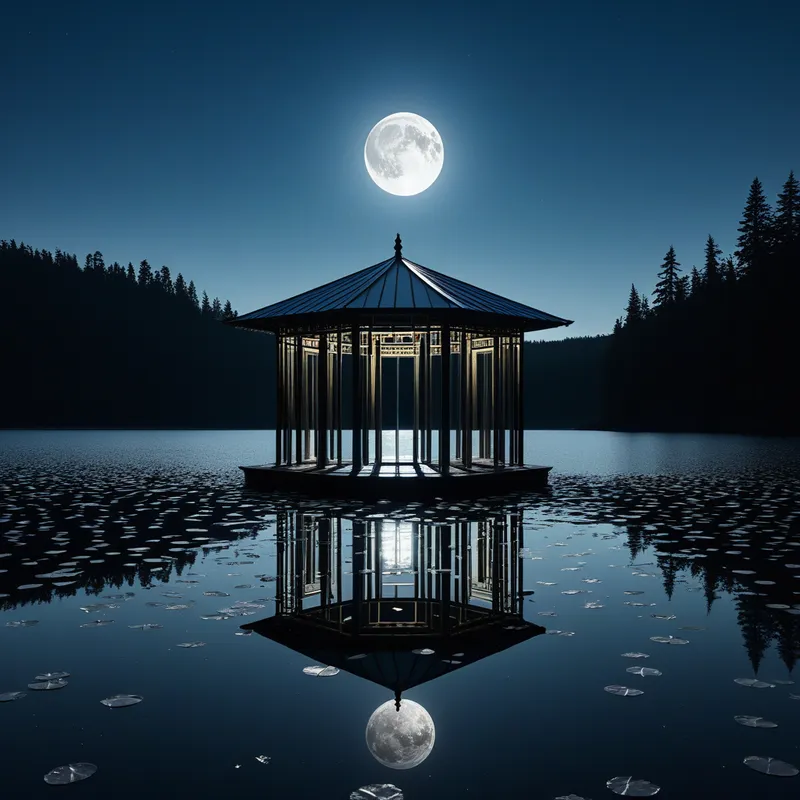
The alchemical journey mirrored here is the opus of Lunaria, the silver work. The base material is the leaden weight of melancholy and existential loneliness (the noble’s initial sorrow). Through the nigredo of devoted labor (building the pavilion on the remote mountain), a structure is created. The albedo, the whitening, is the moment of pure reflection—the moon captured in the water. This is the illuminating, revelatory experience of inner unity, where the conscious mind sees its source reflected in the unconscious.
The triumph is not in holding the silver, but in becoming the silver vessel.
The final, crucial stage is the conscious acceptance of the moon’s departure—the rubedo or citrinitas of this process. Here, the gold is not permanent possession, but the transmutation of longing into a lasting, inner relationship. The ego, having been the site of the conjunction, is forever altered. It is no longer a desperate seeker, but a humble custodian of the pavilion—a space within the psyche that remains open, oriented, and forever capable of hosting fleeting moments of celestial grace. The individual learns to live with the beautiful wound of impermanence, which becomes not a source of despair, but the wellspring of all true creativity and connection to the world’s fleeting splendor.
Associated Symbols
Explore related symbols from the CaleaDream lexicon: