Tsar Ivan the Terrible Myth Meaning & Symbolism
A myth of a pious ruler's descent into monstrous tyranny, embodying the terrifying union of divine authority and unchecked human shadow.
The Tale of Tsar Ivan the Terrible
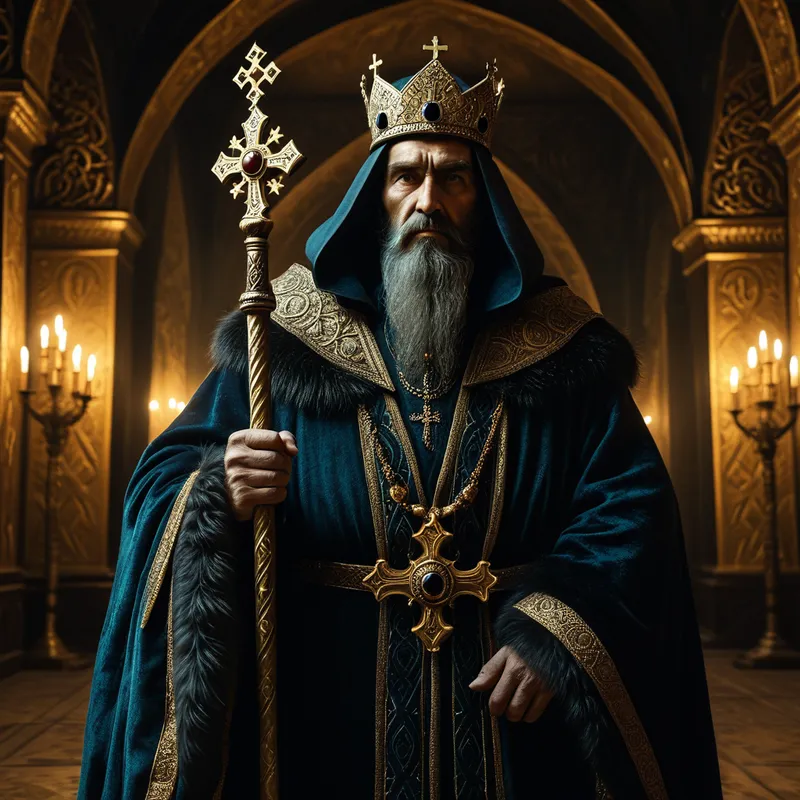
Listen, and hear the tale that echoes in the stones of the Kremlin and the deep, dark forests of the north. It begins not with a monster, but with a chosen one. A boy, Ivan, crowned under the soaring domes, anointed by God to be the first Tsar of All the Russias. The air was thick with incense and hope. He was a scholar, a lawgiver, a pious man who wept during prayers, his soul a vessel for a divine mission: to gather the fractured principalities into one holy, powerful body, a Sobornost made manifest in an empire.
But [the world](/myths/the-world “Myth from Tarot culture.”/) is a cold teacher. Orphans learn to trust no one. Betrayal is a poison that seeps into the marrow. The boyars, the proud nobles, schemed in shadowed halls, their loyalty as thin as winter ice. His beloved first wife, Anastasia, was taken from him—he was certain, by their venom. The grief did not soften him; it calcified into a granite certainty: [the world](/myths/the-world “Myth from Tarot culture.”/) was a nest of serpents, and God’s anointed was the only one who could cleanse it.
So began the great unraveling. The pious scholar’s quill was set aside. In its place rose the Oprichniki, men clad in black, riding black horses, with a dog’s head and a broom tied to their saddles—to sniff out treason and sweep the land clean. Their loyalty was to the Tsar alone, a perverse mirror of monastic brotherhood devoted to terror. Now, the Tsar’s prayers were punctuated by screams from the dungeons. The man who once expanded his realm with wisdom now gazed upon the map with a paranoid’s eye, seeing conspiracy in every border.
The climax of the tale is not a battle, but a moment of shattered divinity. In a fit of rage, a argument over some trivial slight, the Tsar raised his iron-tipped staff and struck his own son and heir, the Tsarevich Ivan. The blow landed true. And as the young man’s life bled out onto the palace floor, the terrible truth crashed upon the father. The monster he had forged to protect God’s kingdom had just destroyed its future. In that instant, the divine mandate cracked. The wail that tore from the Tsar’s throat was not of a ruler, but of a damned soul, staring into [the abyss](/myths/the-abyss “Myth from Kabbalistic culture.”/) he himself had carved. He lived on, a hollowed-out icon, praying fervently for the soul of the son he killed, a ghost haunting the throne he had made a seat of absolute, lonely terror.
Cultural Origins & Context
This is not a myth from a misty pagan antiquity, but a historical memory distilled into a national parable. The figure of Ivan IV, “Grozny”—a term better translated as “Awe-Inspiring” or “Formidable” than simply “Terrible”—is rooted in the 16th century, a pivotal era of Russian state-building. The stories of his piety and his psychosis were woven together in folk songs (byliny), chronicles, and the oral histories of a people caught between the need for a strong, unifying ruler and the horror of his methods.
The myth was told not to chronicle dates, but to grapple with a fundamental Russian tension: the yearning for a righteous, paternal Batushka-Tsar and the terror of his unchecked power. It served as a cautionary tale about the corruption of absolute authority and the fragility of the soul under the burden of divine right. It asked a haunting question of the collective: what price must be paid for unity and order? The myth of Ivan is [the shadow](/myths/the-shadow “Myth from Jungian culture.”/) cast by the dream of the Svyataya Rus.
Symbolic Architecture
At its core, the myth of Ivan is a terrifying map of the [disintegration](/symbols/disintegration “Symbol: A symbol of breakdown, loss of form, or fragmentation, often reflecting anxiety about personal identity, control, or stability.”/) of the ego under the [weight](/symbols/weight “Symbol: Weight symbolizes burdens, responsibilities, and emotional loads one carries in life.”/) of an inflated Self [archetype](/symbols/archetype “Symbol: A universal, primordial pattern or prototype in the collective unconscious that shapes human experience, behavior, and creative expression.”/). He begins as the idealized Ruler, a conscious servant of a higher order (God, the state). But when the personal [psyche](/myths/psyche “Myth from Greek culture.”/) is wounded—by [betrayal](/symbols/betrayal “Symbol: A profound violation of trust in artistic or musical contexts, often representing broken creative partnerships or artistic integrity compromised.”/), [grief](/symbols/grief “Symbol: A profound emotional response to loss, often manifesting as deep sorrow, yearning, and a sense of emptiness.”/), paranoia—the unconscious [Shadow](/symbols/shadow “Symbol: The ‘shadow’ embodies the unconscious, repressed aspects of the self and often represents fears or hidden emotions.”/) rises to defend it.
The Shadow does not knock at the door; it becomes the door, and the ruler who steps through it is transformed into the very monster he sought to keep outside.
The Oprichniki are the perfect [symbol](/symbols/symbol “Symbol: A symbol can represent an idea, concept, or belief, serving as a powerful tool for communication and understanding.”/) of this psychic civil war. They represent the compartmentalized, brutalized function of the psyche that is enlisted to purge perceived enemies—which are often projections of the ruler’s own [vulnerability](/symbols/vulnerability “Symbol: A state of emotional or physical exposure, often involving risk of harm, that reveals authentic self beneath protective layers.”/), doubt, and humanity. The dog’s head signifies a feral, predatory loyalty; the [broom](/symbols/broom “Symbol: A broom symbolizes cleansing, order, and the act of removing negative influences from one’s life.”/), a manic, impossible desire for purity. Ivan’s tragedy is that he consciously believes he is serving God (the transcendent Self), while his actions are dictated entirely by the possessed ego, now fused with the Shadow. The killing of his son is the ultimate symbolic act: the possessed psyche, in its rage for control, murders its own future, its own potential for renewal and continuity.
The Dreamer’s Resonance
To dream of Ivan the Terrible is to encounter a profound inner state of tyrannical possession. The dreamer may not see a historical figure, but will feel the atmosphere: an oppressive, paranoid authority that has taken root within. This could manifest as a relentless, critical inner voice that brooks no dissent, a rigid need for total control over one’s environment or relationships, or a feeling of being both the feared ruler and the terrified subject in one’s own psyche.
Somatically, this dream pattern resonates with the body armoring of constant vigilance—a tight jaw, clenched fists, a knotted stomach. It speaks to a psychological process where vulnerability has been so deeply wounded that the psyche’s defense has become its totality. The dream is a signal from the depths that the inner kingdom is under a state of siege, ruled by a logic of fear, and that the true sovereign—the integrated Self—has been deposed.
Alchemical Translation
The alchemical journey modeled here is the [Nigredo](/myths/nigredo “Myth from Alchemical culture.”/)—the blackening, the descent into the utter darkness of the soul’s own corruption. Ivan’s myth shows us the stage before transformation can begin: the catastrophic recognition that the chosen identity (the pious, strong ruler) has been utterly contaminated by its opposite.
The alchemical fire is not kindled by will, but by the searing heat of self-confrontation. The gold cannot be found until the base metal of one’s own terrible nature is fully seen and endured.
For the modern individual, this myth does not counsel becoming a tyrant, but courageously recognizing where one plays the tyrant in one’s own life. Where do we deploy our inner Oprichniki—our harsh judgments, our rigid rules, our brutal self-criticism—to purge parts of ourselves we fear are weak, messy, or disloyal? The path of transmutation begins with the moment Ivan experiences over his son’s body: the shattering realization of what the possessed identity has cost. This is the dreadful, necessary death of the old, inflated ego. From this blackest ashes, the work of Albedo (whitening, purification) can begin—not through more force, but through the grieving acceptance of one’s own shadow, and the slow, painful reintegration of the exiled humanity. One must cease being the Terrible Tsar to become, simply, a human being, answerable at last not to an inflated idea, but to the broken, real world and the soul within it.
Associated Symbols
Explore related symbols from the CaleaDream lexicon: