Trumpets of Jericho Myth Meaning & Symbolism
A besieged people circle a mighty city for seven days. On the seventh, their priests' trumpets sound, and the city's walls fall by divine command.
The Tale of the Trumpets of Jericho
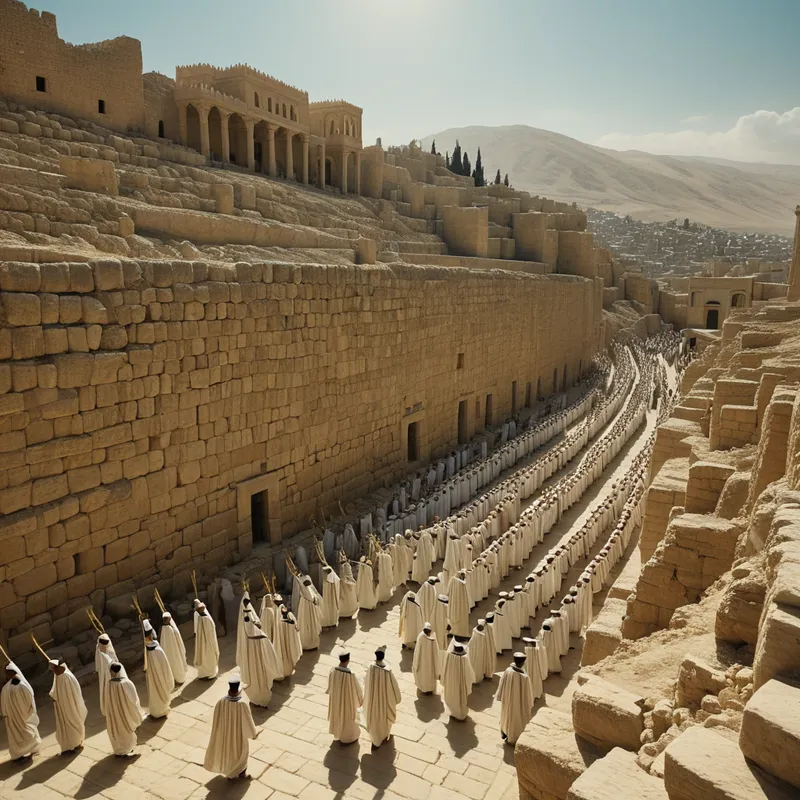
The land was a furnace, and the city was a tooth set in its jaw. [Jericho](/myths/jericho “Myth from Biblical culture.”/) was its name, and its walls were a legend carved in stone, so high they scraped the belly of [the sky](/myths/the-sky “Myth from Persian culture.”/), so thick they swallowed the sun’s shadow whole. Behind them, a kingdom held its breath, its people peering from parapets at the dust cloud on the plain. It was the dust of a nation born in slavery, a people led by a weathered prophet, Joshua, son of Nun.
They came not with the roar of chariots, but with a silence that was louder. The Israelites camped, a sea of tents and weary hope, before the impregnable gate. And the voice of YHWH came to Joshua, a whisper in [the desert](/myths/the-desert “Myth from Biblical culture.”/) wind, with a strategy of madness. There would be no siege engines, no scaling ladders. There would be a procession, a sacred circling.
For six days, as the sun blazed and [the watchers](/myths/the-watchers “Myth from Christian culture.”/) on the walls mocked, a solemn column emerged from the camp. At its heart marched seven priests, bearing before the Ark of the Covenant—the very footstool of the Divine Presence. In their hands they carried seven trumpets made from the horns of rams, instruments of proclamation, not war. Behind them walked the armed men, but their swords remained sheathed. In utter silence, save for the shuffle of sandals on dust and the distant, nervous bleat of a goat from the city, they circled the immense wall once. Then they returned to their camp. The next day, they did the same. And the next. A ritual of unbearable tension, a tightening of an invisible noose.
On the seventh day, they rose in the grey pre-dawn. This day, the circling was not once, but seven times. The air grew thick, charged with a pressure that had nothing to do with the heat. On the seventh circuit, as the column completed its final, fateful turn, Joshua raised his hand. His voice cracked the pregnant silence: “Shout! For YHWH has given you the city!”
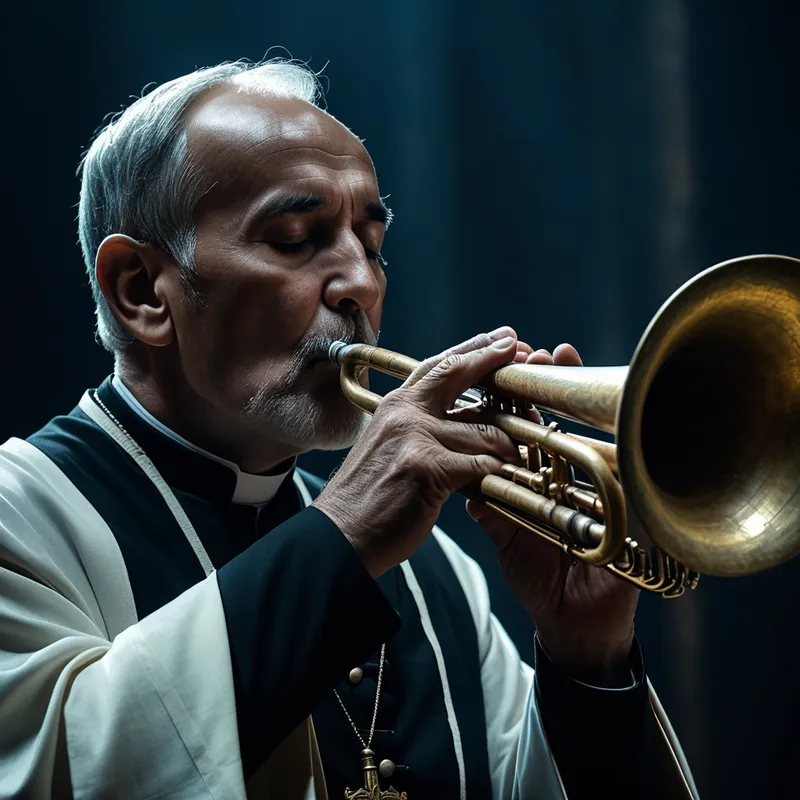
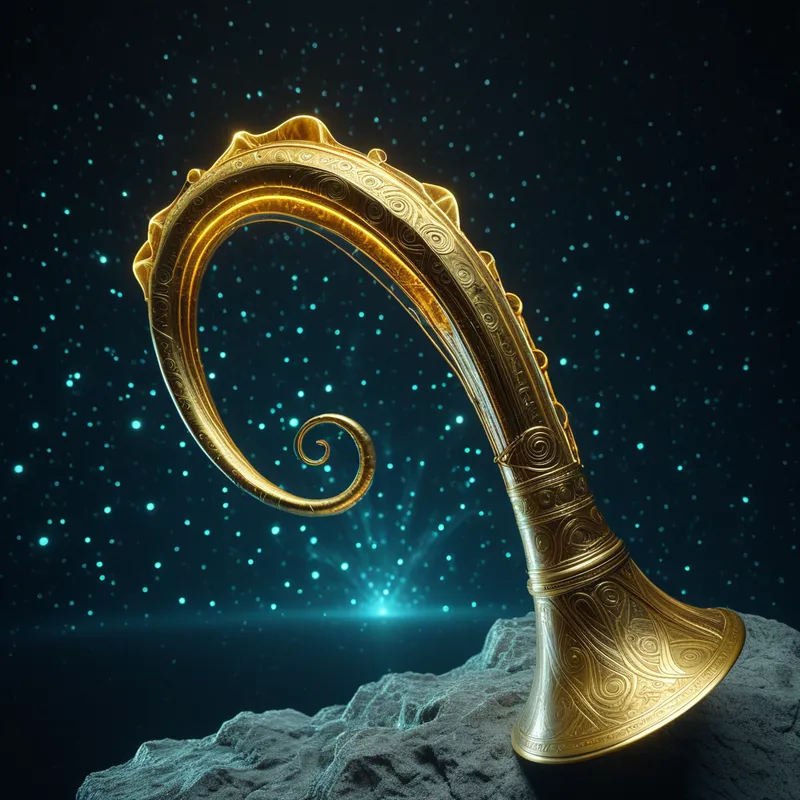
And the priests, their lungs filled with forty years of wilderness and promise, put the ram’s horns to their lips. A sound erupted—not a melody, but a raw, sustained blast, a shofar cry that tore at the fabric of [the world](/myths/the-world “Myth from Tarot culture.”/). It was the sound of covenant, of freedom declared, of a command that bypassed stone to speak to the foundations of [the earth](/myths/the-earth “Myth from Hindu culture.”/) itself. As one, the people roared, a thunder from human throats.
And the walls heard. The great stones, which had defied kings and time, began to tremble. Not from without, but from within. A deep groan rose from the ground, and the legendary fortifications of Jericho shuddered, cracked, and fell in upon themselves in a roaring avalanche of dust and shattered rock. Every wall, save one house marked by a scarlet cord, fell flat. The city that was closed was opened. The impossible was made passage.
Cultural Origins & Context
This narrative is anchored in the Book of Joshua, a text that sits at the fraught intersection of tribal foundation epic and theological manifesto. It belongs to the Torah’s sequel, detailing the conquest of Canaan. For ancient Israel, this was not merely a war story; it was a sacred charter. The tale of Jericho served a critical societal function: to establish, in the most dramatic terms possible, that the land was a divine gift, not a military prize. Victory was attributed solely to the power of YHWH, enacted through strict ritual obedience.
The story was likely passed down orally for generations before being codified, told around fires to reinforce identity, faith, and the radical notion that their God operated on a logic contrary to earthly power. The use of the shofar is deeply significant—it was the instrument of coronation, the Jubilee, and the announcement of holy war (herem). Here, its blast is the trigger of divine judgment and the fulfillment of oath. The story thus culturally functions to subordinate human agency to divine protocol, making collective identity contingent upon faithful adherence to a sacred pattern.
Symbolic Architecture
At its core, the myth is a profound [allegory](/symbols/allegory “Symbol: A narrative device where characters, events, or settings represent abstract ideas or moral qualities, conveying deeper meanings through symbolic storytelling.”/) for the collapse of a hardened, defensive [psyche](/myths/psyche “Myth from Greek culture.”/) through a force that is vibrational, faithful, and patient.
The [Walls of Jericho](/myths/walls-of-jericho “Myth from Biblical culture.”/) symbolize any rigid, seemingly impregnable [structure](/symbols/structure “Symbol: Structure in dreams often symbolizes stability, organization, and the framework of one’s life, reflecting how one perceives their environment and personal life.”/) of the psyche: a complex, a [trauma](/symbols/trauma “Symbol: A deeply distressing or disturbing experience that overwhelms the psyche, often manifesting in dreams as unresolved emotional wounds or psychological injury.”/), a lifelong [pattern](/symbols/pattern “Symbol: A ‘Pattern’ in dreams often signifies the underlying structure of experiences and thoughts, representing both order and the repetitiveness of life’s situations.”/) of [defense](/symbols/defense “Symbol: A protective mechanism or barrier against perceived threats, representing boundaries, security, and resistance to external or internal challenges.”/), a dogma, or an inflated ego. They represent that which is closed off, fortified against change, and seemingly permanent.
The Seven Trumpets (Shofars) are not weapons of destruction but instruments of [revelation](/symbols/revelation “Symbol: A sudden, profound disclosure of truth or insight, often through artistic or musical means, that transforms understanding.”/) and [announcement](/symbols/announcement “Symbol: An announcement in dreams often symbolizes the arrival of new information or significant changes in one’s life.”/). They symbolize the focused, intentional voice—the declared [truth](/symbols/truth “Symbol: Truth represents authenticity, honesty, and the quest for knowledge beyond mere appearances.”/), the heartfelt [prayer](/symbols/prayer “Symbol: Prayer represents communication with the divine or a higher power, often reflecting inner desires and spiritual needs.”/), the therapeutic [word](/symbols/word “Symbol: Words in dreams often represent communication, expression, and the power of language in shaping our realities.”/), the creative [idea](/symbols/idea “Symbol: An ‘Idea’ represents a spark of creativity, innovation, or realization, often emerging as a solution to a problem or a new outlook on life.”/) that is sounded against the [wall](/symbols/wall “Symbol: Walls in dreams often symbolize boundaries, protection, or obstacles in one’s life, reflecting the dreamer’s feelings of confinement or security.”/). Their power lies not in physical force but in their [resonance](/symbols/resonance “Symbol: A deep, sympathetic vibration or connection, often in sound or feeling, that amplifies and harmonizes across systems.”/) with a higher order.
The Seven-Day March represents the necessary, often tedious, process of circumambulation—the [ritual](/symbols/ritual “Symbol: Rituals signify structured, meaningful actions carried out regularly, reflecting cultural beliefs and emotional needs.”/) repetition, the conscious circling of a [problem](/symbols/problem “Symbol: Dreams featuring a ‘problem’ often symbolize internal conflicts or challenging situations that require resolution and self-reflection.”/). It is the work of [attention](/symbols/attention “Symbol: Attention in dreams signifies focus, awareness, and the priorities in one’s life, often indicating where the dreamer’s energy is invested.”/), the commitment to show up daily, even when no change is visible. It builds the energetic charge.
The Fall is not a violent demolition from the outside, but a collapse from within. It signifies the [moment](/symbols/moment “Symbol: The symbol of a ‘moment’ embodies the significance of transient experiences that encapsulate emotional depth or pivotal transformations in life.”/) a complex loses its power, when a defense [mechanism](/symbols/mechanism “Symbol: Represents the body’s internal systems, emotional regulation, or psychological processes working together like a machine.”/) crumbles because its foundational lie has been resonated out of existence.
The most formidable walls are not made of stone, but of fear and forgetfulness. They fall not by siege, but by a sustained note of remembered truth.
The Dreamer’s Resonance
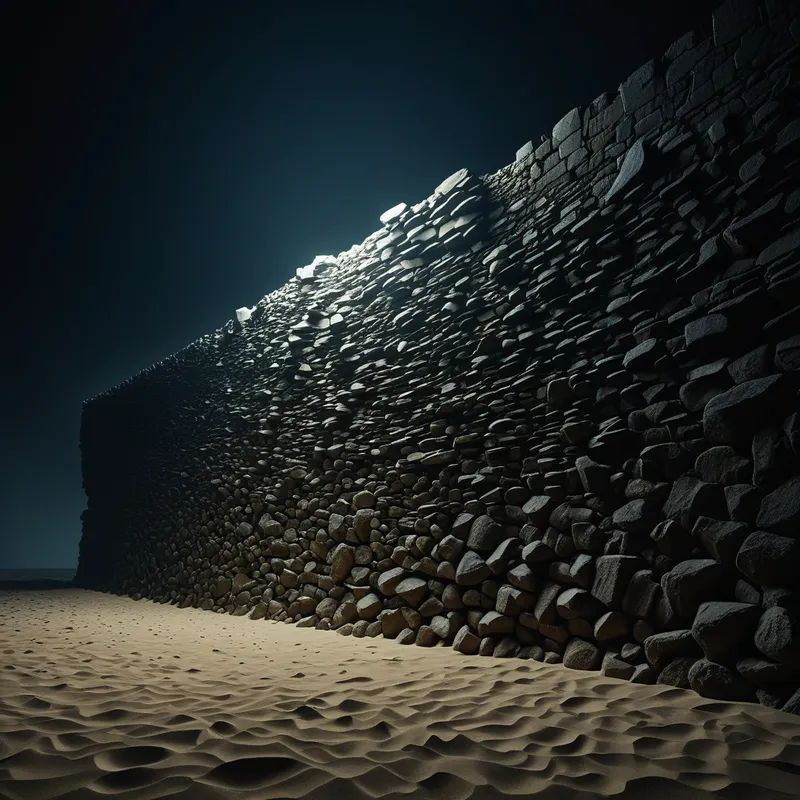
When this myth stirs in the modern unconscious, it often manifests in dreams of confronting immense, obstructive barriers. One may dream of a vast wall blocking a path, a sealed vault one cannot open, or a fortress they feel compelled to circle. The somatic feeling is one of immense pressure and futility, mixed with a strange, ritualistic determination.
Psychologically, the dreamer is in a process of confronting a deeply entrenched complex. The repetitive circling in the dream mirrors the conscious work they are doing in life—perhaps therapy, journaling, or a creative practice—where they feel they are “going around in circles” without breakthrough. The dream is an affirmation of that very process. The appearance of a sound, often a deep hum, a bell, or a horn blast that causes a tremor, signals that the unconscious is preparing a resolution. It indicates that the patient, repetitive work is building to a critical mass where a core insight or emotional release ([the fall](/myths/the-fall “Myth from Biblical culture.”/) of the wall) is imminent. The dream is a map of the psyche’s own protocol for transformation: patience, ritual, and the final, shocking efficacy of truth.
Alchemical Translation
For the individual on the path of individuation, [the Trumpets of Jericho](/myths/the-trumpets-of-jericho “Myth from Biblical culture.”/) model the alchemical stage of [solutio](/myths/solutio “Myth from Alchemical culture.”/)—the dissolution. Our psychic Jericho is the calcified [persona](/myths/persona “Myth from Greek culture.”/), the defensive character we have built to survive the world. Its walls are our pride, our old wounds armored over, our limiting beliefs.
The alchemical work begins with the circumambulatio—the circling. This is the disciplined, daily practice of self-observation, of circling the complex without attacking it head-on. It is mindfulness, active imagination, or any practice that brings conscious attention to the unconscious structure. For six “days,” nothing seems to happen. [The ego](/myths/the-ego “Myth from Jungian culture.”/) grows impatient.
The seventh day is the arrival at the symbolic center, [the Self](/myths/the-self “Myth from Jungian culture.”/). The sevenfold circuit represents the completion of a psychic cycle. The trumpets are the ego’s act of alignment with the Self’s command—the courageous articulation of what one knows, deep down, to be true. It is the moment one finally speaks their shame, owns their desire, or acknowledges their shadow.
The alchemical blast of the trumpet is the ego’s surrender to a logic greater than its own defenses. The wall that falls is the illusion of separateness, revealing the open space where the true city of the Self can be built anew.
The collapse is not annihilation, but liberation. The rubble of the old defenses becomes the raw material for building a more authentic inner landscape. The scarlet cord of Rahab, spared in the collapse, symbolizes that which in our psyche—perhaps an intuition, a hidden loyalty, a seed of future potential—is preserved through the tumult, to be integrated into the new order. The myth, therefore, is a master blueprint for how faith—understood as trust in the transformative process itself—enacts the impossible transmutation of stone into passage.
Associated Symbols
Explore related symbols from the CaleaDream lexicon: