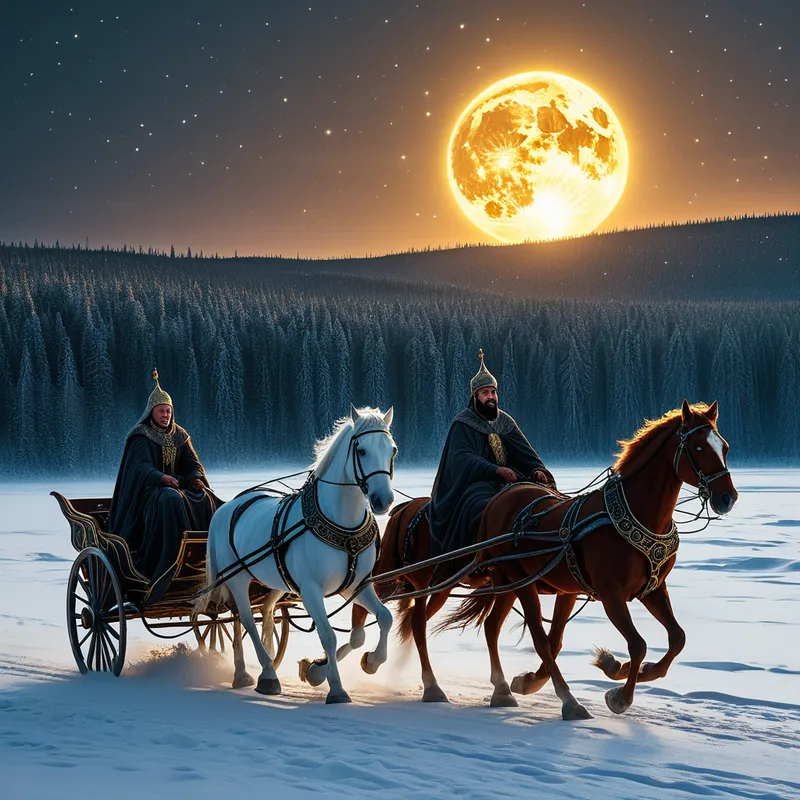
Troika Myth Meaning & Symbolism
A myth of three divine steeds pulling the sun-chariot, embodying the triune forces of creation, preservation, and dissolution across the sky.
The Tale of Troika
Listen, and let the old truth settle in your bones. Before clocks measured time, before cities scarred the earth, the world turned by a breath more ancient. Each dawn was not a given, but a prize hard-won from the jaws of eternal night.
In that time, the sun was not a mere ball of fire, but a living heart, a captive jewel of light. It rested, cold and dormant, in a cavern deep beneath the world, in the realm of Viy or the slumbering Svarog. The sky would remain a barren, black vault forever unless a force of impossible will and unity could wrest it free.
This was the task of the Troika. They were not born, but manifested—three brothers from the same breath of the world-soul. The first was Bely, whose coat was the first hint of morning snow, whose eyes held the pale promise of day. The second was Gnevoy, whose flesh was like living embers, whose breath was the hot wind of summer. The third was Vorony, darker than a moonless midnight, a shape cut from the void itself, steady and unfathomable.
Harnessed together to a chariot of beaten gold and ash-wood, they stood at the edge of the world, where the earth crumbles into star-stuff. Their hooves stamped not on soil, but on the fabric of twilight. With a scream that was both challenge and prayer—a sound woven from whinny, thunder, and breaking ice—they leaped.
Their charge was not a straight path, but a colossal, straining arc across the dome of heaven. Bely led, his white form bleeding light into the darkness, painting the path with streaks of silver and rose. Gnevoy followed, muscles burning, pulling the great weight of the sun’s full, blazing disk into the sky, its heat a tangible force that warmed the frozen lands below. And always, at the flank, was Vorony, his darkness not a retreat but a necessary balance, swallowing the spent light behind them, making space for the journey, his presence a reminder of the abyss they raced against.
It was a daily war. Malevolent spirits, the Navki, would rise as cold mists to lame their legs. The chariot would groan, the sun would shudder. But the Troika’s unity was their power. When Bely faltered, Gnevoy’s fire would bolster him. When Gnevoy’s rage threatened to burn the world, Vorony’s cool darkness would temper him. When the void threatened to overwhelm, the combined light of the first two would push it back.
Their resolution was never final, only cyclical. As they plunged into the western chasm at day’s end, the sun was not lost, but carried on an unseen, subterranean journey back to the eastern gate. The Troika, spent and glorious, would drink from the Smorodina River, its waters healing their celestial fatigue, before gathering their will to run the gauntlet of sky once more at the first cry of the Gamayun.
Cultural Origins & Context
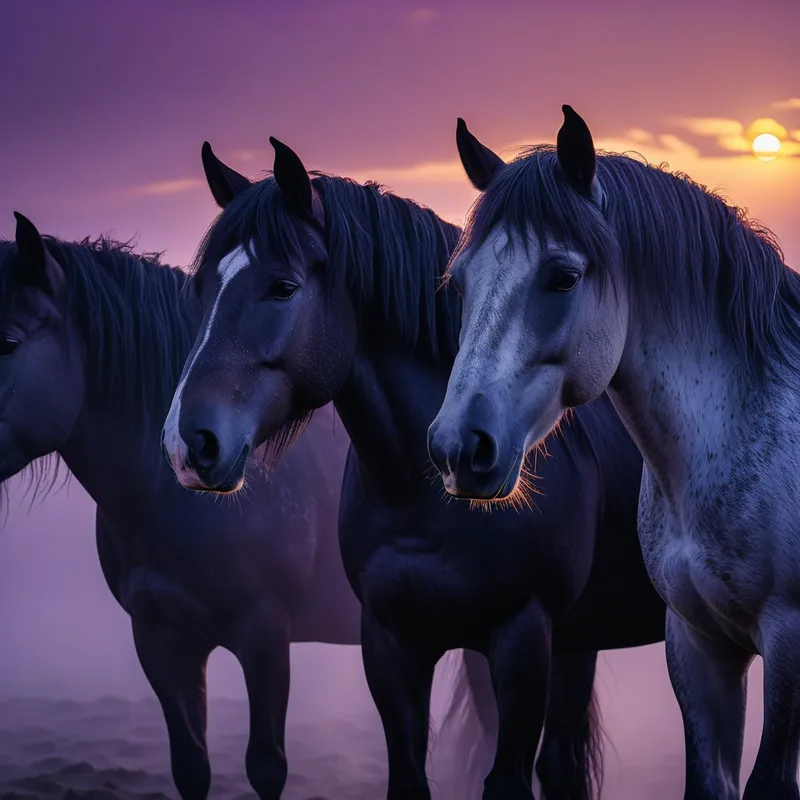
The image of the troika is indelibly etched into the Russian cultural psyche, but its roots sink deep into pre-Christian, Slavic cosmological soil. This was not merely a practical means of transport across vast, snowy plains; it was a living symbol of cosmic order. The myth likely evolved from the observations of nomadic steppe cultures, for whom the horse was soul-kin and survival, merged with the agrarian Slavs’ worship of solar deities like Dazhbog.
It was a myth told not in grand temples, but in the izba during the long, dark winters, woven into byliny and whispered as zagovory. The storyteller, often a elder or a skomorokh, was not just entertaining; they were reinforcing the universe’s fragile balance. The societal function was one of orientation and resilience. It explained the diurnal cycle, yes, but more importantly, it modeled the necessity of harmonious, triune effort. Just as the three horses must pull in unison to move the sun, so must the three estates of the world—the heavenly, the earthly, and the chthonic—or the three aspects of community—strength, spirit, and wisdom—work in concert for survival. It was a myth against entropy and despair, asserting that even the greatest journey (the day, the season, a life) requires multiple, different forces harnessed together.
Symbolic Architecture
Psychologically, the Troika is a masterful representation of the triune nature of the psyche and the dynamics of fate itself. It is the archetypal model of a process that requires divergent elements functioning as one.
The three horses are not good, neutral, and evil. They are three essential modes of being. Bely is the Spirit, the initiating idea, the innocent beginning, the conscious ego setting out with hope. Gnevoy is the Body and the Passion, the driving, visceral life-force, the will to manifest and endure, often carrying the burden of effort. Vorony is the Shadow and the Unconscious, the necessary darkness that contains mystery, rest, dissolution, and the unknown territory we must traverse.
The journey of the sun is not a victory of light over dark, but the sacred, eternal collaboration between them. The black horse does not pull away from the light; it pulls the light through the realm of its own nature.
The chariot is the embodied Self, the vessel of consciousness. The sun is the ultimate value, the central, guiding light of the psyche—the goal of individuation. The myth states unequivocally that this central value cannot be moved by a single force. The intellect (Bely) alone is too frail; raw instinct (Gnevoy) alone is destructive; the unconscious (Vorony) alone is static. Only in harness, in a tense and glorious synergy, does forward motion—individuation, the dawning of consciousness—occur.
The Dreamer’s Resonance
When the Troika gallops into the modern dreamscape, it signals a profound moment of psychic integration. The dreamer is often in a state where a major life “journey” or project feels stalled, or where they feel fragmented into conflicting parts.
To dream of watching the Troika from below, in awe, suggests the dreamer is witnessing their own potential for integrated power from a place of disconnection. They see the magnificent unity required but feel earthbound. To dream of driving the Troika, but losing control, points to a conscious ego struggling to manage the immense, autonomous forces of instinct and the unconscious it has harnessed. The chariot may veer, or one horse may rebel.
A potent modern motif is dreaming of being one of the horses—often feeling the strain of the harness, the foam on one’s own flank. This is a somatic immersion in a specific archetypal energy. Being the white horse may relate to burnout of one’s ideals or initiating spirit; being the red horse may connect to rage or exhausted passion; being the black horse may speak to carrying a burden of repressed material or navigating a dark night of the soul. The dream is the psyche’s way of embodying the specific “horse” that is carrying the load at that time, asking for recognition and re-balance with its brothers.
Alchemical Translation
The alchemical process mirrored in the Troika myth is the Solve et Coagula applied to the soul’s substance. It is the opus of forging unity from multiplicity.
First, the Separatio: The dreamer must first differentiate the three “horses” within. What is my pure, initiating spirit (Bely)? What is my driving, red passion (Gnevoy)? What is my necessary, containing darkness (Vorony)? Often, we try to disown Vorony, the shadow horse, hoping to journey with only light and passion. This leads to a brittle, unsustainable consciousness that cannot withstand the night.
Then, the Coniunctio: This is the harnessing. It is the conscious, often difficult decision to yoke these disparate parts together toward a single, solar goal—the true Self. This is not forced control, but a sacred agreement. The ego (the charioteer) must learn the feel of each rein, knowing when to give slack to the black horse’s intuitive path through darkness, when to spur the red horse’s flagging strength, and when to trust the white horse’s vision of the path ahead.
The gold is not the sun at the end of the journey, but the seamless, triune action of the run itself. The transmutation is in the harnessing, and the prize is the capacity to make the journey again and again.
Finally, the journey itself is the transformation. Each dawn achieved is a minor Rubedo, a daily triumph of integrated consciousness over chaos. For the modern individual, this translates to any meaningful endeavor—raising a child, creating art, sustaining a relationship, pursuing a vocation. It will require your hopeful spirit, your gritty endurance, and your willingness to traverse inner and outer shadows. The myth assures us that this triune struggle is not a flaw in our design, but the very celestial mechanics of a soul in motion. We are all, always, either preparing for the harness, straining in the run, or drinking from the healing waters, gathering strength for the next glorious, necessary ascent into light.
Associated Symbols
Explore related symbols from the CaleaDream lexicon: