Tristan and Iseult Myth Meaning & Symbolism
A knight and a queen, bound by a fateful potion, navigate a labyrinth of forbidden love, loyalty, and tragic destiny in a timeless Celtic romance.
The Tale of Tristan and Iseult
Hear now a tale woven from sea-spray and sorrow, a story sung by harps in smoky halls where the firelight dances like forgotten promises. It begins with a wound and a voyage. Tristan, the lion-hearted knight of Cornwall, lies poisoned by a Morholt’s blade. No healer in his uncle King Mark’s land can cure him. So they set him adrift in a coracle, a boat without oar or sail, surrendering him to the mercy of the waves and fate.
The sea, that great gray mother, carries him to the shores of Ireland. There, he is found by Iseult the Fair, daughter of the Irish queen, whose hands know the secrets of herbs and healing. She tends his wound, not knowing he is the slayer of her kinsman. Under her care, his strength returns, and with it, a debt that cannot be spoken. He returns to Cornwall, singing her praises, and King Mark, desiring an alliance, sends Tristan back across the sea to win this radiant healer as his bride.
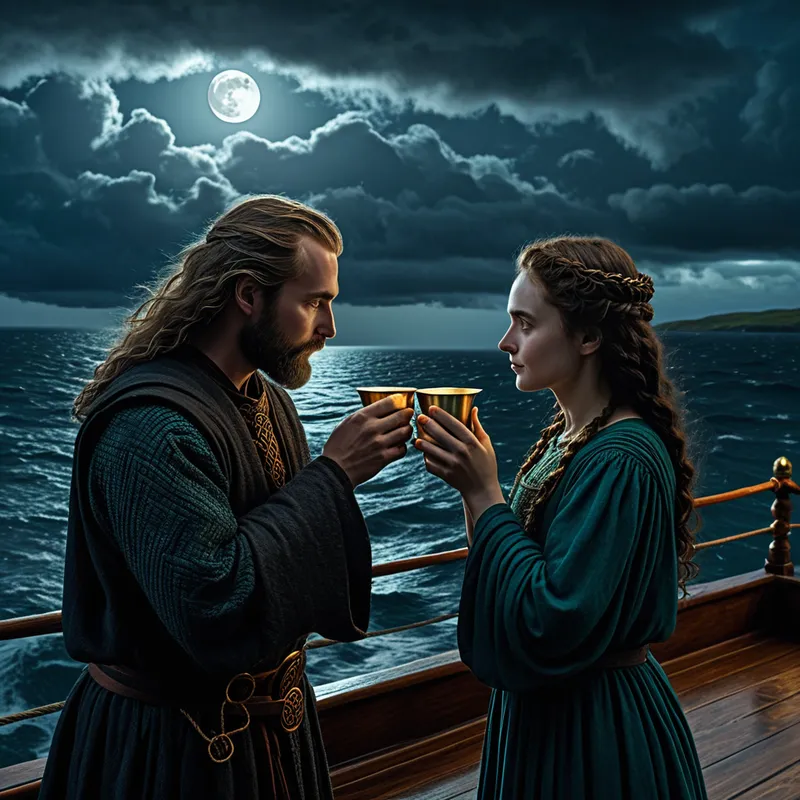
The Irish king agrees. Iseult’s mother, foreseeing a cold political union, prepares a powerful potion of binding. It is meant for the wedding night, to seal love between king and queen forever. She entrusts it to Brangien, Iseult’s loyal handmaid. But the sea is treacherous, and the journey long. On the ship sailing back to Cornwall, a thirst rises. The air is close. Tristan and Iseult, parched and weary, call for wine. By cruel mischance or fate’s own hand, Brangien brings forth the wrong flask.
They drink.
Not wine, but destiny floods their veins. The world tilts on its axis. The political pact dissolves; the future king’s claim evaporates. In that shared draught, they are unmade and remade. Two souls, now one, bound by a force older than kingdoms, deeper than loyalty. From that moment, they are no longer knight and future queen, but two halves of a single, burning star trapped in a world of stone.
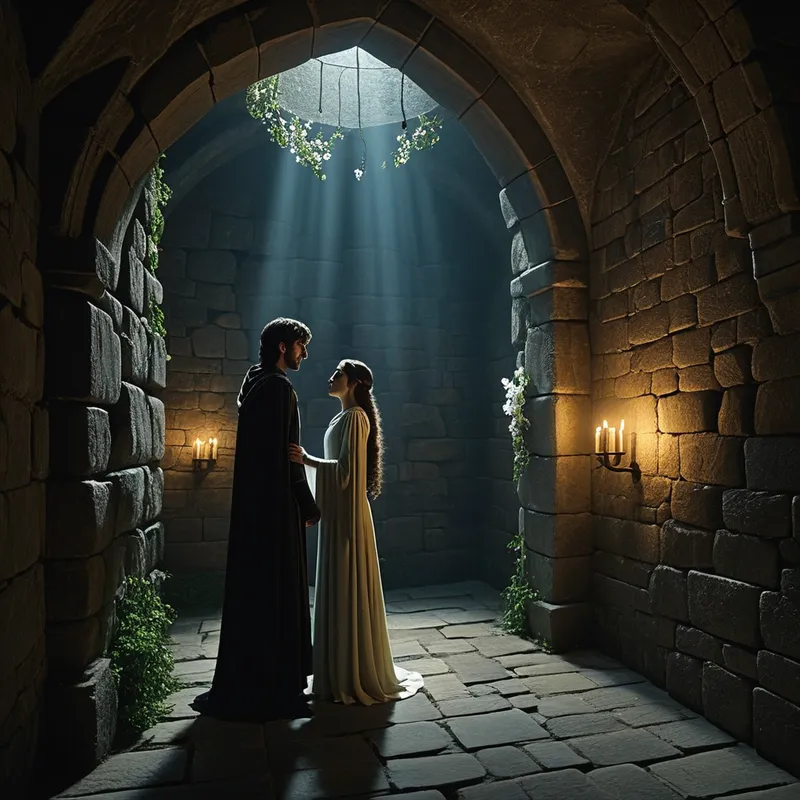
What follows is a labyrinth of stolen glances in the torchlit halls of Tintagel, of secret meetings in the orchard beneath the jealous moon, of lies woven like protective spells around their sacred crime. King Mark’s suspicion grows, a shadow that lengthens with every passing day. The lovers are betrayed by whispering courtiers, by the evidence of a flour-strewn floor between their beds, by the glint of Mark’s own ring. They flee to the wild forest of Morrois, living a life of harsh beauty, outlaws sustained only by their love and the memory of the potion’s fire.
Yet, the call of the world, of duty and fractured honor, cannot be silenced forever. A fragile peace is brokered. Iseult returns to Mark’s side. Tristan, exiled, wanders far across the sea. In Brittany, he weds another—another Iseult, of the White Hands—but his heart remains a captive across the water, a locked chest whose key was swallowed by the sea.
The end comes with a wound, as it began. Tristan lies dying, poisoned once more. He sends for the only healer: Iseult the Fair. His ship is to return with white sails if she is aboard, black if she is not. His new wife, Iseult of the White Hands, consumed by jealous grief, watches the horizon. She sees the white sails of hope and speaks the lie that kills: “The sails are black.”
Tristan turns his face to the wall, lets go of life, and his spirit departs. Iseult the Fair arrives, steps into the chamber, sees her love cold, and lies down beside him. Her heart breaks upon the anvil of that sight, and she follows him into the dark. From their graves, a hazel tree and a honeysuckle vine grow, intertwining so tightly that no hand could ever part them.
Cultural Origins & Context
The story of Tristan and Iseult is a haunting melody that predates its most famous medieval French versions. Its roots are deeply Celtic, likely originating in oral traditions among the Brittonic peoples of Cornwall, Wales, and Brittany. It is a story of the fili and the bard, told not in castles but in chieftains’ halls, where the boundaries between the human world and the Otherworld were thin.
Its societal function was complex. On one level, it is a supreme exploration of a foundational Celtic cultural tension: the conflict between geis (personal sacred duty) and fírinne (overwhelming, destined passion). Tristan is bound by geis to his uncle and king, Mark—a bond of kinship and loyalty as strong as iron. The potion imposes a fírinne, a fate-passion that shatters that iron. The story asks the unbearable question: What happens when the heart’s deepest truth is treason?
It also reflects a world where love was often a political transaction, and the potion serves as a mythical explanation for the uncontrollable, anarchic force of romantic love that threatens the social order. The tale validates the individual’s profound inner experience while simultaneously mourning the catastrophic cost it exacts on the communal web.
Symbolic Architecture
The myth’s power lies not in a simple romance, but in its stark depiction of forces that structure the human psyche.
The potion is not a cause, but a symbol of recognition. It is the moment the unconscious truth of a connection becomes conscious, irrevocable, and fateful.
Tristan represents the ego in service to the King (the ruling principle, tradition, the conscious order). Iseult is the anima, the healing but ultimately disruptive force of the deeper Self. Their union, catalyzed by the potion, is the ego’s fateful encounter with the soul. This is why it cannot be integrated into the kingdom of Mark (the established conscious life); it must flee to the wild forest of Morrois—the realm of the unconscious, where the civilized self is stripped away.
The two Iseults—the Fair and of the White Hands—are two faces of the anima. The Fair is the transformative, fated, and ultimately tragic connection to the core of the Self. The White Hands represents the anima as it can be “married” on a conventional, conscious level: nameable, present, but ultimately empty, a relationship of form without the numinous content. Tristan’s marriage to her is the ego’s attempt to live without the fatal, vital connection, and it is a living death.
The Dreamer’s Resonance
When this myth stirs in modern dreams, it signals a profound somatic and psychological crossroads. To dream of a forbidden, fated love is rarely about a literal affair. It is the psyche announcing a deep, non-negotiable call from the Self.
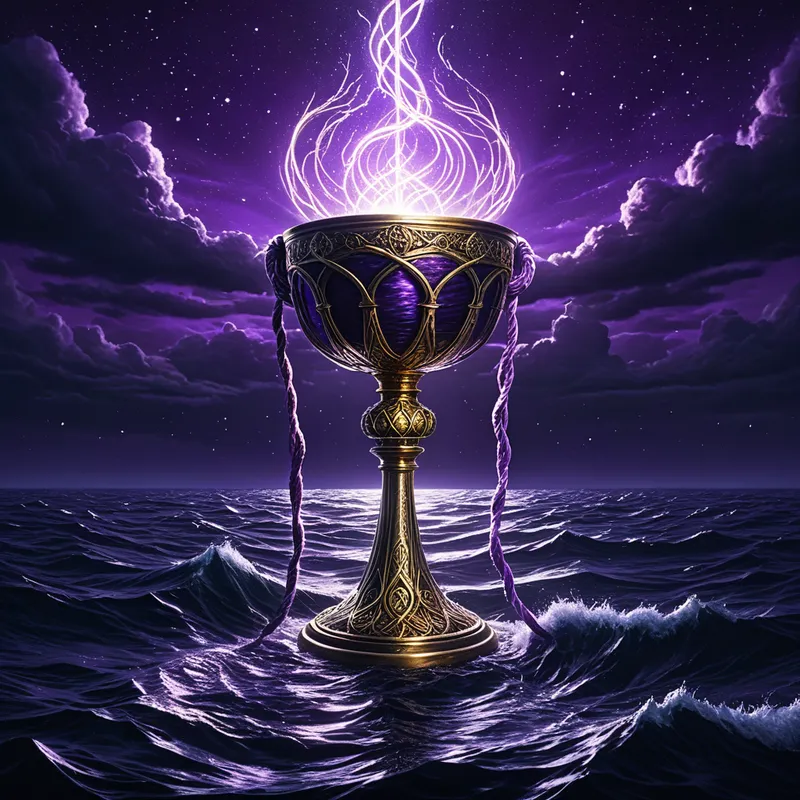
You may dream of drinking from a strange cup, of finding a secret room in a familiar house (the castle of your conscious life), or of a bond with someone that feels instantly ancient and devastatingly right, yet is surrounded by danger. Somatically, this can feel like a thrilling yet terrifying activation—a quickening of the heart, a sense of both expansion and imminent loss.
This is the process of the potion working in the soul. The dreamer is undergoing the recognition of a part of their own being—a creative drive, a true vocation, a buried trauma, or a spiritual calling—that is fundamentally at odds with their current “kingdom” (job, identity, relationships, beliefs). The conflict, the secrecy, the fear of betrayal in the dream mirror the inner civil war between the old loyalties of the ego and the new, compelling claim of the deeper Self.
Alchemical Translation
The alchemical journey of this myth is not toward a happy union, but toward a coniunctio achieved through sacrifice—the alchemical “chymical wedding” that occurs in death. For the modern individual, the myth models the painful but necessary process of psychic differentiation.
The first stage is the Poisoning/Wounding (Tristan’s initial injury). This is the symptom, the depression, the anxiety, the sense that the current conscious life is unsustainable, even poisonous. It forces the Voyage (the coracle) into the unknown depths of the unconscious.
There, one encounters the Healer/Anima (Iseult) who holds the cure, which is also the poison: self-knowledge. The drinking of the Potion is the irreversible moment of insight, where you see the truth of your own nature and its conflict with your worldly role. This necessitates the Flight to the Forest—a period of interior exile, where you must live with this raw, uncivilized truth, separating from old identities (the kingdom) to honor the new bond.
The tragedy is not the love, but the attempt to force the sacred, inner union to conform to the laws of the outer world. The triumph is in the fidelity to that inner truth, even unto death.
The final Death is the dissolution of the ego’s old form. Tristan dies not from the later poison, but from the belief that the connection (the white sails) is lost. This is the ultimate risk: the ego must be willing to die to its old hopes and formulations. In that death, the true, transcendent union occurs—symbolized by the intertwining hazel and honeysuckle. For the individual, this translates to the birth of a new, more authentic psychic structure. The old “Tristan” (the loyal nephew) and the old “Iseult” (the political bride) die, so that the essence of what bound them—the core of the Self—can manifest in a new, symbolic, and eternal form within the soul’s landscape. The love was never for possession, but for a transformation that required everything.
Associated Symbols
Explore related symbols from the CaleaDream lexicon: