Triskelion Myth Meaning & Symbolism
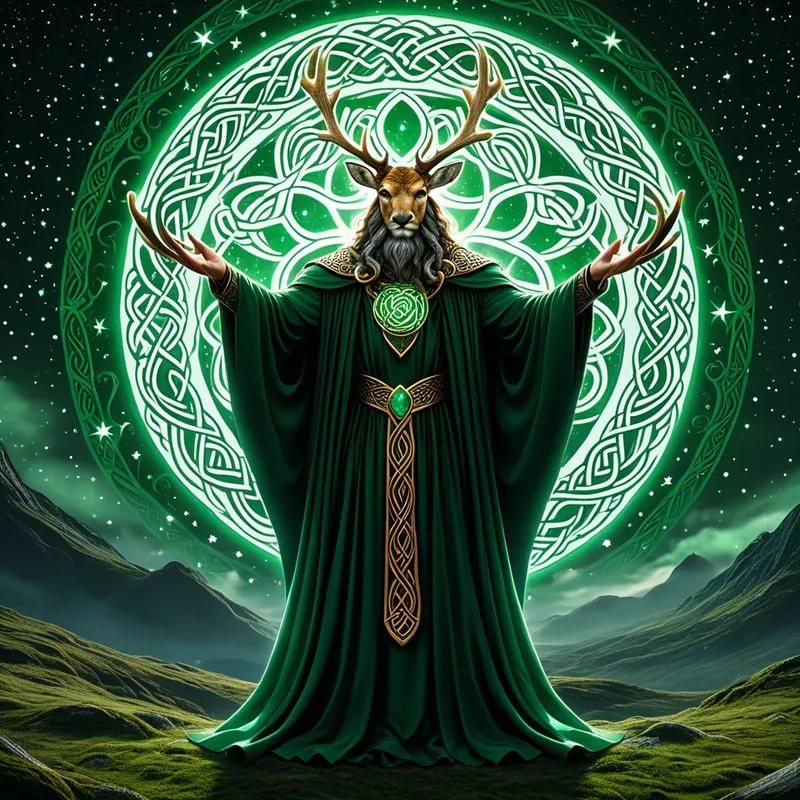
A tale of the primordial spiral, where three cosmic forces—Land, Sea, and Sky—must find harmony through sacrifice, birthing the symbol of eternal motion and triune unity.
The Tale of Triskelion
Listen. Before the memory of stone, when [the world](/myths/the-world “Myth from Tarot culture.”/) was a breath held in the dark, there were Three. Not gods as you know them, but Forces—primal, vast, and dreaming. There was An Domhan, the Land, whose bones were mountains and whose flesh was the deep, dark soil. There was An Fharraige, [the Sea](/myths/the-sea “Myth from Greek culture.”/), whose voice was the crash of waves and whose blood was the salt tide. And there was An Spéir, [the Sky](/myths/the-sky “Myth from Persian culture.”/), whose thoughts were lightning and whose breath was the gale.
Each was complete, yet each was alone. The Land was solid and still, but craved the Sea’s fluid song. The Sea was boundless and shifting, but longed for the Sky’s soaring fire. The Sky was free and vast, but yearned for the Land’s steadfast anchor. Their separate dreams brushed against one another in [the void](/myths/the-void “Myth from Buddhist culture.”/), creating not harmony, but chaos—earthquakes where land met sea, hurricanes where sea met sky, and wild fires where sky glanced upon land.
In the center of this turmoil, a place of pure potential existed: An Lár, the Center. It was a silent, spinning point of nothingness that held the seed of everything. The Three felt its pull, a longing deeper than their solitude. One by one, they turned their immense consciousness toward An Lár.
The Land extended a root, massive and slow as continental drift. The Sea sent a tendril of mist, rising in a graceful, endless coil. The Sky cast down a thread of sunlight, spiraling like a falling star. As the three extensions approached the silent center, they did not clash, but began to weave. The root softened, learning flow from [the mist](/myths/the-mist “Myth from Celtic culture.”/). The mist gained purpose, learning direction from the light. The light became grounded, learning patience from the root.
Yet, to truly meet, each had to sacrifice its solitary nature. The Land had to release a piece of its unyielding solidity. The Sea had to give up a portion of its formless freedom. The Sky had to surrender a fragment of its detached brilliance. This sacrifice was not a loss, but a release into the center. As they let go, their essences did not vanish but transformed, merging in An Lár in a burst of silent, cosmic light.
From this convergence, the first pattern was born: a single, dynamic form with three arms, each echoing the original force yet forever changed by the others, locked in an eternal, graceful dance around the sacred center. It was the Triskelion. It did not sit still. It began to turn, and as it turned, its motion sang the world into being—the hills rolled out from its curve, the rivers traced its path, and the stars wheeled in its rhythm. The Three were no longer separate. They were a process, a verb, a becoming.
Cultural Origins & Context
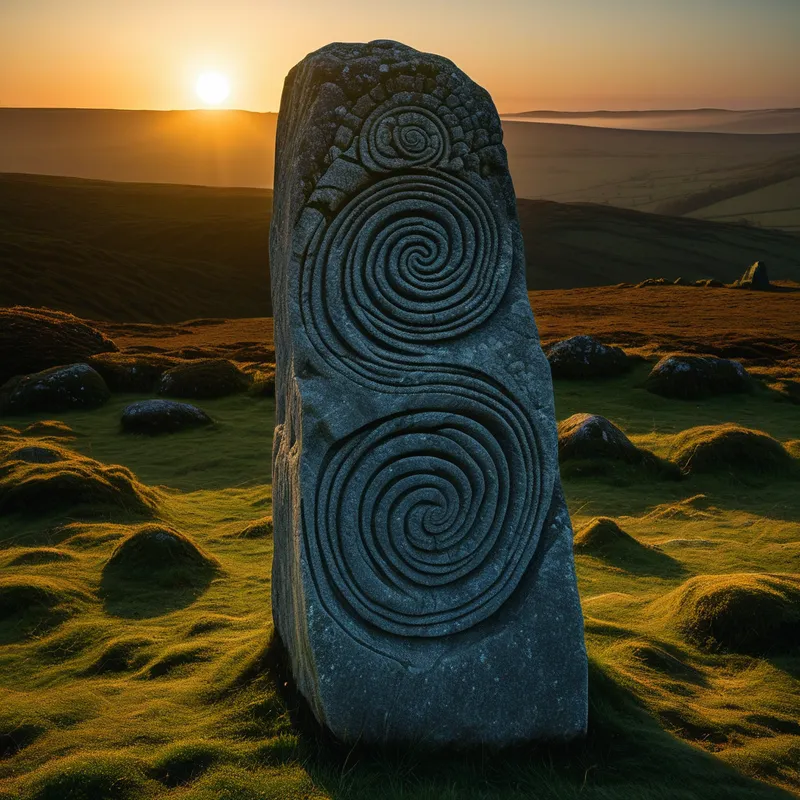
The myth of [the Triskelion](/myths/the-triskelion “Myth from Celtic culture.”/), as a narrative of cosmic forces, is not found in a single, surviving Celtic text. The ancient Celts transmitted their deepest wisdom orally, through the sacred office of the Druids and Bards. This story is a reconstruction, a whispering back from the stones themselves—from the majestic triple spirals carved into the entrance stone of Newgrange, and from similar symbols found on Celtic coins, armor, and artifacts across Europe.
Its function was not merely decorative but profoundly pedagogical and cosmological. In a culture that saw the world as alive and interconnected, the myth explained the nature of reality as a dynamic equilibrium. It taught that stability (Land) is not opposed to change (Sea) or aspiration (Sky), but that all three are necessary facets of a single, flowing existence. The story was likely recited during festivals marking the cross-quarter days, reminding the tribe that their lives, their seasons, and their society were part of this greater, triune dance.
Symbolic Architecture
At its [heart](/symbols/heart “Symbol: The heart symbolizes love, emotion, and the core of one’s existence, representing deep connections with others and self.”/), the Triskelion is a map of a fundamental psychic and cosmic law: unity arises from the dynamic [tension](/symbols/tension “Symbol: A state of mental or emotional strain, often manifesting physically as tightness, pressure, or unease, signaling unresolved conflict or anticipation.”/) of opposites, mediated by a third, reconciling force. It is the ultimate [symbol](/symbols/symbol “Symbol: A symbol can represent an idea, concept, or belief, serving as a powerful tool for communication and understanding.”/) of non-binary thinking.
The center is not a place of rest, but the vortex where separate currents become a single, transformative flow.
Psychologically, the Three Forces represent core aspects of [the self](/myths/the-self “Myth from Jungian culture.”/). The Land is the [body](/symbols/body “Symbol: The body in dreams often symbolizes the dreamer’s self-identity, personal health, and the relationship they have with their physical existence.”/), the instincts, and the unconscious—the grounded, [fertile soil](/symbols/fertile-soil “Symbol: Fertile soil symbolizes potential, growth, and nurturing, representing the foundation for new beginnings and creativity.”/) of being. The Sea is the [soul](/symbols/soul “Symbol: The soul represents the essence of a person, encompassing their spirit, identity, and connection to the universe.”/), the emotions, and [the personal unconscious](/myths/the-personal-unconscious “Myth from Jungian Psychology culture.”/)—the deep, fluid [realm](/symbols/realm “Symbol: The symbol of ‘Realm’ often signifies the boundaries of one’s consciousness, experiences, or emotional states, suggesting aspects of reality that are either explored or ignored.”/) of feeling and [memory](/symbols/memory “Symbol: Memory symbolizes the past, lessons learned, and the narratives we construct about our identities.”/). The Sky is the [spirit](/symbols/spirit “Symbol: Spirit symbolizes the essence of life, vitality, and the spiritual journey of the individual.”/), the intellect, and [consciousness](/symbols/consciousness “Symbol: Consciousness represents the state of awareness and perception, encompassing thoughts, feelings, and experiences.”/)—the aspirational, illuminating fire of mind. Our inner [chaos](/symbols/chaos “Symbol: In Arts & Music, chaos represents raw creative potential, uncontrolled expression, and the breakdown of order to forge new artistic forms.”/)—[anxiety](/symbols/anxiety “Symbol: Anxiety in dreams reflects internal conflicts, fears of the unknown, or stress from waking life, often demonstrating the subconscious mind’s struggle for peace.”/), conflict, [fragmentation](/symbols/fragmentation “Symbol: The experience of breaking apart, losing cohesion, or being separated into pieces. Often represents disintegration of self, relationships, or reality.”/)—stems from these aspects living in [isolation](/symbols/isolation “Symbol: A state of physical or emotional separation from others, often representing a need for introspection or signaling distress.”/), each claiming supremacy.
The sacred An Lár, the Center, is the nascent Self. It is not an existing ego, but the potential point of [integration](/symbols/integration “Symbol: The process of unifying disparate parts of the self or experience into a cohesive whole, often representing psychological wholeness or resolution of internal conflict.”/). The myth instructs that wholeness is not achieved by one [aspect](/symbols/aspect “Symbol: A distinct feature, quality, or perspective of something, often representing a partial view of a larger whole.”/) conquering the others, but by each making a sacred sacrifice—[the ego](/myths/the-ego “Myth from Jungian culture.”/) (Sky) relinquishing total control, the body (Land) releasing rigid identifications, the soul (Sea) surrendering to a [direction](/symbols/direction “Symbol: Direction in dreams often relates to life choices, guidance, and the path one is following, emphasizing the importance of navigation in personal journeys.”/) beyond its own moods. This sacrifice is the act of consciousness attending to the unconscious, and vice-versa.
The Dreamer’s Resonance
When the Triskelion pattern emerges in modern dreams—as three interlocking spirals, a trio of dancing figures, or a wheel with three distinct yet connected parts—it signals a profound somatic and psychological process underway. The dreamer is in the midst of their own convergence at An Lár.
Somatically, this may feel like a deep re-calibration. One might experience a release of chronic tension (Land yielding), a surge of creative or emotional energy that seeks new form (Sea flowing), or sudden moments of lucid insight and perspective (Sky illuminating). It is the body-mind preparing for a new pattern of being.
Psychologically, the dream marks the struggle and promise of integration. The dreamer may be grappling with a life situation that demands they reconcile three seemingly opposing demands: career, family, and personal passion (Land, Sea, Sky). Or, it may reflect an internal conflict between thought, feeling, and action. The Triskelion in the dream does not offer a static solution, but shows the motion of the solution—the necessity of allowing these parts to communicate, to sacrifice their absolute autonomy, and to begin moving in a coordinated dance around a new, emerging center of gravity: the authentic self.
Alchemical Translation
The myth of the Triskelion is a perfect allegory for the alchemical individuation process. The initial state of separate, warring Forces is the [Nigredo](/myths/nigredo “Myth from Alchemical culture.”/), the blackening, the chaos of the unexamined life.
Individuation is not the creation of a perfect, static self, but the initiation of an eternal internal motion—the conscious participation in one’s own becoming.
The journey toward An Lár is the Albedo, the whitening, where one consciously identifies and engages with these inner opposites. The act of sacrifice—the Land giving its solidity, the Sea its formlessness, the Sky its detachment—is the crucial mortificatio. It is the death of the old, compartmentalized way of being.
The convergence and birth of the spinning Triskelion is the Citrinitas and the ultimate [Rubedo](/myths/rubedo “Myth from Alchemical culture.”/). The new symbol is the [lapis philosophorum](/myths/lapis-philosophorum “Myth from Alchemical culture.”/), [the Philosopher’s Stone](/myths/the-philosophers-stone “Myth from Alchemical culture.”/). But note: the Stone here is not a static object. It is a spinning pattern. The [triumph](/myths/triumph “Myth from Roman culture.”/) is not a final state of perfection, but the achievement of a sustainable, dynamic process. The integrated individual is one in whom body, soul, and spirit are in perpetual, creative dialogue, constantly generating and regenerating their life from the sacred center. They have not solved life’s paradoxes; they have learned to dance within them, becoming a living embodiment of the eternal triple spiral.
Associated Symbols
Explore related symbols from the CaleaDream lexicon: