Triquetra Myth Meaning & Symbolism
A tale of the Triple Goddesses who weave the world from a single thread of life, mending a tear in reality with an eternal knot of becoming.
The Tale of Triquetra
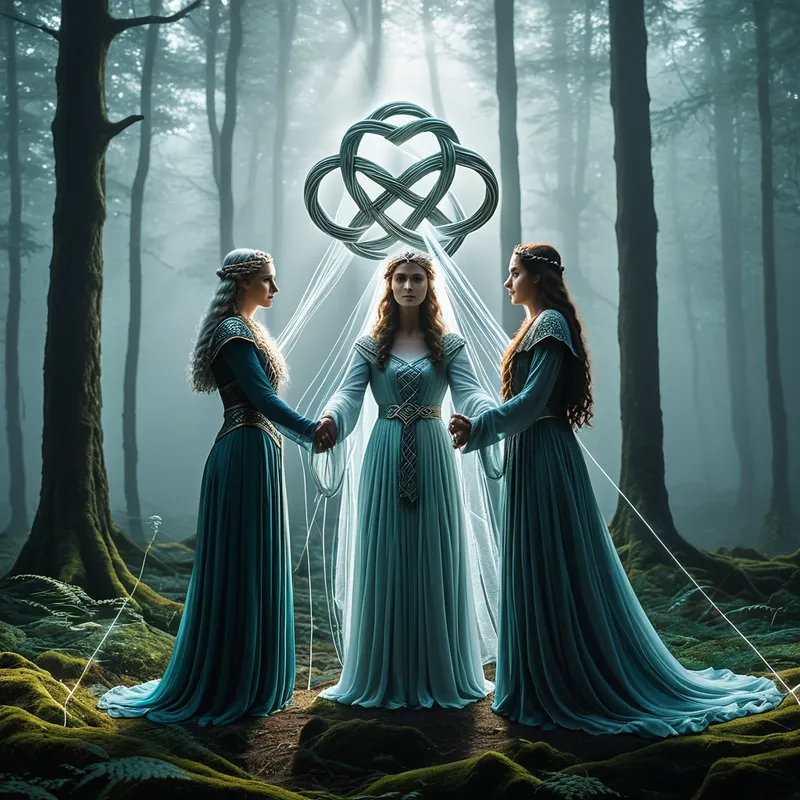
Listen. [The world](/myths/the-world “Myth from Tarot culture.”/) was not born in fire or flood, but in a single, silver sigh. Before the first oak took root, before the first salmon leaped, there was the Awen, the flowing spirit. And from its endless song stepped three who were one: the Morrígna in their gentlest guise. They were the Weaver, the Keeper, and the Mender.
The Weaver, maiden-fingered and bright-eyed, began. With a laugh like spring rain, she reached into the swirling mist of potential and drew forth a thread. It was not a thread of wool or flax, but of pure becoming—glimmering, humming with the promise of all things. She sang as she worked, and her song was the green push of shoots through soil, the first cry of a fawn.
She passed the living thread to the Keeper, the mother whose lap was the wide, warm earth. The Keeper’s hands, strong and sure, took the thread and wove it into the tapestry of the Middle World. Her song was the deep, steady rhythm of the seasons, the growth of forests, the flow of rivers, the nurturing silence of the loam. In her weave were the patterns of the badger’s sett and the hawk’s flight, the cycle of [the moon](/myths/the-moon “Myth from Tarot culture.”/) and the turning of the tides.
This vibrant tapestry stretched from the roots of the mountains to the canopy of the stars. But from the [Sídhe](/myths/sdhe “Myth from Celtic / Irish culture.”/), the realm beyond [the veil](/myths/the-veil “Myth from Various culture.”/), a wind of forgetting blew. A claw of cold despair, born of the fear of endings, scraped across the weave. A single thread, the very first one spun by the Maiden, snapped.
A silence fell, colder than the deepest winter. The tapestry did not unravel, but a sickness spread from the break. Flowers bloomed but bore no scent. Streams ran but made no sound. The hearts of creatures grew heavy with a loneliness they could not name. The world was wounded.
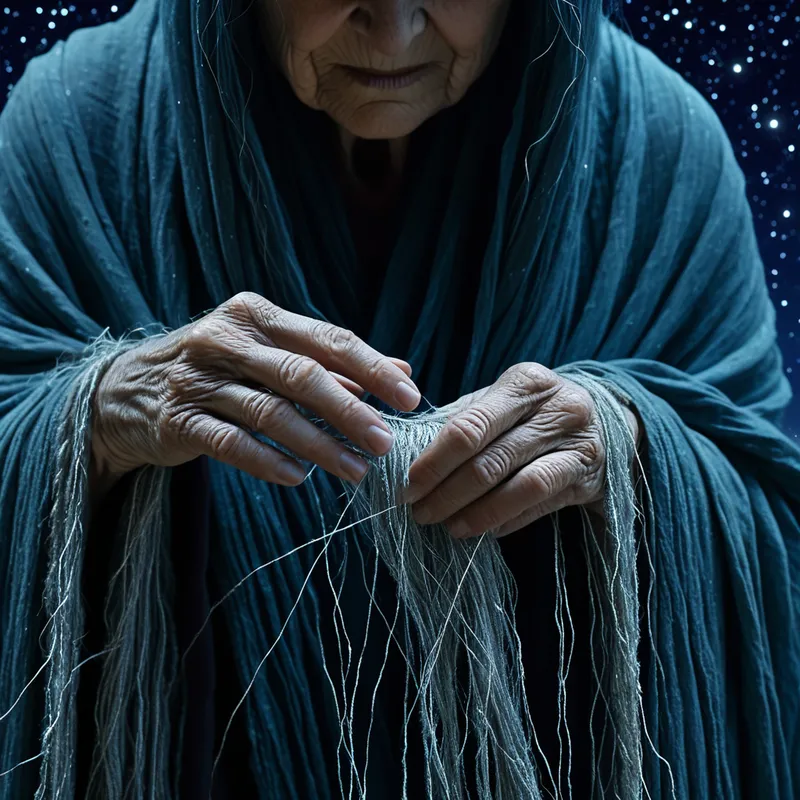
The Weaver wept silver tears. The Keeper’s hands trembled upon her loom. Then, the Mender stepped forward. She was [the Crone](/myths/the-crone “Myth from Celtic culture.”/), her face a map of time, her eyes holding the light of distant stars. She did not look at the broken thread with sorrow, but with a knowing depth. “Nothing is truly lost,” her voice rustled like dry leaves, “only waiting to be remembered differently.”
She gathered the two severed ends. But instead of simply tying them back, she held them aloft. The Weaver, inspired, added a third strand from the yet-unspun Awen. The Keeper anchored it to the heart of the living world. And the Mender, with movements slow as continents shifting, began to braid.
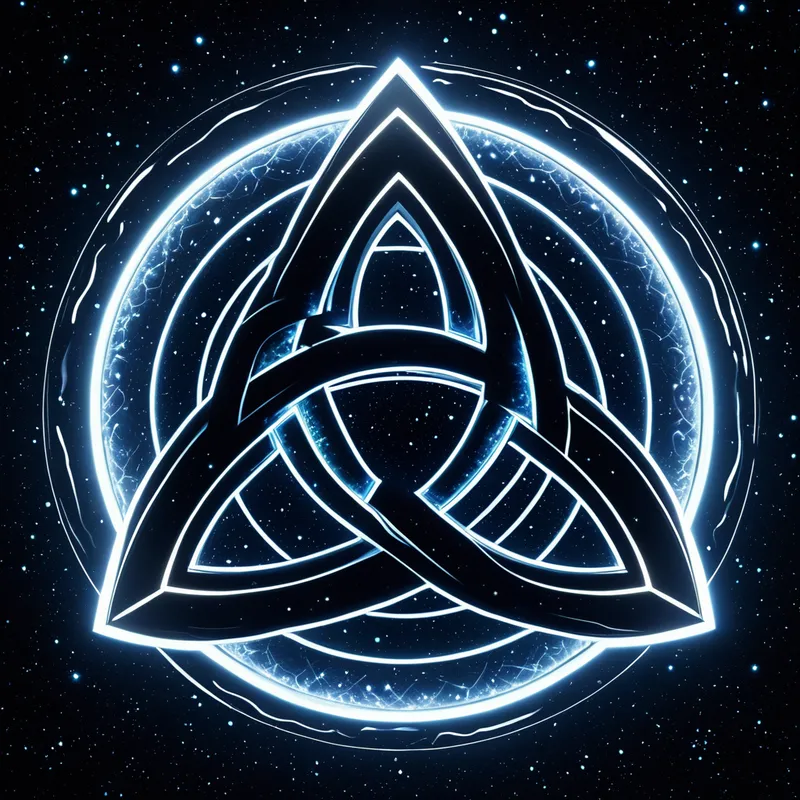
She did not join them end-to-end. She looped them, interlocked them, each strand passing over and under, becoming the foundation for the next, in a dance without beginning or end. She wove a knot of three arcs, a single line tracing an eternal path. As the final curve closed, a pulse of light, warm and golden, radiated from the knot. The scent returned to the flowers. The song returned to the [water](/myths/water “Myth from Chinese culture.”/). The loneliness lifted, replaced by a profound sense of connection.
The Morrígna placed the glowing knot—the Triquetra—at the center of all things. It was not a patch, but a new law woven into reality itself: that life, death, and rebirth are not a line, but a circle; not a chain, but a sacred, endless braid.
Cultural Origins & Context
The myth of the Triquetra is not found in a single, canonical text like those of Greco-Roman tradition. The ancient Celts transmitted their sacred knowledge orally, through the revered class of the Druids and bards. This story is a reconstruction, a tapestry itself, woven from fragments: the pervasive iconography of the threefold knot on stone crosses and metalwork; the insistent thematic trinities in surviving Irish and Welsh mythologies (like the threefold death, or the triple goddesses of war and sovereignty); and the deep-seated Celtic veneration of the number three as sacred and complete.
Its societal function was multifaceted. As a teaching story, it encoded the core cosmological principle of interconnection and cyclical regeneration, opposing a linear, finite view of existence. It sanctified the roles of the feminine divine in a culture that held powerful goddesses of land and sovereignty. Furthermore, it provided a metaphysical model for resilience. The “broken thread” could represent any catastrophe—personal, tribal, or seasonal. The myth taught that the response is not mere repair, but a creative re-weaving that integrates the break into a stronger, more complex pattern of continuity.
Symbolic Architecture
At its [heart](/symbols/heart “Symbol: The heart symbolizes love, emotion, and the core of one’s existence, representing deep connections with others and self.”/), the Triquetra myth is a map of [psychic wholeness](/symbols/psychic-wholeness “Symbol: A state of complete integration between conscious and unconscious aspects of the psyche, representing spiritual unity and self-realization.”/). The three goddesses represent not just stages of [life](/symbols/life “Symbol: The symbol of ‘Life’ represents a journey of growth, interconnectedness, and existential meaning, encompassing both the joys and challenges that define human experience.”/), but fundamental, co-existing aspects of [consciousness](/symbols/consciousness “Symbol: Consciousness represents the state of awareness and perception, encompassing thoughts, feelings, and experiences.”/) within the individual and the [cosmos](/symbols/cosmos “Symbol: The entire universe as an ordered, harmonious system, often representing the totality of existence, spiritual connection, and the unknown.”/).
The broken thread is not a flaw in creation, but the necessary space where the soul encounters its own potential for mending.
The Weaver is the spark of inspiration, the unconscious [prima materia](/myths/prima-materia “Myth from Alchemical culture.”/) from which all psychic content first emerges. The Keeper is [the ego](/myths/the-ego “Myth from Jungian culture.”/) function that structures, nurtures, and gives form to that content in the “middle world” of daily conscious life. The Mender is the transcendent function, the wisdom of [the Self](/myths/the-self “Myth from Jungian culture.”/) that arises when [the ego](/myths/the-ego “Myth from Jungian culture.”/)’s structures are wounded or fail. She does not reject the break but uses it as the catalyst for a higher-order [synthesis](/symbols/synthesis “Symbol: The process of combining separate elements into a unified whole, representing integration, resolution, and the completion of a personal journey.”/).
The Triquetra [knot](/symbols/knot “Symbol: A knot symbolizes connections, commitments, complications, and the binding or untying of relationships and situations.”/) itself is the ultimate [symbol](/symbols/symbol “Symbol: A symbol can represent an idea, concept, or belief, serving as a powerful tool for communication and understanding.”/) of this [alchemy](/symbols/alchemy “Symbol: A transformative process of purification and creation, often symbolizing personal or spiritual evolution through difficult stages.”/). It visually denies simple cause-and-effect. Each arc is distinct, yet all are formed from one unbroken line. It symbolizes the interdependence of [body](/symbols/body “Symbol: The body in dreams often symbolizes the dreamer’s self-identity, personal health, and the relationship they have with their physical existence.”/), mind, and [spirit](/symbols/spirit “Symbol: Spirit symbolizes the essence of life, vitality, and the spiritual journey of the individual.”/); past, present, and future; and the three great realms of Land, Sea, and Sky in Celtic cosmology. It is a [mandala](/symbols/mandala “Symbol: A sacred geometric circle representing wholeness, the cosmos, and the journey toward spiritual integration.”/) of dynamic [equilibrium](/symbols/equilibrium “Symbol: A state of balance, stability, or harmony between opposing forces, often representing inner peace or external order.”/), where opposites are held in a creative, rotating [tension](/symbols/tension “Symbol: A state of mental or emotional strain, often manifesting physically as tightness, pressure, or unease, signaling unresolved conflict or anticipation.”/).
The Dreamer’s Resonance
When the Triquetra pattern surfaces in modern dreams, it often appears during a profound process of psychological integration, particularly following a rupture—a loss, a betrayal, a diagnosis, or a deep disillusionment. The dreamer may not see a literal knot, but experience its geometry: three connected lights, three paths converging, three figures merging into one, or a powerful somatic sensation of being braided or woven.
This is the [psyche](/myths/psyche “Myth from Greek culture.”/) activating the “Mender” archetype. The dream signals that the conscious mind (the Keeper) is overwhelmed by the break in life’s tapestry, and the instinctive, creative Self is intervening. The Triquetra in a dream is a reassurance from the depths: you are not unraveling. You are being reconfigured. The pain, [the void](/myths/the-void “Myth from Buddhist culture.”/), the severed connection is being actively integrated into a new, more resilient structure of being. It is an image of the [psyche](/myths/psyche “Myth from Greek culture.”/) performing its own non-linear surgery, stitching the wound with threads of meaning drawn from both memory (the broken thread) and future potential (the new strand from the Awen).

Alchemical Translation
The myth models the complete arc of individuation—Jung’s process of becoming whole. We all begin in the state of the Weaver, with unconscious potentials and drives. We build our conscious lives (the Keeper’s tapestry), forming identity, relationships, and achievements. Then, inevitably, comes the rupture: the midlife crisis, the failure of a cherished ideal, the confrontation with mortality. The tapestry of our constructed self is torn.
The alchemical gold is not forged in the fire of success, but in the patient, twisting braid that incorporates the base metal of failure.
The ego’s first response is often the Weaver’s despair or the Keeper’s frantic attempt to re-weave the old pattern. The alchemical work begins with the invocation of the Mender—the willingness to sit in the void of the break without panic. This is the [nigredo](/myths/nigredo “Myth from Alchemical culture.”/), [the dark night of the soul](/myths/the-dark-night-of-the-soul “Myth from Christian Mysticism culture.”/).
The act of braiding the three strands is the coniunctio oppositorum, [the sacred marriage](/myths/the-sacred-marriage “Myth from Various culture.”/) of opposites. The old self (the broken thread), the raw material of the unconscious (the new thread of Awen), and the organizing principle of the witnessing consciousness are brought together. The result is not a return to the old, flat tapestry, but the creation of the Triquetra—a three-dimensional, rotating symbol of the Self. The individual moves from a life lived on a single plane (ego-identification) to one that acknowledges and circulates energy between multiple, interconnected levels of being.
Thus, the myth instructs us that our deepest wounds are not termini, but the very points where the eternal braid of the Self can be consciously grasped and continued. We are invited to become not just weavers of our lives, but menders of our own souls, creating from our fractures a knot of meaning that holds us, eternally, within the great, unbroken flow.
Associated Symbols
Explore related symbols from the CaleaDream lexicon: