
Trickster Hyena Myth Meaning & Symbolism
A cunning, disruptive figure from African folklore whose chaotic antics reveal societal flaws and force a confrontation with the shadow self.
The Tale of Trickster Hyena
Listen, and let the firelight cast the shadows. In the time when the world was still soft clay, before the rules hardened into walls, there walked a creature of the in-between. He was not lion, king of the sun-baked plain. He was not antelope, fleet-footed child of the grass. He was Trickster Hyena, whose coat was the color of dust and shadow, whose laugh was the sound of breaking pottery.
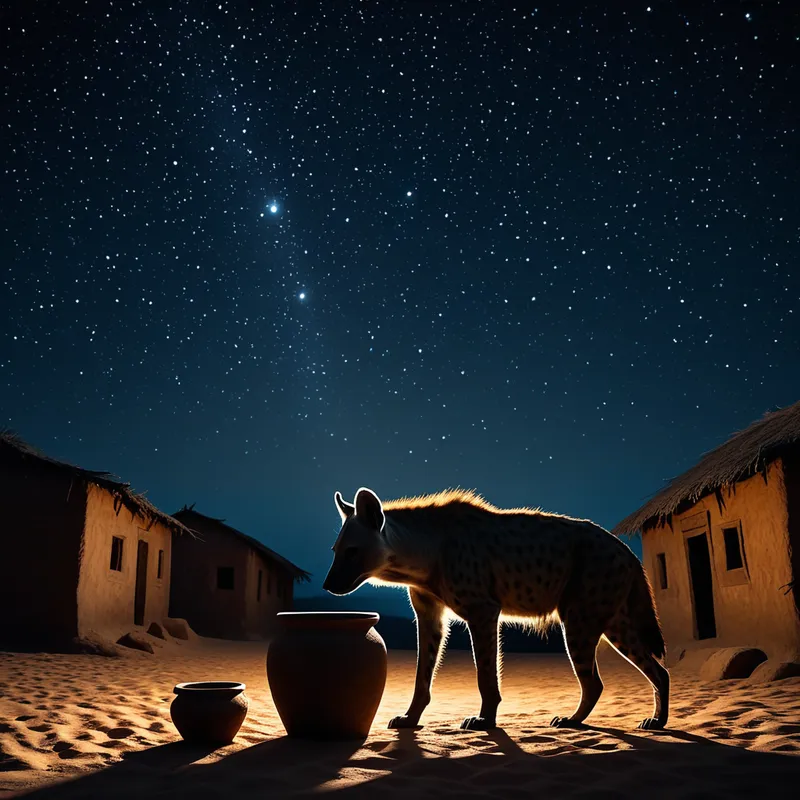
He lived on the edges. The village at dusk, the watering hole at midnight, the space between what is said and what is meant. One season, the rains failed. The earth cracked its lips, and the people’s bellies sang hollow songs. The chief, a man whose wisdom had grown stiff, decreed a great feast to beg the sky’s mercy. All the village’s last grain was poured into one enormous, sacred clay pot to brew the strongest beer.
Trickster Hyena watched from the thornbush, his nose twitching at the sweet, fermenting scent. “A feast for the sky,” he chuckled to himself, a dry rustle of bones. “But the sky has no tongue.” That night, when the moon was a sliver—a thief’s moon—he slipped into the village. He did not move like a thief, but like a shadow unhooking itself from a tree. He found the great pot, guarded by a youth already dreaming of rain. With a push that was more clever than strong, he tipped the pot. The thick, precious liquid did not spill; he caught it in his mouth, drinking not for thirst, but for the act itself. The deed was a silent laugh.
When the village awoke to the empty pot, chaos, hot and sharp, uncoiled. The chief blamed the neighboring tribe. The youth blamed spirits. Suspicion, a weed long dormant, sprouted thorns between brothers. Trickster Hyena, bloated and lazy, lay in a cool ravine and listened to the discord his full belly had composed. He had stolen not just beer, but peace.
Yet his work was not done. The true theft was yet to come. As the people argued, he crept to the shrine of the ancestors and stole the smooth, black stone that was the heart of their consensus. He did not keep it. He placed it in the nest of the sharp-tongued Honeyguide, who sang the location of the stone to everyone, but in a different, accusing tune for each ear.
Now the village tore at its own seams. It was then that the youngest child, who still saw with night-eyes, pointed to the ravine and said, “There lies the one who laughs at our tears.”
Cornered, with the mob’s anger a heat on his back, Trickster Hyena did not run. He stood, and his laughing cry split the air. “You made a pot so big your eyes could not see over its rim!” he yelped. “You gave your last grain to a concept while your neighbor’s child whimpered! I did not break your peace. I only showed you it was already cracked.”
His words, bitter as medicine, hung in the air. The mob’s fury turned inward, a slow, sickening realization. The hyena did not wait for thanks—tricksters never do. He vanished into the tall grass, leaving behind a village humbled, a sacred pot broken, and a truth, ugly and necessary, wriggling in the sunlight where all could finally see it.
Cultural Origins & Context
The myth of the Trickster Hyena is not a single story, but a pattern woven through the oral traditions of numerous peoples across the continent, from the Shona to the Akan, and among East African pastoralist communities. This figure thrives in the ecology of the spoken word, told by griots, elders, and mothers at dusk. The hyena was a perfect vessel for this role—an animal that is both a formidable scavenger and hunter, existing on the margins of the clean categories humans prefer. Its eerie, human-like laugh made it a being of ambiguous intelligence.
Societally, these tales functioned as complex social tools. They were entertainment, certainly, but also a pressure valve and a mirror. In rigidly hierarchical societies, the trickster’s antics often targeted the pompous chief, the greedy merchant, or the self-righteous priest, allowing for critique through the safe medium of allegory. The stories taught children about the consequences of greed and deceit, but also about the value of cleverness and the fact that authority is not always wise. They were a way to process the inherent chaos of life, to personify misfortune, and to acknowledge that disorder is a creative force as much as a destructive one.
Symbolic Architecture
Psychologically, the Trickster Hyena is a masterful embodiment of the Shadow. He is not pure evil, but the amoral, instinctual force that exists outside the polite agreements of the conscious ego and society. He represents appetite in all its forms—hunger, lust, curiosity, the desire to disrupt. His theft is never merely for material gain; it is a symbolic act that exposes hypocrisy, challenges unjust order, and forces a system to confront what it has excluded or denied.
The trickster does not lie; he reveals the lies the world tells itself to feel stable.
His laughter is the key symbol. It is the sound of the psyche recognizing its own absurd contradictions. When he laughs at the village’s self-imposed famine, he is laughing at the ego’s capacity for self-sabotage in the name of propriety. He is chaos, but a necessary chaos. Without him, the village’s stagnant order would have continued unchallenged until it collapsed. He is the catalyst for crisis, and thus, for potential growth. He holds the dual role of fool and sage, destroyer and, inadvertently, healer.

The Dreamer’s Resonance
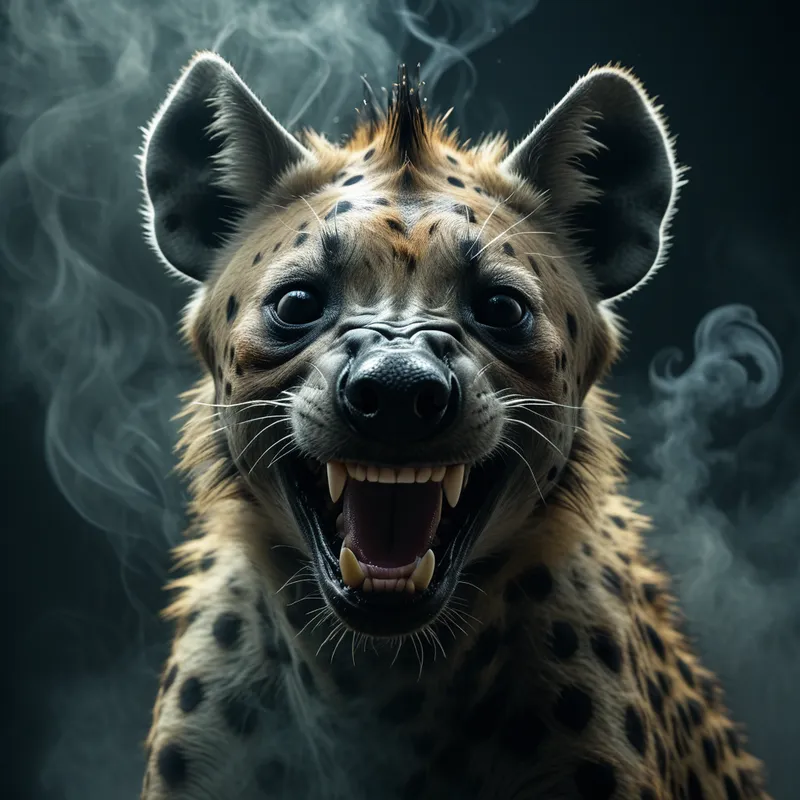
When the Trickster Hyena pads into modern dreams, he announces a phase of psychic disruption. This is not the terrifying invasion of a monster, but the unsettling, often embarrassing, intrusion of repressed material. Dreaming of a hyena laughing might coincide with a time when one’s carefully constructed persona is being undermined—perhaps by a compulsive behavior, a social blunder, or the eruption of a “childish” emotion like envy or spite in a professional setting.
Somatically, this can feel like a cringe in the soul, a flush of shame, or an uncontrollable nervous giggle at an inappropriate moment. Psychologically, the dream signals that an aspect of the self deemed “unacceptable”—the greedy, lustful, lazy, or cynical part—is demanding recognition. The hyena does not ask politely; he steals the “sacred pot” of your self-image. The dream is an invitation, however uncomfortable, to stop projecting your own chaotic impulses onto others (the “neighboring tribe” in the myth) and to begin the messy process of re-integration.
Alchemical Translation
The myth models the alchemical stage of Nigredo—the blackening, the confrontation with the prima materia, the shadow. The individuation process requires this descent. The ego, like the village chief, often tries to maintain order through willpower and tradition, offering its energy (the grain) to idealized concepts (the sky gods of perfection). The Trickster Hyena is the function of the unconscious that sabotages this one-sidedness. He forces the Opus to begin by creating a crisis.
The transformation does not happen in the feast of the ego, but in the sobering hangover after the trickster has drunk its fill.
The modern individual’s journey mirrors this. We must allow our inner trickster to “steal the beer”—to let our plans fail, our pride be wounded, our repressed instincts surface. This feels like regression, like chaos. But it is only through this rupture that we can see the cracks in our personal “pot.” The hyena’s final act—stealing the stone of consensus and giving it to the gossipy bird—represents the internalization of the conflict. The problem is no longer “out there”; it is within, singing a different accusing tune in each ear of our psyche. The resolution comes not from banishing the hyena, but from hearing its cackling truth and, in that humbling moment, beginning the slow work of crafting a more inclusive, authentic self that acknowledges both the chief and the trickster within.
Associated Symbols
Explore related symbols from the CaleaDream lexicon: