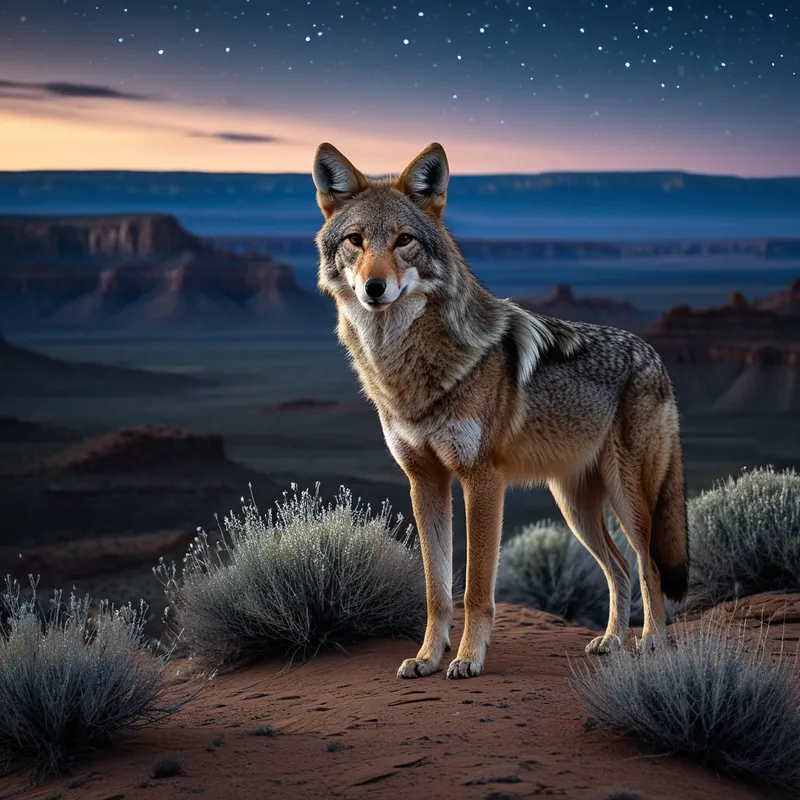
Trickster Coyote Myth Meaning & Symbolism
A sacred chaos-bringer, Coyote shatters order to create wisdom, embodying the paradoxes of life and the shadow that teaches through laughter and disaster.
The Tale of Trickster Coyote
In the time before time, when [the world](/myths/the-world “Myth from Tarot culture.”/) was soft and the laws were still being written, there walked Coyote. He was not the first, but he was the cleverest. The air smelled of hot sage and dry earth, and the sun beat down on a land waiting for its shape.
The People had fire, but it was a feeble, guarded [thing](/myths/thing “Myth from Norse culture.”/), clutched close and secret. They shivered in the long nights, their stories whispered, not sung. Coyote watched from a ridge, his yellow eyes catching the last of the light. “This will not do,” he chuckled to himself, a sound like stones tumbling in a gully. “Their world is too quiet, too careful.”
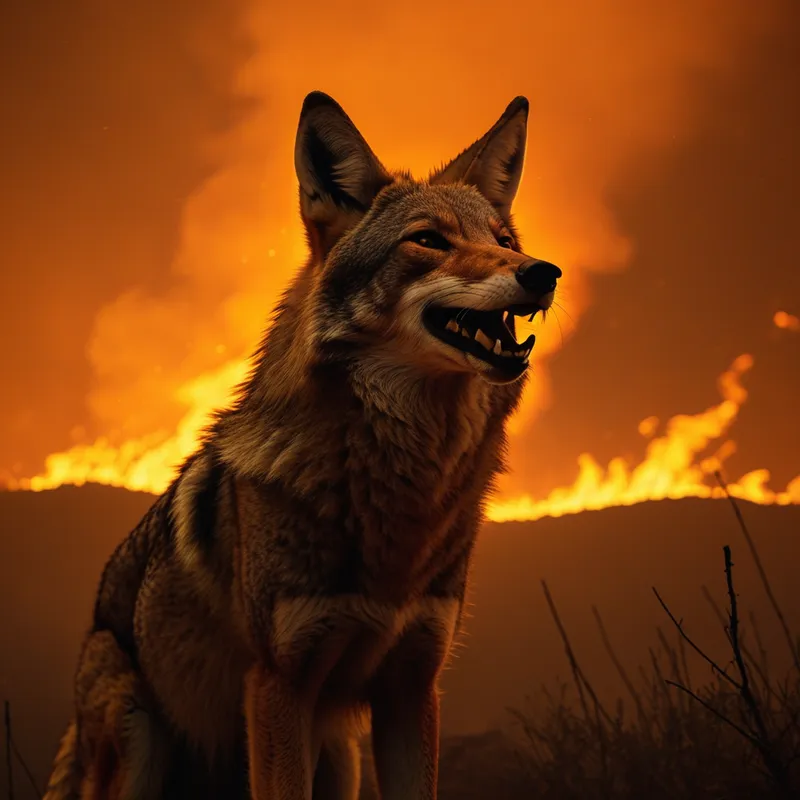
He loped down into the camp, a shadow among the shadows. He saw the fire, a tiny, precious heart guarded by a stern and powerful being. Coyote did not charge. He sat, he whined, he told a joke so foolish that even the rocks seemed to laugh. He disarmed with absurdity. While the guardian was distracted, shaking its head at this ridiculous creature, Coyote darted. Not to fight, but to play. He snatched a burning brand in his jaws—the heat searing, the taste of ash and potential flooding his mouth—and he ran.
He ran not as a thief, but as a messenger of chaos. The brand became a comet trailing sparks across the dark plain. He dropped it here, and a patch of grass roared into flame. He kicked it there, and a stand of juniper became a torch. The People cried out in terror! But as they watched the wildfire rage, they saw something else. The old, dead wood burned away. The heat cracked open seeds long dormant. And from Coyote’s chaotic, dangerous gift, they learned to tend their own flames, to respect its power, to gather around its warmth and, for the first time, see each other’s faces clearly enough to truly tell a story.
This was his way. He would steal the sun and moon and juggle them, bringing unpredictable day and night until they found their rhythm. He would try to fly like the eagles, crafting wings of mud and feathers, only to fall spectacularly into a river, creating the first rapids. He pursued his own desires with hilarious, catastrophic single-mindedness, chasing a beautiful star until he fell through [the sky](/myths/the-sky “Myth from Persian culture.”/), his body scattering to form the constellations that now guide the very People he confused. He was [the architect](/myths/the-architect “Myth from Various culture.”/) of disaster and the accidental author of wisdom. Wherever there was a rule, Coyote found the exception. Wherever there was a solemn truth, he was the punchline that revealed a deeper one. He shaped the world not with careful hands, but with stumbling paws, teaching that creation is often a messy, painful, and uproariously funny affair.
Cultural Origins & Context
The stories of Coyote are not from a single, monolithic “Native American” culture, but are a vital thread woven through the oral traditions of numerous peoples across the North American West and Southwest, including the Navajo (Diné), Nez Perce, Crow, and many others. He is a pan-tribal archetype with local flavors. These narratives were not mere bedtime stories; they were the living textbooks of the people, told by elders and storytellers around fires, in kivas, and during seasonal gatherings.
The societal function was multifaceted. On one level, Coyote tales were profound moral and practical instruction. They taught about the consequences of greed, arrogance, and foolishness by showing Coyote’s spectacular failures. On another, they were a sacred release valve. In societies with complex social rules and spiritual protocols, Coyote provided a sanctioned space to laugh at taboo, to question authority, and to acknowledge the chaotic, unpredictable undercurrent of life. He was a sacred clown, whose antics reinforced social norms by showing what happens when they are broken, while simultaneously reminding everyone that the cosmos itself contains a principle of delightful, transformative disorder.
Symbolic Architecture
Coyote is the embodied [paradox](/symbols/paradox “Symbol: A contradictory yet true concept that challenges logic and perception, often representing unresolved tensions or profound truths.”/). He is the necessary counterweight to the Culture [Hero](/symbols/hero “Symbol: A hero embodies strength, courage, and the ability to overcome significant challenges.”/). If the Culture [Hero](/symbols/hero “Symbol: A hero embodies strength, courage, and the ability to overcome significant challenges.”/) brings the sacred law, Coyote is the [spirit](/symbols/spirit “Symbol: Spirit symbolizes the essence of life, vitality, and the spiritual journey of the individual.”/) that ensures [the law](/symbols/the-law “Symbol: Represents external rules, societal order, moral boundaries, and the tension between personal freedom and collective structure.”/) does not become dead dogma. He represents the unpredictable [flux](/symbols/flux “Symbol: A state of continuous change, instability, or flow, often representing the impermanent nature of existence and experience.”/) of [reality](/symbols/reality “Symbol: Reality signifies the state of existence and perception, often reflecting one’s understanding of truth and life experiences.”/) itself—the [drought](/symbols/drought “Symbol: Drought signifies a period of emotional scarcity, lack of resources, or feelings of deprivation leading to anxiety or intense longing.”/) that follows the rain, the joke that undermines the [king](/symbols/king “Symbol: A symbol of ultimate authority, leadership, and societal order, often representing the dreamer’s inner power or external control figures.”/), the creative [insight](/symbols/insight “Symbol: A sudden, deep understanding of a complex situation or truth, often arriving unexpectedly and illuminating hidden connections.”/) that arises from a mistake.
The Trickster does not destroy the world to end it, but to break it open so that something new may be born from the pieces.
Psychologically, Coyote is the ultimate [symbol](/symbols/symbol “Symbol: A symbol can represent an idea, concept, or belief, serving as a powerful tool for communication and understanding.”/) of the [Shadow](/symbols/shadow “Symbol: The ‘shadow’ embodies the unconscious, repressed aspects of the self and often represents fears or hidden emotions.”/). Not the evil [shadow](/symbols/shadow “Symbol: The ‘shadow’ embodies the unconscious, repressed aspects of the self and often represents fears or hidden emotions.”/), but the totality of the repressed—our foolishness, our appetites, our cunning, our [capacity](/symbols/capacity “Symbol: A measure of one’s potential, limits, or ability to contain, process, or achieve something, often reflecting self-assessment or external demands.”/) for [chaos](/symbols/chaos “Symbol: In Arts & Music, chaos represents raw creative potential, uncontrolled expression, and the breakdown of order to forge new artistic forms.”/) and rule-breaking. He is the part of the [psyche](/myths/psyche “Myth from Greek culture.”/) that the conscious ego tries to organize and control, but which inevitably erupts, often causing trouble, but just as often forcing [adaptation](/symbols/adaptation “Symbol: The process of adjusting to new conditions, often involving psychological or physical change to survive or thrive.”/), growth, and a more complete understanding of [the self](/myths/the-self “Myth from Jungian culture.”/). He is the divine idiot whose actions, though selfish, catalyze evolution and [consciousness](/symbols/consciousness “Symbol: Consciousness represents the state of awareness and perception, encompassing thoughts, feelings, and experiences.”/).
The Dreamer’s Resonance
When Coyote trots into the modern dreamscape, he announces a period of deconstruction. The dreamer may be experiencing a rigid, overly controlled life where their own spontaneity or “unacceptable” desires have been locked away. Coyote’s appearance is the psyche’s rebellion against this sterility.
Somatically, this might manifest as nervous energy, unexpected laughter in serious situations, or a feeling of restless mischief. Psychologically, it is the process of shadow integration. The dreamer is being confronted with the parts of themselves they have deemed “unprofessional,” “silly,” or “disruptive.” Coyote dreams often involve scenarios where careful plans go absurdly awry, where the dreamer acts “out of character,” or where they find themselves in a chaotic situation that, paradoxically, feels more alive than their waking order. The dream is not a warning, but an invitation: the psyche is trying to reintroduce flexibility, humor, and creative chaos into a life that has become too linear and predictable.

Alchemical Translation
The alchemical journey modeled by Coyote is not the heroic ascent of the mountain, but the transformative stumble into the ravine. The process of individuation—becoming a whole, integrated Self—requires the dissolution of the [persona](/myths/persona “Myth from Greek culture.”/), the carefully constructed mask we show the world. Coyote is the agent of that solve (dissolution).
The gold of the spirit is often found not in the refined ingot, but in the fool’s mud, if one has the courage to sift through it.
His myths show that transcendence often comes through descent into our own foolishness and appetites. The modern individual engaged in this work must allow their inner Coyote to have its say. This means acknowledging one’s capacity for mischief, for selfishness, for error—not to act it out blindly, but to consciously engage with that energy. It is about learning the sacred function of humor in the face of suffering, the creative potential of a failed plan, and the wisdom that can only be earned by falling flat on one’s face. The goal is not to become Coyote, but to integrate his spirit: to hold order and chaos, solemnity and laughter, wisdom and folly, in a dynamic, living tension. This is the coincidentia oppositorum—the union of opposites—that defines the alchemical gold of a mature and resilient psyche. We learn, as the old stories teach, to tend the fire Coyote stole, to navigate by the stars his fall created, and to tell our story with the full range of our human voice, from the solemn chant to the irreverent, life-affirming laugh.
Associated Symbols
Explore related symbols from the CaleaDream lexicon: