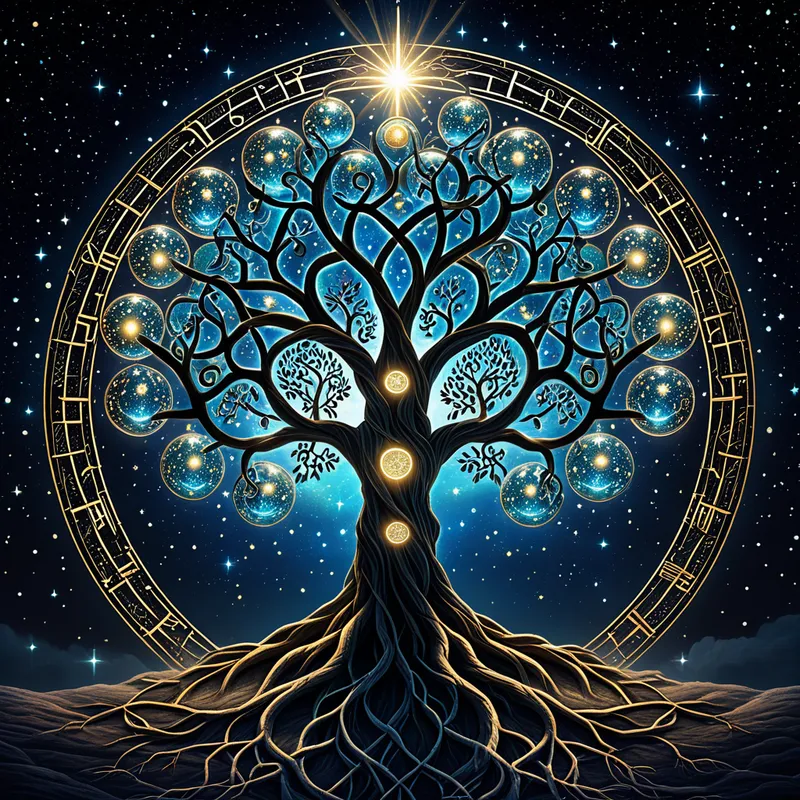
Tree of Life Myth Meaning & Symbolism
A sacred diagram of ten spheres and twenty-two paths, mapping the descent of divine light into creation and the soul's journey back to its source.
The Tale of the Tree of Life
Before [the world](/myths/the-world “Myth from Tarot culture.”/) was a world, before time was a line, there was only the Infinite—Ein Sof—a boundless, nameless sea of light without end or edge. It was All, and All was One, a perfect, silent unity where no “other” could exist.
But within that perfect unity, a desire stirred—not a lack, but an overflowing generosity. A wish to be known, to be revealed. And so, from the heart of the Infinite, a single, focused ray of light pierced the boundless dark. This was the first contraction, the first breath: [Tzimtzum](/myths/tzimtzum “Myth from Kabbalistic culture.”/). A space was made, a hollow vessel formed within the light, a womb for worlds.
Into that vessel, the light poured. But [the vessel](/myths/the-vessel “Myth from Alchemical culture.”/), new and untested, could not bear the intensity of the pure, undifferentiated flow. It shattered. Sparks of the original, holy light scattered like a billion stars, falling through the emptiness, encasing themselves in shells of density and matter. This was the Breaking of the Vessels, the cosmic catastrophe that seeded all potential—and all brokenness—into the fabric of what would become.
Yet, the flow did not cease. A new, gentler pattern emerged. The light began to descend in measured, graduated stages, like [water](/myths/water “Myth from Chinese culture.”/) flowing through ten crystal basins, each filtering and coloring the radiance. These basins are the Sefirot. The highest, Keter, received the first, almost-unknowable touch of the Infinite. From it flowed Chokhmah and Binah—Father and Mother of the cosmos. Downward the light cascaded: the loving-kindness of Chesed met by the rigorous judgment of Gevurah, finding balance in the beauty of Tiferet.
The flow continued through victory, splendor, foundation, until it reached the tenth and final vessel: Malkhut, our world. Here, the light finally came to rest, woven into the very substance of earth, stone, leaf, and human heart. The scattered sparks from the Breaking slept within everything, waiting.
And the pattern of these ten vessels, connected by twenty-two paths of influence—the letters of the Hebrew alphabet, the building blocks of reality—formed a sacred architecture. It is not a tree that grows in a field, but [the Tree of Life](/myths/the-tree-of-life “Myth from Kabbalistic culture.”/), a luminous, dynamic map of the descent of the Divine into form. It is the blueprint of the cosmos, the structure of the human soul, and the ladder by which the scattered sparks may be gathered, and the soul may ascend back to its source. The tale is not of a hero who slays a beast, but of a cosmos that breathes, breaks, and yearns to heal; and of every soul that is a microcosm of that great, breathing tree.
Cultural Origins & Context
The mythic structure of the Etz Chaim is the heart of the Jewish mystical tradition known as Kabbalah, which means “to receive.” Its most iconic formulation emerged in medieval Spain and Provence, crystallizing in the 13th-century text the Zohar. This was not a tradition for the many, but for the few—scholars who had mastered Torah and Talmud, and who sought the hidden, inner dimensions of reality. It was passed down orally from master to carefully prepared disciple, often under oath of secrecy, for its concepts were considered powerful and potentially destabilizing.
Its societal function was dual. For the community, it provided a profound theosophy that explained the presence of evil and exile (as consequences of the shattered vessels) and infused daily ritual with cosmic significance—every prayer an act of “raising sparks,” of mending the world (Tikkun Olam). For the individual mystic, it was a precise contemplative technology. By meditating on the Sefirot and their connections, [the adept](/myths/the-adept “Myth from Alchemical culture.”/) sought to align their own soul with the divine attributes, navigating the inner paths to achieve Devekut. The Tree was both a map of God’s inner life and a mirror held up to the soul of the practitioner.
Symbolic Architecture
The [Tree](/symbols/tree “Symbol: In dreams, the tree often symbolizes growth, stability, and the interconnectedness of life.”/) is a supreme [symbol](/symbols/symbol “Symbol: A symbol can represent an idea, concept, or belief, serving as a powerful tool for communication and understanding.”/) of holistic [integration](/symbols/integration “Symbol: The process of unifying disparate parts of the self or experience into a cohesive whole, often representing psychological wholeness or resolution of internal conflict.”/). It represents the entire process of [emanation](/symbols/emanation “Symbol: A spiritual or divine energy flowing outward from a source, often representing creation, influence, or the manifestation of the sacred into the material world.”/), from the unmanifest to the manifest, as a single, living organism. Each Sefirah is not a separate god, but a specific [modality](/symbols/modality “Symbol: In arts and music, modality refers to systems of organizing tones, scales, or modes, often evoking distinct emotional atmospheres or cultural traditions.”/) of the one divine [energy](/symbols/energy “Symbol: Energy symbolizes vitality, motivation, and the drive that fuels actions and ambitions.”/), a facet of the [diamond](/symbols/diamond “Symbol: Diamonds symbolize purity, strength, and unyielding love, often representing wealth and high status.”/) of [consciousness](/symbols/consciousness “Symbol: Consciousness represents the state of awareness and perception, encompassing thoughts, feelings, and experiences.”/).
The journey from Keter to Malkhut is the story of spirit becoming matter; the journey back is the story of consciousness remembering its origin.
Psychologically, the three pillars of the Tree are foundational. The right pillar (Chokhmah, Chesed, [Netzach](/symbols/netzach “Symbol: The seventh Sephirah on the Kabbalistic Tree of Life, representing eternal victory, endurance, and the emotional drive of nature.”/)) symbolizes the expansive, masculine, and gracious energies. The left pillar ([Binah](/symbols/binah “Symbol: In Kabbalah, the third Sephirah representing divine understanding, the feminine principle, and the womb of creation.”/), Gevurah, Hod) represents the restrictive, feminine, and structuring forces. The central pillar (Keter, Tiferet, [Yesod](/symbols/yesod “Symbol: The ninth Sephirah in Kabbalah, representing the foundation of the universe, the subconscious mind, and the astral plane where dreams form.”/), Malkhut) is the [path](/symbols/path “Symbol: The ‘path’ symbolizes a journey, choices, and the direction one’s life is taking, often representing individual growth and exploration.”/) of balance and reconciliation, where opposites are harmonized. The entire [structure](/symbols/structure “Symbol: Structure in dreams often symbolizes stability, organization, and the framework of one’s life, reflecting how one perceives their environment and personal life.”/) models a complete [psyche](/myths/psyche “Myth from Greek culture.”/): from the transcendent spark of will (Keter) and the archetypal parents of thought (Chokhmah/[Binah](/symbols/binah “Symbol: In Kabbalah, the third Sephirah representing divine understanding, the feminine principle, and the womb of creation.”/)), down through the [heart](/symbols/heart “Symbol: The heart symbolizes love, emotion, and the core of one’s existence, representing deep connections with others and self.”/)’s [compassion](/symbols/compassion “Symbol: A deep feeling of empathy and concern for others’ suffering, often involving a desire to help or alleviate their pain.”/) (Tiferet) and the foundational energies of the unconscious ([Yesod](/symbols/yesod “Symbol: The ninth Sephirah in Kabbalah, representing the foundation of the universe, the subconscious mind, and the astral plane where dreams form.”/)), to finally manifest in the concrete [reality](/symbols/reality “Symbol: Reality signifies the state of existence and perception, often reflecting one’s understanding of truth and life experiences.”/) of the [persona](/symbols/persona “Symbol: The social mask or outward identity one presents to the world, often concealing the true self.”/) and the physical [body](/symbols/body “Symbol: The body in dreams often symbolizes the dreamer’s self-identity, personal health, and the relationship they have with their physical existence.”/) (Malkhut).
The Dreamer’s Resonance
When the Tree of Life appears in modern dreams, it rarely does so as a literal diagram. It manifests as an experience of profound inner structure. One might dream of a luminous, internal latticework, a neural network of light connecting different centers of feeling and thought in the body. There may be a sense of one “node” or center being darkened, blocked, or over-energized—a Sefirah out of balance.
This dream signals a somatic and psychological process of integration. The dreamer is likely grappling with a life situation where two opposing forces—perhaps boundless generosity versus necessary boundaries (the tension between Chesed and Gevurah)—need to be brought into the heart’s harmony (Tiferet). The dream presents the psyche not as a chaos of impulses, but as a sacred, interconnected system. To see it is to be invited to participate in its repair, to find the path (the dream may highlight a bridge, a staircase, a cable of light) between one’s fragmented experiences and one’s core, central self.
Alchemical Translation
The Kabbalistic myth models the alchemical process of individuation—the journey toward psychic wholeness—with stunning precision. The initial state of Ein Sof mirrors the undifferentiated unconscious. The Tzimtzum is the necessary act of ego-formation, creating a conscious space (the “I”) within the boundless psyche. The “Breaking of the Vessels” is the inevitable trauma of incarnation and development, where our original, whole potential shatters into complexes, wounds, and disparate personality fragments—the “scattered sparks.”
Individuation is the labor of Tikkun Olam applied to the soul: gathering the lost sparks of our potential from the shells of our past wounds.
The work of the modern individual, then, is to navigate the Sefirot within. It begins with acknowledging the primal will and direction (Keter) of one’s true Self. It involves reconciling the inspired [flash of insight](/myths/flash-of-insight “Myth from Alchemical culture.”/) (Chokhmah) with the deep, formative understanding that gives it sustainable shape (Binah). It requires balancing our limitless capacity for love with the necessary discipline that gives it form, finding the beauty in that tension. We descend into the foundations of our instinctual and emotional life (Yesod), not to be ruled by them, but to bring their energy upward, transforming raw impulse into authentic expression in our kingdom (Malkhut)—our actual life in the world.
The ultimate transmutation is realizing that this entire process is not a linear ascent to escape the world, but a spiral of descent and return. By fully incarnating—by bringing conscious light into every “vessel” of our being, even the most broken—we do not leave the tree, we become it. We realize that the root (Keter) and the fruit (Malkhut) were always one, and the journey was the purpose. The healed psyche is a living Tree of Life, where the divine flow circulates without shattering, and the individual becomes a stable vessel through which the Infinite touches the finite world.
Associated Symbols
Explore related symbols from the CaleaDream lexicon: