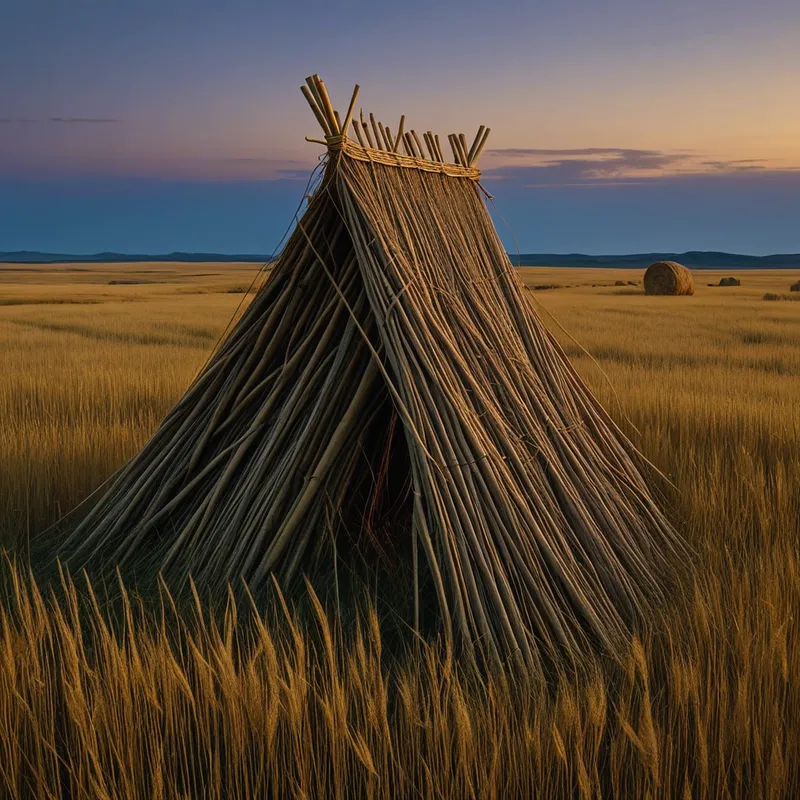
Travois Myth Meaning & Symbolism
A mythic story of a being who chose to become the first travois, transforming its body to carry the burdens of the people forever.
The Tale of Travois
Listen. The wind remembers. It whispers across the endless grass, a story older than the oldest stone. In the time before time, when the People walked, the world was wide and their burdens were heavy. They carried their lodges on their backs, their children in their arms, the sacred bundles weighing down their spirits. Their shoulders ached with the memory of every camp, their feet were slow upon the great journey.
Then came the time of the great wandering, when the buffalo had fled beyond the horizon and the sun burned white in a cloudless sky. The elders looked upon the suffering of the children, whose little legs could not keep pace. They saw the strength leaving the hunters, bent double under the weight of the meat and hides that meant survival. A deep silence fell upon the camp, a silence of despair. It was in this silence that a voice was heard, not from a human throat, but from the very ground, from the bones of the earth.
It was the spirit of the Saskatoon. It had watched. It had felt the sorrow in each footfall. And it spoke to the wisest elder in a dream. “You carry the world upon your backs,” the spirit whispered, its voice like rustling leaves. “But the world itself can be made to carry you.”
The elder awoke with the vision burning behind his eyes. He went to the stand of straight, strong Lodgepole pines. He did not ask for their lives; he asked for their strength. He sang the song of the burden-bearer, his voice cracking with hope. And the trees listened. One, the straightest and truest, seemed to sigh. Its spirit stepped forth, a shimmering form of wood and will.
“I will not be a tree that stands and watches,” it said. “I will be a tree that walks with you. Take my body. Shape it not for stillness, but for journey.”
With reverence, the people took two of its long, straight limbs. They called upon the spirit of the Tatanka, who gave sinew from its own great heart. They called upon the spirit of the Pte, who offered its tough hide. Under the guidance of the tree-spirit, they bound the poles together at one end. They stretched the hide between them, creating a bed that could cradle a child, a bundle, a dream.
But a frame is not a carrier. It needed a heart, a connection. The tree-spirit looked at its own creation, this skeletal form lying on the grass. “This is my new body,” it said. “But it is empty. To move, it must be joined to life.” And with a final sigh that became the wind through the poles, the spirit poured its essence into the crafted wood. The travois was no longer a thing. It was a being. It was Travois.
The elder took the bound end and placed it upon his shoulders. The weight was there, but it was a weight shared. He began to walk. And the Travois walked with him, its poles whispering songs of the prairie as they slid over the earth, bearing the load without complaint. The people wept, not from sorrow, but from awe. They had been given not just a tool, but a companion for the long road.
Cultural Origins & Context
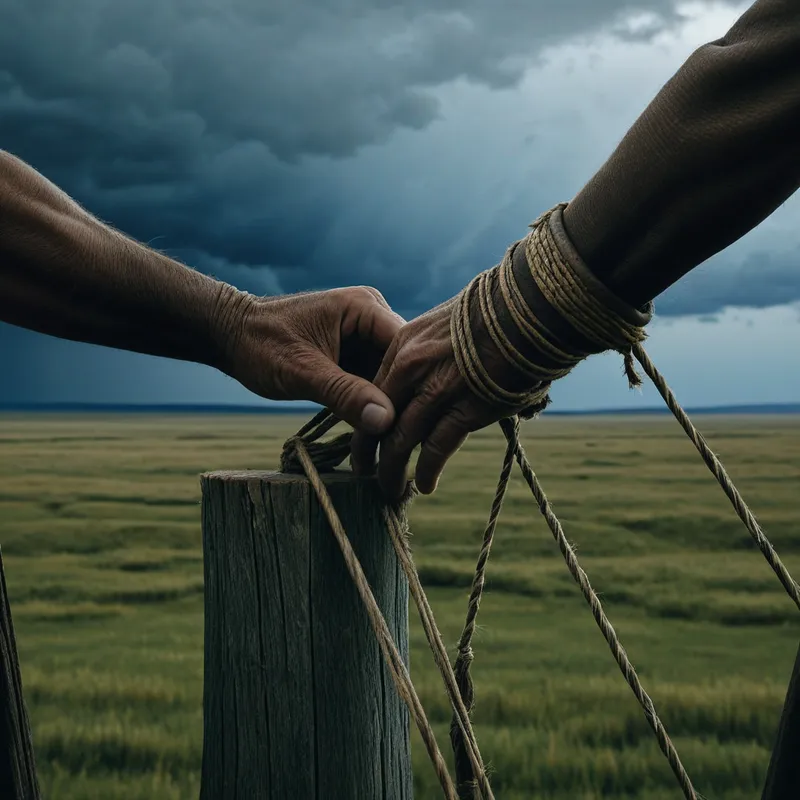
The story of Travois is not a single, fixed myth from one nation, but a pervasive narrative essence found woven into the oral traditions of many Plains and Plateau cultures, including the Lakota, Blackfoot, Crow, and Nez Perce. In a world defined by seasonal migration following the bison herds, the physical travois—a simple yet revolutionary A-frame sled pulled by people or later, horses—was the cornerstone of mobility and survival. The myth explaining its origin served a crucial societal function: it transformed a vital technology into a sacred covenant.
This story was likely told by elders and storytellers during times of preparation for travel, or when teaching the young about the respectful use of tools. It was not merely a “how-it-came-to-be” tale; it was a lesson in relational ethics. It taught that the world is animate, that tools have spirit, and that humanity’s survival depends on respectful dialogue with the non-human persons—trees, animals, the very land—who offer their bodies and gifts. The myth ensured that the travois was treated not as an inert object to be used and discarded, but as a living partner in the people’s journey, instilling values of gratitude, responsibility, and interconnectedness.
Symbolic Architecture
At its core, the myth of Travois is a profound allegory for the nature of burden, support, and willing sacrifice. The tree-spirit’s transformation represents the ultimate act of service: the transition from autonomous, rooted existence to a form defined entirely by its utility for others.
The greatest strength is not in refusing to bend, but in choosing what, and for whom, you will bear.
The two poles symbolize duality in partnership—strength and flexibility, the individual and the collective, the path ahead and the path behind. The platform stretched between them is the sacred space of the community’s life, its hopes, its history, and its future. The act of pulling is not one of domination, but of partnership; the human provides direction and motive force, while the travois provides the capacity. Psychologically, this mirrors the integration of our burdens into our identity. We do not simply “carry” our trariefs, responsibilities, or histories; we are in a dynamic relationship with them. They shape our posture, our path, and our pace.
The spirit’s choice is critical. It is not conquered or tricked. It chooses to be transformed. This represents the conscious acceptance of a load, the alchemy where a heavy obligation is transmuted into a sacred duty through the power of voluntary assent.
The Dreamer’s Resonance
When the archetype of Travois appears in modern dreams, it often signals a profound somatic and psychological engagement with the theme of burden. One might dream of dragging a heavy, unnamed load behind them, feeling the strain in their shoulders and back—a direct somatic echo of the myth. The load itself is rarely clear; it is a feeling, a mass, a shadow.
This dream is the psyche’s way of making the intangible, tangible. The “travois” in the dream is the dreamer’s own constructed framework for carrying their psychological weight—their obligations, their past traumas, their unexpressed grief, or their sense of responsibility for others. The dream asks: What have you lashed to your frame? Is the burden yours to carry alone? The often-unseen “poles” represent the dual supports in the dreamer’s life, which may be under strain: perhaps the balance between work and home, between self-care and care for others, or between intellect and intuition.
A dream of a travois breaking, or of being unable to move it, points to a system at the point of failure. It is a call from the deep self to examine the structure of one’s burdens, to perhaps unbundle them, and to remember the mythic truth: the spirit within the burden-bearer must be acknowledged, or the journey ceases.
Alchemical Translation
The individuation process, the journey toward psychic wholeness, is itself a great migration. We must carry with us all that we are—the wounds, the gifts, the histories, the potentials. The myth of Travois provides a precise model for this inner alchemy.
First, there is the Acknowledgment of the Burden. Like the People in the story, we must feel the authentic weight of our psyche’s contents, the exhaustion of trying to carry it all in our arms or on our backs. This is the necessary despair that precedes transformation.
Second, the Dialogue with the Self. The elder listens to the dream, to the voice of the spirit (the Self, the inner guide). This is the introspective phase where we ask not how to escape the burden, but how to relate to it differently. What inner resource (the “straight tree” of our integrity, our core strength) can be called upon?
Third, the Sacrifice and Reshaping. This is the critical alchemical fire. The autonomous ego (the tree that stands alone) must willingly sacrifice its form for a greater function. It must allow itself to be reshaped into a structure of service—not to others blindly, but to the journey of the whole psyche. We must craft our own “travois”—a conscious attitude, a therapeutic practice, a creative outlet—designed specifically to carry our unique load.
Individuation is the process of building a travois for your soul, so that you may pull your whole self toward the horizon.
Finally, the Integration and Journey. The spirit animates the structure. The burden is loaded. The walking begins. The transformed part of the self (the caregiver archetype, the burden-bearer) is now in a dynamic, pulling partnership with the conscious ego. The load is still there, but it is framed, it is shared, it is moving. It has become part of the journey itself, not an obstacle to it. The goal is not to arrive at a place without burden, but to become the one who can bear the journey gracefully, in sacred partnership with all that you are and all that you carry.
Associated Symbols
Explore related symbols from the CaleaDream lexicon: