Transfiguration of Jesus Myth Meaning & Symbolism
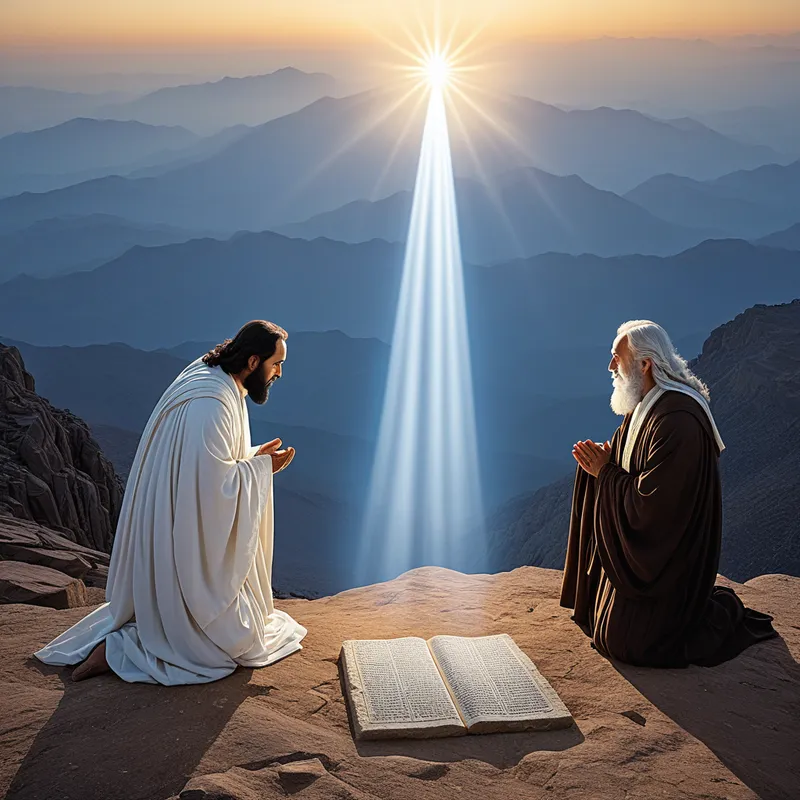
Jesus ascends a mountain, his body and garments becoming radiant light, witnessed by three disciples and conversing with Moses and Elijah.
The Tale of the Transfiguration of Jesus
The air on the mountain was thin, a sharp, cold clarity that bit the lungs. The climb had been long, a silent pilgrimage led by the teacher, [Jesus](/myths/jesus “Myth from Christian culture.”/) of Nazareth. His three chosen ones—[Peter](/myths/peter “Myth from Biblical culture.”/), and the brothers James and John—followed, their breath pluming in the twilight, driven by a wordless compulsion. They were ascending not just rock and earth, but into a realm of gathering silence, away from the clamor of the crowds and the weight of foreboding words about suffering and death that had lately fallen from their master’s lips.
They reached [the summit](/myths/the-summit “Myth from Taoist culture.”/) as the sun bled into [the horizon](/myths/the-horizon “Myth from Various culture.”/), painting [the world](/myths/the-world “Myth from Tarot culture.”/) in hues of violet and gold. Jesus moved apart to pray, as was his custom. The disciples, weary, settled against the cold stone, their eyes heavy. But sleep was not to claim them.
It began as a subtle vibration in the air, a humming just below hearing. Then, a light—not from the dying sun, but from the man himself. His face, often lined with compassion and sorrow, began to shine like the sun, a radiance that held the warmth of creation’s first dawn. His garments, simple traveler’s wool, became blindingly white, a purity so intense it seemed to burn without consuming, “as no fuller on earth could whiten them.” This was no reflected glory; it was an emanation from within, the very substance of his being unveiled.
And then, he was not alone. Two figures manifested within the nimbus of light, men of immense spiritual gravity. One bore the stern countenance of [the Law](/myths/the-law “Myth from Biblical culture.”/), his presence speaking of tablets of stone and a covenant carved by divine fire—[Moses](/myths/moses “Myth from Biblical culture.”/). The other carried the fierce, untamed spirit of [the Prophets](/myths/the-prophets “Myth from Biblical culture.”/), a man who had ascended in a whirlwind—Elijah. They spoke with Jesus, a conversation of epochs, of fulfillments and passages. [The veil](/myths/the-veil “Myth from Various culture.”/) between times had dissolved on that mountain peak.
Peter, ever the man of action in the face of the ineffable, shattered the stunned silence. “Rabbi,” he blurted out, his voice trembling, “it is good for us to be here. Let us put up three shelters—one for you, one for Moses, and one for Elijah.” He did not know what he said, for he and his companions were utterly terrified, the awe of the numinous shaking them to their core.
Then, the culmination. A luminous cloud, the ancient [Shekinah](/myths/shekinah “Myth from Christian culture.”/) glory, enveloped them, a tangible, holy mist. And from within the cloud came a Voice, the same that had spoken at the Jordan: “This is my Son, whom I love. Listen to him!”
At this, the disciples fell face down on the ground, overcome by a terror beyond description. The world of solid rock and known prophecy had vanished, replaced by pure, unmediated Presence. Then, a touch. A familiar hand rested on a shoulder. “Get up,” Jesus said, his voice now returned to its normal, compassionate timbre. “Don’t be afraid.” They lifted their eyes. The light was gone. Moses and Elijah had vanished. They saw only Jesus, alone, as he had always been. Yet, nothing would ever be the same. As they descended the mountain the next day, he charged them to tell no one of this vision until “the Son of Man” had risen from the dead—a command that wrapped the mystery in further mystery, a seed of light planted in the dark soil of their confusion.

Cultural Origins & Context
The account of [the Transfiguration](/myths/the-transfiguration “Myth from Christian culture.”/) is recorded in the three Synoptic Gospels (Matthew 17:1–8, Mark 9:2–8, Luke 9:28–36) and is alluded to in the Second Epistle of Peter. It occupies a pivotal narrative position, situated after Peter’s confession of Jesus as the Messiah and Jesus’s first prediction of his Passion. Culturally, it functions as a divine seal of approval on Jesus’s identity and mission, bridging the Old Testament (represented by Moses and Elijah) and the nascent New Testament.
Told within the early Christian communities, it served multiple societal functions. For followers facing persecution and doubt, it was a foundational testimony—a moment where the hidden divinity of Christ was revealed to authoritative witnesses. It validated Jesus not as a mere teacher or prophet, but as the fulfillment and culmination of the Law and the Prophets. The story was passed down as oral tradition before being codified in the Gospels, functioning as a cornerstone of Christological belief, affirming the paradoxical unity of human and divine in Jesus. It was a story meant to inspire awe, confirm faith, and prepare the community for the scandal of the cross by prefacing it with the certainty of glory.
Symbolic Architecture
The [mountain](/symbols/mountain “Symbol: Mountains often symbolize challenges, aspirations, and the journey toward self-discovery and enlightenment.”/) is the universal [axis](/symbols/axis “Symbol: A central line or principle around which things revolve, representing stability, orientation, and the fundamental structure of reality or consciousness.”/) mundi, the place where [heaven](/symbols/heaven “Symbol: A symbolic journey toward ultimate fulfillment, spiritual transcendence, or connection with the divine, often representing life’s highest aspirations.”/) and [earth](/symbols/earth “Symbol: The symbol of Earth often represents grounding, stability, and the physical realm, embodying a connection to nature and the innate support it provides.”/) meet. It symbolizes the arduous [ascent](/symbols/ascent “Symbol: Symbolizes upward movement, progress, spiritual elevation, or striving toward higher goals, often representing personal growth or transcendence.”/) of [consciousness](/symbols/consciousness “Symbol: Consciousness represents the state of awareness and perception, encompassing thoughts, feelings, and experiences.”/) from the mundane to the transcendent, the [journey](/symbols/journey “Symbol: A journey in dreams typically signifies adventure, growth, or a significant life transition.”/) [inward](/symbols/inward “Symbol: A journey toward self-awareness, introspection, and the exploration of one’s inner world, thoughts, and unconscious mind.”/) to the [summit](/symbols/summit “Symbol: The highest point of a mountain, representing achievement, perspective, and the culmination of effort.”/) of [the Self](/myths/the-self “Myth from Jungian culture.”/).
The transfiguring light is not an external award, but the revelation of an intrinsic, foundational radiance that was always present, obscured only by the garments of ordinary perception.
Moses and Elijah represent the complete archetypal [structure](/symbols/structure “Symbol: Structure in dreams often symbolizes stability, organization, and the framework of one’s life, reflecting how one perceives their environment and personal life.”/) of spiritual tradition—[the Law](/symbols/the-law “Symbol: Represents external rules, societal order, moral boundaries, and the tension between personal freedom and collective structure.”/) (structure, order, [covenant](/symbols/covenant “Symbol: A binding agreement or sacred promise between parties, often carrying deep moral, spiritual, or social obligations and consequences.”/)) and the Prophets (inspiration, critique, fiery transformation). Their [conversation](/symbols/conversation “Symbol: A conversation in a dream often symbolizes the need for communication and understanding, both with oneself and others.”/) with Jesus signifies that the new consciousness does not destroy the old but fulfills it, engaging it in a [dialogue](/symbols/dialogue “Symbol: Conversation or exchange between characters, representing communication, relationships, and narrative flow in games and leisure activities.”/) of completion. Peter’s desire to build three shelters is [the ego](/myths/the-ego “Myth from Jungian culture.”/)’s instinctive attempt to capture, institutionalize, and make permanent a fleeting experience of the numinous—to box the infinite into manageable dogma. The divine Voice from the cloud shatters this attempt, redirecting [attention](/symbols/attention “Symbol: Attention in dreams signifies focus, awareness, and the priorities in one’s life, often indicating where the dreamer’s energy is invested.”/) solely to the living, speaking [presence](/symbols/presence “Symbol: Presence in dreams often signifies awareness or acknowledgment of something significant in one’s life.”/) (“Listen to him!”). The command to silence until after [the resurrection](/myths/the-resurrection “Myth from Christian culture.”/) encapsulates the necessity of integrating the dazzling [vision](/symbols/vision “Symbol: Vision reflects perception, insight, and clarity — often signifying the ability to foresee or understand deeper truths.”/) of the Self with the inevitable descent into the [shadow](/symbols/shadow “Symbol: The ‘shadow’ embodies the unconscious, repressed aspects of the self and often represents fears or hidden emotions.”/) and [death](/symbols/death “Symbol: Symbolizes transformation, endings, and new beginnings; often associated with fear of the unknown.”/) of the old [identity](/symbols/identity “Symbol: Identity represents the sense of self, encompassing personal beliefs, cultural background, and social roles.”/).

The Dreamer’s Resonance
When this mythic pattern stirs in modern dreams, it signals a critical juncture in the dreamer’s psychological development. To dream of a radiant figure, or of oneself emitting a powerful, non-threatening light, often points to an emerging recognition of one’s own authentic essence or potential—the “true self” breaking through the [persona](/myths/persona “Myth from Greek culture.”/). The somatic experience in such dreams is often one of awe mixed with fear, a trembling at [the threshold](/myths/the-threshold “Myth from Folklore culture.”/) of a new, more integrated state of being.
Dreams featuring encounters with authoritative or ancestral figures (like Moses and Elijah) alongside this light suggest the [psyche](/myths/psyche “Myth from Greek culture.”/) is reconciling internalized structures (personal and cultural “laws”) with one’s inner calling or voice (the “prophet”). The dreamer may be processing a profound insight that feels both utterly new and deeply familiar, a synthesis that promises wholeness but demands the terrifying dissolution of a former, more limited self-concept. The dream is an unconscious enactment of the [transfiguration](/myths/transfiguration “Myth from Christian culture.”/) moment, preparing the conscious mind for a transformation it may intellectually and emotionally resist.

Alchemical Translation
Psychologically, the Transfiguration is a supreme model of the individuation process—the alchemical opus of becoming who one fundamentally is. The ascent is the difficult work of introspection and confronting the unconscious. The radiant transformation is the experience of Self-realization, where the complex, often conflicted elements of the personality are suddenly seen in their unified, luminous origin.
The goal of the process is not to become a disembodied light, but to return, as Jesus did, to touch the terrified ego and say, “Get up. Don’t be afraid,” integrating the sublime vision back into the human journey.
Moses and Elijah represent the archetypal contents of the personal and collective unconscious that must be acknowledged and conversed with. Peter’s reaction is the ego’s inevitable clumsiness in the face of the Self. The command to “Listen to him!” is the core of the alchemical work: to attend to the guiding voice of the central, transcendent function within the psyche, rather than to the peripheral impulses of fear or the desire to prematurely concretize the experience. The entire myth maps the journey from partial identity to the shocking, glorious glimpse of the total personality, followed by the necessary return to the world of time, relationship, and suffering, now carrying an unshakable [inner light](/myths/inner-light “Myth from Buddhist culture.”/). It is the pattern of revelation, integration, and purposeful descent.
Associated Symbols
Explore related symbols from the CaleaDream lexicon: