
Týr Myth Meaning & Symbolism
The god of justice sacrifices his hand as a pledge to bind the monstrous wolf Fenrir, ensuring cosmic order at a terrible personal cost.
The Tale of Týr
Hark, and listen to the tale spun when [the world](/myths/the-world “Myth from Tarot culture.”/) was younger, when the Æsir walked the green ways of Asgard and the [threads of fate](/myths/threads-of-fate “Myth from Greek culture.”/) were still being woven. It begins not with a shout, but with a growing dread—a shadow that paced at the edge of the gods’ golden realm.
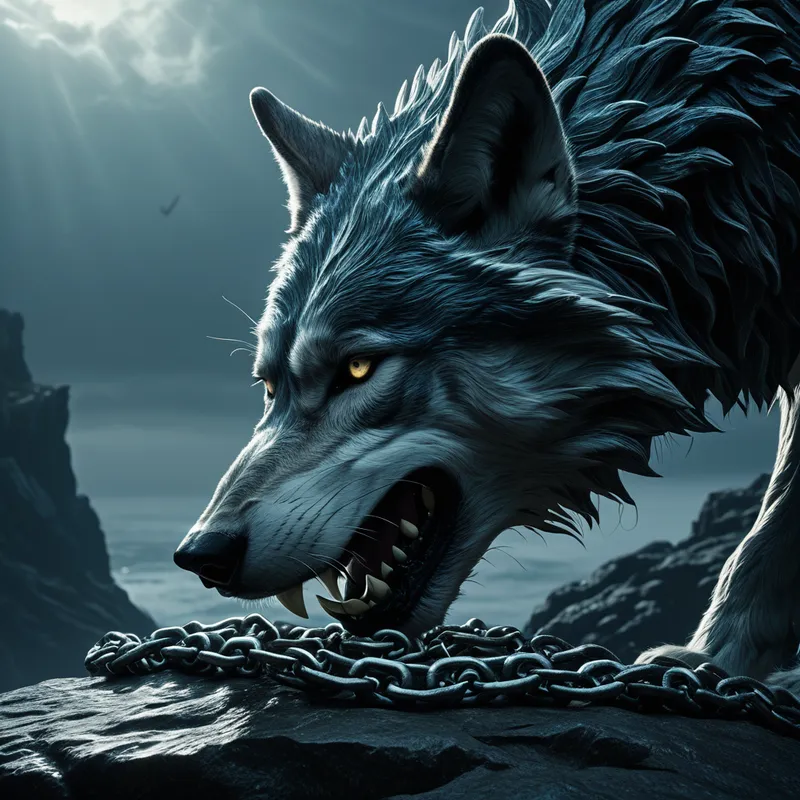
[The shadow](/myths/the-shadow “Myth from Jungian culture.”/) had a name: [Fenrir](/myths/fenrir “Myth from Norse culture.”/). Born of trickery and chaos, the wolf grew not by the day, but by the breath. He grew so vast that his howls shook the roots of [Yggdrasil](/myths/yggdrasil “Myth from Global/Universal culture.”/) itself. The gods saw in his amber eyes the doom foretold, the swallowing of the sun. They knew he must be restrained. Yet, how do you bind a force of nature? With cunning, and with a pledge.
Twice they tried, with chains named Lædingr and Drómi. Twice the wolf, with a grunt and a heave of his mighty shoulders, shattered the links like dried twigs. His eyes grew sharper, his trust thinner. A third fetter was needed, one born not of brute iron, but of impossible things: the sound of a cat’s footfall, the beard of a woman, the roots of a mountain, the sinews of a bear, the breath of a fish, and the spittle of a bird. From these six impossibilities, [the dwarven smiths](/myths/the-dwarven-smiths “Myth from Norse culture.”/) crafted [Gleipnir](/myths/gleipnir “Myth from Norse culture.”/), a silken ribbon, smooth and soft as a cord of silk.
But the wolf would not be fooled. “A ribbon?” he growled, his voice like grinding stones. “There is no fame in breaking such a trifle. Yet I sense magic in it. If you wish me to be bound by this, one of you must place your hand in my mouth as a pledge of good faith.”
A silence fell upon the shining field. [The wind](/myths/the-wind “Myth from Various culture.”/) stilled. The challenge hung in the air, a test not of strength, but of truth. Who among the mighty Æsir would dare?
Then, one stepped forward. Not Odin, whose wisdom saw the sacrifice’s bitter fruit. Not Thor, whose might lay in his hammer, not in such a pact. It was Týr. The god of [justice](/myths/justice “Myth from Tarot culture.”/) and of oaths. His face was calm, a mask of solemn resolve. He understood the terrible arithmetic of order: one hand for the safety of all the worlds.
He knelt before the great wolf. Without a word, he laid his right hand—the hand that would wield a sword in pledge, the hand that would shake on treaties—into the cavernous, hot maw of Fenrir. The other gods, their hearts hammering, bound the wolf with Gleipnir. The more Fenrir struggled, the tighter the magical band constricted. Realizing he had been tricked, that his freedom was eternally forfeit, the wolf’s jaws snapped shut in a final, vengeful act.
The sound was not a scream, but a clean, terrible severance. Týr did not cry out. He stepped back, his wound a fountain of gold, his sacrifice complete. The wolf was bound, gnashing and howling on its island prison, a doom postponed. And Týr, the one-handed god, became forever the living testament to the price of the oath, the cost of [the law](/myths/the-law “Myth from Biblical culture.”/), and the solemn bond that holds chaos at bay.
Cultural Origins & Context
The myth of Týr and Fenrir is preserved primarily in the Prose Edda of Snorri Sturluson and echoes in earlier poetic fragments. It was not a mere fireside story, but a foundational narrative for a society built on precarious order. The Norse world was one of harsh climates, feuds, and existential threats. Law, embodied in the þing, was the fragile wall against chaos. Týr (whose name is linguistically connected to Dyeus, the Proto-Indo-European sky god, like Zeus or Jupiter) had evolved from a sovereign sky father into the specific god of the [thing](/myths/thing “Myth from Norse culture.”/), of formal combat, and of justice.
The myth was likely told by skalds and elders to encode a brutal social truth. An oath was not a casual promise; it was a cosmic contract. To break it was to invite chaos back into the world. Týr’s sacrifice models the ultimate guarantor: the authority figure who stakes his own flesh to uphold the system. The story functioned as a sacred precedent, explaining why the gods, in their wisdom and trickery, were justified in their deceit of Fenrir. It presented a difficult ethical equation—is betrayal permissible to ensure survival?—and answered it with the visceral image of a god paying the price personally.
Symbolic Architecture
At its [heart](/symbols/heart “Symbol: The heart symbolizes love, emotion, and the core of one’s existence, representing deep connections with others and self.”/), this is a myth of the conscious ego (Týr) confronting and binding the ravenous, unconscious [shadow](/symbols/shadow “Symbol: The ‘shadow’ embodies the unconscious, repressed aspects of the self and often represents fears or hidden emotions.”/) (Fenrir). Fenrir is not mere evil; he is a natural force of unbounded instinct, potential, and destruction. He is what happens when raw power is left untamed and distrusted. The gods’ initial attempts with heavy chains (Lædingr and Drómi) symbolize failed efforts to suppress the [shadow](/symbols/shadow “Symbol: The ‘shadow’ embodies the unconscious, repressed aspects of the self and often represents fears or hidden emotions.”/) through brute force or willpower—it only grows stronger.
True binding requires the “impossible” materials of Gleipnir: the intangible, subtle, and paradoxical aspects of reality. It requires cunning, art, and acceptance, not just force.
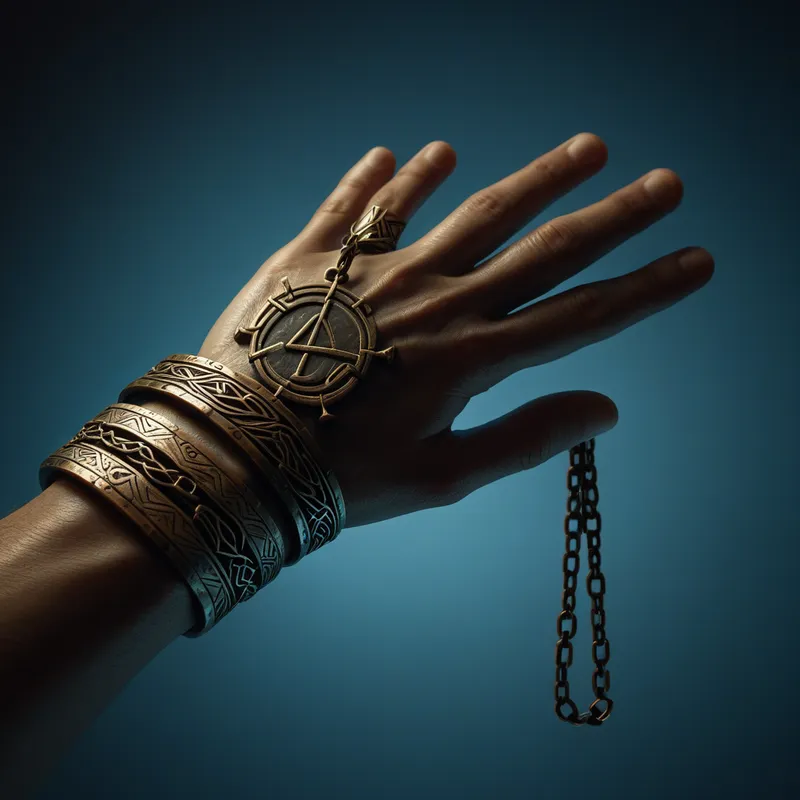
Týr’s hand is the ultimate [symbol](/symbols/symbol “Symbol: A symbol can represent an idea, concept, or belief, serving as a powerful tool for communication and understanding.”/). It represents agency, [action](/symbols/action “Symbol: Action in dreams represents the drive for agency, motivation, and the ability to take control of situations in waking life.”/), pledge, and [connection](/symbols/connection “Symbol: Connection symbolizes relationships, communication, and bonds among individuals.”/). His sacrifice is not a [loss](/symbols/loss “Symbol: Loss often symbolizes change, grief, and transformation in dreams, representing the emotional or psychological detachment from something or someone significant.”/) of power, but a transformation of it. He exchanges the hand that grasps (for power, for control) for the eternal [status](/symbols/status “Symbol: Represents one’s social position, rank, or standing within a group, often tied to achievement, power, or recognition.”/) of the one who gave. He becomes the embodied [oath](/symbols/oath “Symbol: A solemn promise or vow, often invoking a higher power or sacred principle, binding individuals to specific actions or loyalties.”/). His maiming is a permanent wound of [consciousness](/symbols/consciousness “Symbol: Consciousness represents the state of awareness and perception, encompassing thoughts, feelings, and experiences.”/), a reminder that order is not inherent but purchased, and that integrity has a somatic cost. He is the god who limps, whose balance is forever altered, because he has met the [chaos](/symbols/chaos “Symbol: In Arts & Music, chaos represents raw creative potential, uncontrolled expression, and the breakdown of order to forge new artistic forms.”/) within the [system](/symbols/system “Symbol: A system represents structure, organization, and interrelated components functioning together, often reflecting personal or social order.”/) and within himself.
The Dreamer’s Resonance
When this myth stirs in the modern [psyche](/myths/psyche “Myth from Greek culture.”/), it may manifest in dreams of painful bargains, of sacrificing a part of oneself (a hand, a voice, an opportunity) to secure a greater stability. One might dream of making a promise they instinctively know will cost them dearly, yet feel compelled to make. Dreams of being bound or of binding something ferocious also echo this pattern.
Somatically, this can feel like a tension in the right hand or arm, a sense of “handing over” one’s power, or a phantom limb sensation of something vital missing that was willingly given. Psychologically, the dreamer is likely at a crossroads where a foundational aspect of their life—a relationship, career, or personal code—requires re-negotiation. The “Fenrir” in the dream is the untamed force (a rage, a desire, a talent, a fear) that threatens to destabilize their current world. The dream process is the psyche working through the terrifying but necessary act of engaging with that force directly, offering a pledge of recognition, to integrate it rather than let it run wild or remain chained in resentment.
Alchemical Translation
The alchemical journey here is the transmutation of naive order into wise sovereignty. The initial state is a fragile ego (the gods) terrified of a potent inner content (Fenrir). The [nigredo](/myths/nigredo “Myth from Alchemical culture.”/), or blackening, is the recognition that this content cannot be ignored or easily destroyed; it is part of [the self](/myths/the-self “Myth from Jungian culture.”/).
The binding with Gleipnir represents the albedo, the whitening. It is the application of subtle, sophisticated understanding—the “impossible” ingredients—to contain and relate to the shadow. This is the crafting of a conscious relationship with one’s inner chaos.
The sacrifice of the hand is the rubedo, the reddening. It is the culminating act of psychic transmutation: the conscious, painful surrender of a former mode of being to achieve a higher integration.
For the modern individual, this models the process of individuation when facing a deep, destructive pattern or a boundless talent that feels dangerous. One must first acknowledge its power (stop trying to break it with willpower). Then, one must craft a new, nuanced relationship with it (the binding). Finally, one must sacrifice the old identity—the “hand” that used to manage the world in the old way—to this new truth. The result is not a “perfect” whole, but a sovereign one. The individual, like the one-handed god, carries a visible wound, a reminder of the cost of their integrity. They have lost a literal piece of their former self, but in doing so, they have gained an unshakeable authority. They have bound their personal Fenrir, not to destroy it, but to dialogue with it, securing an inner peace purchased with their own flesh and truth.
Associated Symbols
Explore related symbols from the CaleaDream lexicon: