Torana Myth Meaning & Symbolism
The myth of the celestial gateway, a threshold of divine order and cosmic law, forged to separate the heavens from the chaos of the primordial waters.
The Tale of Torana
Listen, and hear the tale of the First Threshold, born when the world was a song not yet sung.
In the time before time, there was only the One, the boundless, breathless Brahman. From its silent potential, a desire stirred—a desire to become many. And so, with a sound that was the universe itself—Om—the waters of existence were churned. Not the waters of a sea, but the waters of possibility, dark, infinite, and without shore. This was the Garbhodaka.
Upon these endless, dreaming waters, Vishnu rested, reclined on the coils of the great serpent Ananta Shesha. From his navel, a lotus grew, piercing the vaporous gloom. Upon its radiant bloom sat Brahma, tasked with fashioning the worlds. But the worlds were formless, adrift. The heavens had no floor; the earth had no ceiling. All was a swirling, beautiful chaos, where the music of the spheres was a cacophony, and the dance of creation had no stage.
The gods themselves grew weary. Their luminous abodes had no definition, forever bleeding into the murk of unformed realms. Demonic whispers, the asuras born of shadow, slithered through the unbounded spaces, threatening the fragile harmonies of the new creation. A great lament arose in the assembly of the devas. “Where does the sacred end and the profane begin?” they cried. “Where is the line that holds the form, the law that gives the dance its steps?”
Hearing this, the great preserver, Vishnu, opened his eyes. His gaze was not of judgment, but of profound ordinance. He breathed out, and his breath was not air, but the principle of Dharma. “For there to be a here,” he intoned, his voice the sound of mountains forming, “there must be a there. For there to be within, there must be a without. A cosmos requires a threshold.”
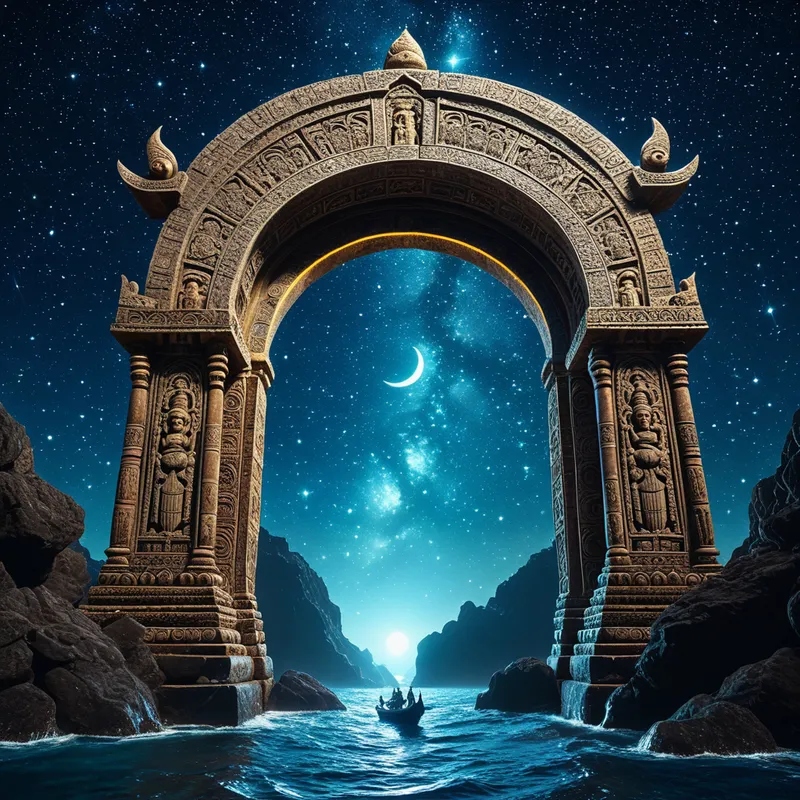
He raised his hand, the Sudarshana Chakra spinning at his fingertip, not as a weapon, but as a compass. From the very substance of the cosmic law, from the essence of boundary and distinction, he willed a form into being. It did not rise from the waters, but separated them. It was an arch—a colossal, magnificent archway. Its pillars were forged from the concept of Here and There. Its lintel was carved from the principle of Limit. Intricate scenes of cosmic order—the rising sun, the waxing moon, the cycles of birth and duty—adorned its surface, glowing with an inner light.
This was the first Torana. With a sound like a universe clicking into place, it settled into the fabric of existence. On one side, the chaotic, fertile, potential-charged waters of the Garbhodaka receded, held at bay. On the other, a defined space emerged—a realm where stars could find fixed paths, where mountains could root themselves, where the devas could build their city of Amaravati. The Torana stood, silent and immutable, not as a wall, but as a gateway. A reminder that to enter the realm of form, of meaning, of sacred order, one must pass through the acknowledgment of the limit. The cosmos had its doorframe, and the great dance of life could now begin in earnest.
Cultural Origins & Context
The concept of the Torana is deeply woven into the architectural and ritual fabric of the Indian subcontinent, far transcending a single, codified “myth.” While the narrative of its primordial creation is a synthesis of cosmological principles found in texts like the Vedas and Puranas, its physical and symbolic presence is ubiquitous. Historically, Toranas are the magnificent free-standing gateways or ornate archways leading to stupa complexes, temples, and sacred enclosures, such as the famed ones at Sanchi.
The myth is not a story told in one linear epic, but a truth enacted and reinforced every time a devotee passes through a temple’s gopuram (tower gateway) or under a festooned arch during a festival. It was passed down not only by priests and storytellers but by sculptors and architects who encoded the entire cosmology into the stone of the gateway itself. Its societal function was multifaceted: it demarcated the sacred from the profane, preparing the pilgrim’s mind for entry into a divine space; it served as a visual sermon, its carvings depicting scenes from scriptures for an often non-literate populace; and it was a cosmic model, representing the axis between heaven and earth, the point of transition from the mundane to the enlightened state.
Symbolic Architecture
The Torana is far more than an architectural feature; it is a supreme symbol of the principle of distinction, the necessary precondition for consciousness and order.
The gateway does not deny the wilderness beyond; it gives meaning to the sanctuary within by acknowledging the wilderness’s existence.
Psychologically, it represents the liminal space—the critical threshold between two states of being. It is the moment between sleep and wakefulness, the breath between thought and speech, the space between impulse and action. In the cosmic sense, it symbolizes the emergence of Nama-Rupa (Name and Form) from the unmanifest Brahman. The chaos of the primordial waters is not destroyed but organized; potential is given a channel through which to manifest.
The arch itself, often laden with symbols of abundance (Lakshmi), protection (mythical guardians like Shardulas), and cosmic cycles, represents the structured, lawful framework of reality—Dharma. Passing through it is an act of alignment with this cosmic order. It is the embodiment of the mind’s capacity to create categories, boundaries, and identities, which are essential for navigating existence but which also create the fundamental sense of separation that spirituality often seeks to transcend.
The Dreamer’s Resonance
When the archetype of the Torana appears in modern dreams, it signals a profound psychological process at a threshold. The dreamer is in a liminal state, navigating a passage between two major phases of life, identity, or understanding.
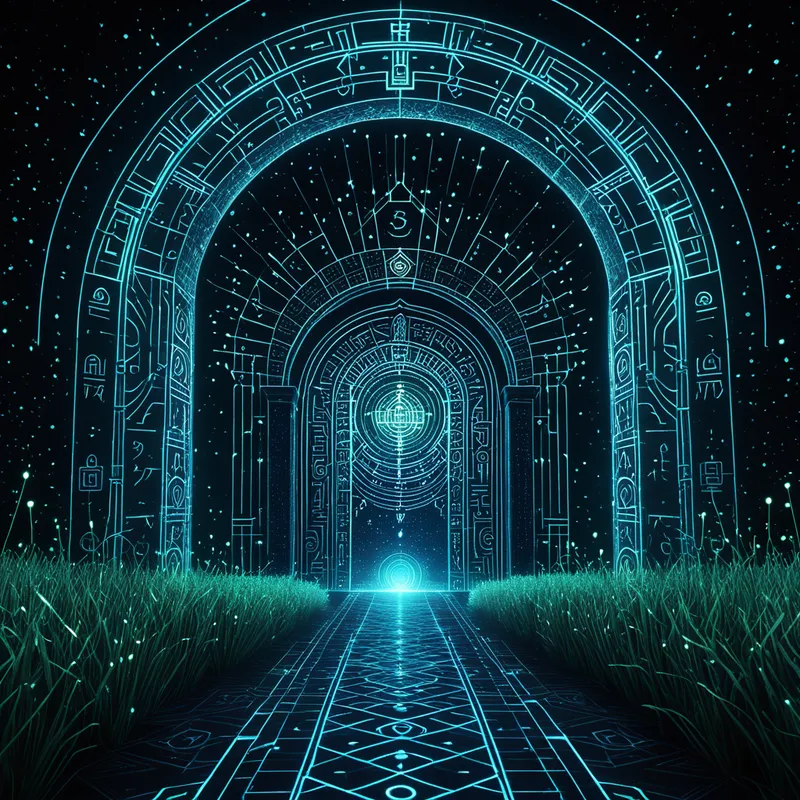
The somatic experience might be one of hesitation—feet rooted before the arch, feeling the palpable difference in “air” on either side. The Torana in a dream can appear as a simple doorframe glowing in a void, a monumental stone arch in a misty landscape, or even a security gate at an airport that feels cosmically significant. The key is the mandate to pass through. Anxiety dreams of being unable to find the entrance, or of the gateway being locked, reflect resistance to an impending transformation—a refusal to leave an old, familiar chaos for a new, demanding order. Conversely, dreams of passing through with ease and emerging into a radiant, structured space indicate successful integration and readiness to embody a new phase of life with clarity and purpose. The gateway tests the dreamer’s willingness to accept the definitions and responsibilities that come with a new state of being.
Alchemical Translation
The alchemical journey of individuation—the process of becoming a whole, integrated Self—is perfectly modeled by the myth of the Torana. The initial state is the prima materia, the psychic chaos: our unprocessed emotions, conflicting desires, and unconscious drives (the primordial waters).
The first act of the soul’s alchemy is not to flee the chaos, but to erect a sacred boundary within it, creating a vessel for transformation.
The “Torana” we must build is the conscious structure of the ego—not as a final fortress, but as a necessary gateway. This involves the difficult work of discernment: defining values, making choices, setting personal boundaries, and taking responsibility (carving the laws of Dharma into our being). This separates the nascent “I” from the undifferentiated swamp of the unconscious. It is a ruling, ordering principle (the ruler archetype) applied inwardly.
Passing through this self-created gateway repeatedly is the essence of psychological growth. Each major life transition—from dependency to autonomy, from professional ambition to meaning, from engagement with the world to interior reflection—requires us to dismantle an old, outgrown gateway and construct a new, more expansive one. The ultimate alchemical goal, mirrored in mystical traditions, is to eventually stand as the Torana: to become so integrated that one embodies the threshold itself, fully in relationship with both the inner chaos (creativity, shadow) and the inner cosmos (order, spirit), allowing for conscious passage between them without losing oneself in either. The gateway becomes not a barrier, but the very symbol of conscious, fluid existence.
Associated Symbols
Explore related symbols from the CaleaDream lexicon: