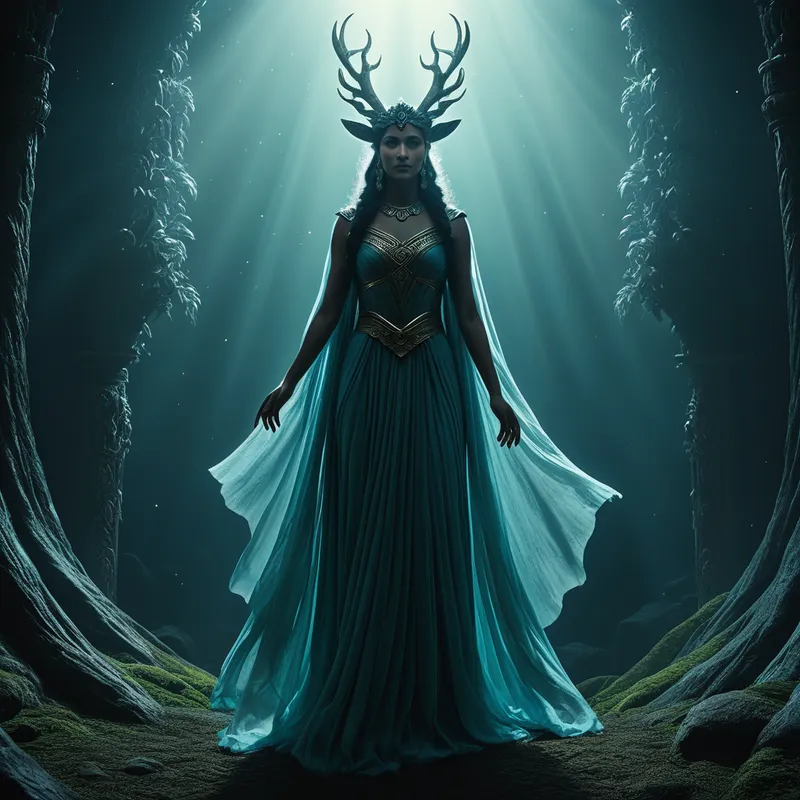
Tonatiuh the Sun God
The fierce Aztec sun deity who required daily human hearts to sustain his journey, embodying both life-giving light and brutal sacrifice.
The Tale of Tonatiuh the Sun God
Before the sun, there was only darkness and silence. The gods gathered in the sacred city of Teotihuacan, gazing into [the abyss](/myths/the-abyss “Myth from Kabbalistic culture.”/) of a sunless sky. A great fire roared in the plaza, and from its heart arose a question that demanded an answer: who would leap into the flames to become the new sun, to bring motion to the still world? Two gods stepped forward. One was the proud and wealthy Tecciztecatl, adorned in quetzal feathers and gold. The other was Nanahuatl, the humble and diseased god, covered in sores, poor in all but spirit.
Tecciztecatl approached the pyre first, but four times he recoiled from the terrible heat, his courage failing him. Then it was Nanahuatl’s turn. Without hesitation, without a glance back, the lowly god ran forward and threw himself utterly into the divine blaze. His body crackled and burned, and from the ashes of his sacrifice, he began to rise—transfigured, radiant, glorious. Shamed by this act of ultimate courage, Tecciztecatl finally followed, leaping into the flames behind him. Thus, two suns began to ascend: [Tonatiuh](/myths/tonatiuh “Myth from Aztec culture.”/), born from Nanahuatl’s sacrifice, and a second, lesser sun from Tecciztecatl.
But a world with two suns was an abomination, a scorching curse. One of the gods, furious, took a rabbit and hurled it at the face of the second sun, dimming its light, scarring its surface. It fell from [the sky](/myths/the-sky “Myth from Persian culture.”/), becoming [the moon](/myths/the-moon “Myth from Tarot culture.”/). And so Tonatiuh alone took his place in the heavens. Yet he did not move. He hung, a blazing disk on the eastern horizon, silent and immobile. The gods were perplexed. They had given a sun, but the sun would not journey.
Then Tonatiuh spoke, his voice the sound of crackling embers. “Why should I move? Why should I labor? You have asked everything of me, but you offer nothing. If I am to traverse the sky, to bring life and order, you must feed me. Not with [ambrosia](/myths/ambrosia “Myth from Greek culture.”/), not with prayers, but with the most precious substance in all creation: the human heart, and the most vital drink: human blood. This is my price. This is my sustenance.”
The gods understood. The cosmos demanded reciprocity. To set the great wheel in motion, a pact was struck—the tequitl of existence itself. From that day forth, Tonatiuh began his perilous journey from dawn to dusk, battling the forces of darkness each night to be reborn each morning. His daily passage was not a given; it was an achievement, purchased anew each sunrise with the sacred debt paid on the blood-stained stones of the teocalli.
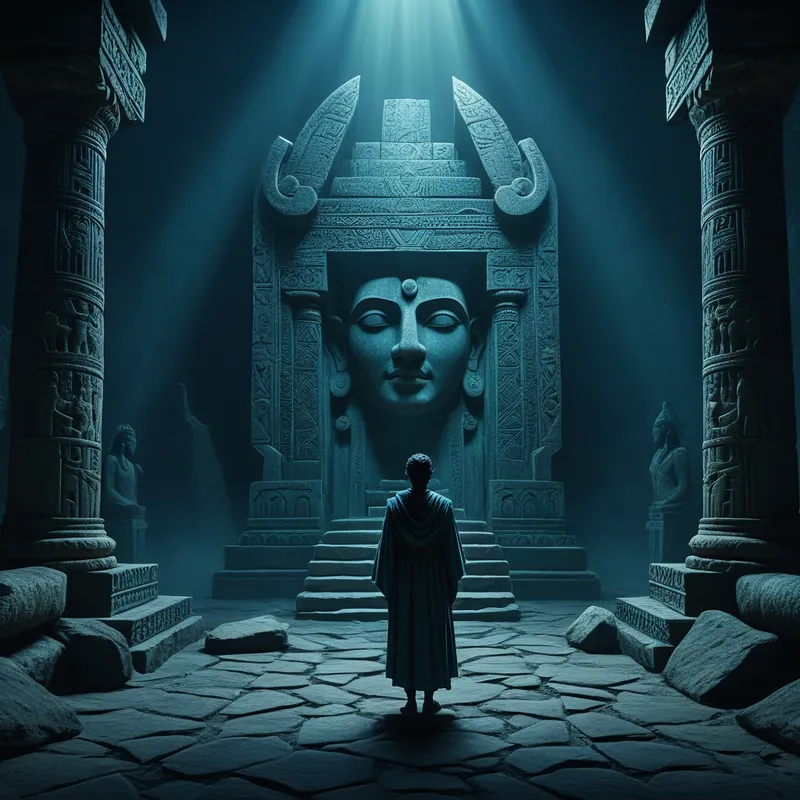
Cultural Origins & Context
Tonatiuh’s myth is not a story from a distant, primitive past, but the central pillar of the Aztec cosmic and state ideology. He emerges in the Postclassic period (c. 900–1521 CE), a time of immense city-states, vast empires, and profound theological systematization. The Aztecs, or Mexica, saw themselves as the “People of the Sun,” charged with a terrible and glorious destiny: to feed Tonatiuh and thus stave off the final, eternal darkness.
This was a cosmology of profound anxiety and precision. [The world](/myths/the-world “Myth from Tarot culture.”/) had already been destroyed four times, each in a cataclysmic “Sun” or era. They lived in [the Fifth Sun](/myths/the-fifth-sun “Myth from Aztec culture.”/), the “Sun of Movement” (Nahui Ollin), whose symbol was etched at the center of the great Calendar Stone. This era was destined to end in world-shattering earthquakes. The only [thing](/myths/thing “Myth from Norse culture.”/) postponing this apocalypse was the strength of Tonatiuh, and his strength came solely from chalchihuatl—the precious liquid of life: human blood.
Thus, the practice of human sacrifice (nextlahualli, “the paying of debts”) was not mere brutality; it was a sacred technology of cosmic maintenance. The warrior’s capture on the battlefield, the procession to [the temple](/myths/the-temple “Myth from Jewish culture.”/), the extraction of the still-beating heart held aloft to the sun—this was not murder, but a form of divine communion and recycling of vital energy. The victim became ixiptla, a god-impersonator, their [death](/myths/death “Myth from Tarot culture.”/) a sacred transaction that fueled the solar engine. To refuse this duty was to condemn all of creation to extinction.
Symbolic Architecture
Tonatiuh represents the ultimate [paradox](/symbols/paradox “Symbol: A contradictory yet true concept that challenges logic and perception, often representing unresolved tensions or profound truths.”/) of the ruler [archetype](/symbols/archetype “Symbol: A universal, primordial pattern or prototype in the collective unconscious that shapes human experience, behavior, and creative expression.”/): the [life](/symbols/life “Symbol: The symbol of ‘Life’ represents a journey of growth, interconnectedness, and existential meaning, encompassing both the joys and challenges that define human experience.”/)-giver who is also the life-taker. His light enables corn to grow, seasons to turn, and time itself to be measured. Yet this benevolent order is purchased through a economy of violence. He is not a distant, indifferent star, but a hungry, demanding deity whose [appetite](/symbols/appetite “Symbol: Represents desire, need, and consumption in physical, emotional, or spiritual realms. Often signals unmet needs or excessive cravings.”/) defines the [rhythm](/symbols/rhythm “Symbol: A fundamental pattern of movement or sound in time, representing life’s cycles, emotional flow, and universal order.”/) of society.
The sun god’s demand reveals a foundational psychological and cosmological truth: that creation and destruction are not opposites, but two phases of a single, sacred cycle. Light is born from the darkness of the sacrificial fire; life is sustained by the energy released in death.
His visage on the [Calendar](/symbols/calendar “Symbol: The calendar symbolizes time management, the passage of time, and the importance of deadlines in one’s life.”/) [Stone](/symbols/stone “Symbol: In dreams, a stone often symbolizes strength, stability, and permanence, but it may also represent emotional burdens or obstacles that need to be acknowledged and processed.”/) is iconic: a central face with a clawed [tongue](/symbols/tongue “Symbol: Represents communication, self-expression, and the power of words.”/), grasping [human](/symbols/human “Symbol: The symbol of a human represents individuality, complexity of emotions, and social relationships.”/) hearts in each hand, framed by the glyph for [movement](/symbols/movement “Symbol: Movement symbolizes change, progress, and the dynamics of personal growth, reflecting an individual’s desire or need to transform their circumstances.”/) (ollin). He is the still point of the turning world, the insatiable center around which all life, [death](/symbols/death “Symbol: Symbolizes transformation, endings, and new beginnings; often associated with fear of the unknown.”/), and [ritual](/symbols/ritual “Symbol: Rituals signify structured, meaningful actions carried out regularly, reflecting cultural beliefs and emotional needs.”/) must revolve. He embodies the terrifying [responsibility](/symbols/responsibility “Symbol: Responsibility in dreams often signifies the weight of duties and the expectations placed upon the dreamer.”/) of power—the understanding that to hold the highest [office](/symbols/office “Symbol: Dreaming of an office often symbolizes a space of responsibility, work-related stress, or the pursuit of goals in one’s waking life.”/) is to bear the burden of making horrific choices for the perceived greater good, to become the [conduit](/symbols/conduit “Symbol: A passage or channel that transfers energy, information, or substance from one place to another, often hidden or structural.”/) through which life force is both distributed and consumed.
The Dreamer’s Resonance
To encounter Tonatiuh in the inner landscape is to confront the non-negotiable demands of one’s own highest calling. He is the archetypal voice that says, “If you wish to achieve your purpose, you must pay the price.” This “price” is not necessarily literal blood, but rather the sacrifice of what is precious: comfort, old identities, personal time, or certain relationships in service to a larger goal—one’s creative work, spiritual path, or duty.
He manifests as the burning ambition that will not let us rest, the radiant vision that consumes our former selves. He is the fierce discipline of the artist at dawn, the relentless drive of the healer, the heavy burden of leadership. [The shadow](/myths/the-shadow “Myth from Jungian culture.”/) of Tonatiuh appears when this sacred duty curdles into mere tyranny—when the sacrifice demanded is no longer for life, but for [the ego](/myths/the-ego “Myth from Jungian culture.”/)’s hunger for power, leading to burnout of [the self](/myths/the-self “Myth from Jungian culture.”/) and exploitation of others. The dream asks: What sun are you trying to keep in motion, and what heart are you willing to offer for its journey?
Alchemical Translation
The alchemy of Tonatiuh is the transformation of base matter (the mortal body) into transcendent light (solar energy) through the catalyst of sacrifice. It is the process of [solve et coagula](/myths/solve-et-coagula “Myth from Alchemical culture.”/)—dissolving the individual into the cosmic, then coagulating that cosmic energy back into a new order.
The myth insists that perpetual motion, whether of the sun or the soul, requires a constant input of fuel. Spiritual and creative inertia is the natural state; dynamic life is the earned exception. The heart offered is always a piece of one’s current form, willingly surrendered to be transmuted into the energy for the next.
Psychologically, this translates to the necessary “deaths” we undergo for growth. The end of a relationship, the failure of a project, the surrender of a cherished belief—these are painful sacrifices on the [altar](/myths/altar “Myth from Christian culture.”/) of becoming. Yet, in the symbolic logic of the myth, these offerings are not wasted. They are the tonalli (vital heat, soul force) fed to our inner sun, allowing our consciousness to rise, move forward, and illuminate new territories of the self. To refuse all sacrifice is to choose to remain forever frozen on the dawn horizon, full of potential but devoid of motion.
Associated Symbols
Explore related symbols from the CaleaDream lexicon:
- Sacrifice — The sacred act of offering something precious to sustain a higher order, representing the non-negotiable cost of creation and maintenance.
- Heart — The central organ of life and feeling, offered as the ultimate sustenance to the divine, symbolizing the core essence given in devotion or duty.
- Sun — The celestial source of light, heat, and cyclical time, embodying the ruling consciousness, life-giving power, and the focal point of cosmic debt.
- Blood — The vital fluid equated with life force and sacred energy, the essential currency in the economy of reciprocity between humanity and the gods.
- Fire — The transformative element of purification and change, the medium through which the god is born and which consumes [sacrificial offerings](/myths/sacrificial-offerings “Myth from Various culture.”/).
- Eagle — The celestial bird that soars closest to the sun, often representing the warrior spirit whose captured essence feeds the solar deity.
- Circle — The shape of the solar disk, the calendar, and the cyclical nature of time and sacrifice, denoting wholeness, eternity, and inescapable return.
- Ritual — The prescribed ceremonial actions that enact the cosmic pact, structuring [chaos](/myths/chaos “Myth from Greek culture.”/) into order through repeated, sacred performance.
- Power — The potent energy that flows from sacrifice to deity and back again, manifesting as sovereignty, motion, and the capacity to enforce cosmic law.
- Journey — The perilous daily passage of the sun across the sky, mirroring the soul’s own trajectory through life, death, and necessary struggle.
- Rebirth — The daily resurrection of the sun at dawn, symbolizing the promise of renewal that is earned through the trials and offerings of the night.
- Stone of Power — The monumental altar or calendar stone upon which the cosmic order is inscribed and the rituals of sustenance are performed.