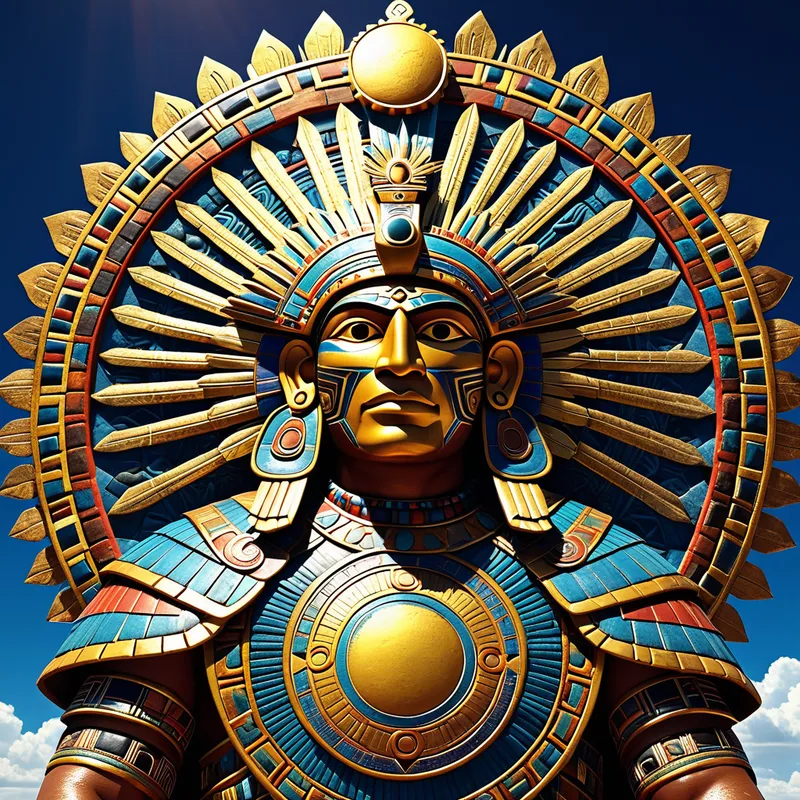
Tonatiuh Myth Meaning & Symbolism
The myth of the Fifth Sun, where the arrogant god Nanahuatl sacrifices himself to become Tonatiuh, whose daily journey requires the sustenance of human hearts.
The Tale of Tonatiuh
Listen. The world has been born and destroyed four times. We live in the time of the Fifth Sun, and its story is one of fire and humility.
In the silence after the fourth cataclysm, the gods gathered in the sacred darkness of Teotihuacan. A question hung in the void, heavier than stone: who would bear the unbearable burden? Who would leap into the primordial fire and become the new sun, to set the broken world in motion once more? Two stepped forward. One was Tecciztecatl, lord of riches, adorned in quetzal feathers and gold. The other was Nanahuatl, covered in sores, poor and wretched, whose only offerings were pus and scabs.
A great pyre was built, a tower of flames that licked the belly of the night. The gods called for the leap. Tecciztecatl, in all his splendor, approached the terrible heat. Four times he advanced, and four times the fury of the fire drove him back, his courage melting like wax. Then it was Nanahuatl’s turn. Without hesitation, without a glance back, the lowly one closed his eyes, gathered his resolve, and ran. He flung himself into the heart of the inferno. The flames roared, consuming his form, burning away his infirmities. Inspired by this ultimate act of courage, shamed by his own fear, Tecciztecatl finally followed.
In the heavens, two new lights began to glow. But a sun that burns with the pride of a coward burns too fiercely. The gods saw the two suns rising and knew the world would be scorched to ash. So one of them took a rabbit and flung it at the second, brighter light. It struck, dimming its radiance, scarring its face—and so the moon was born.
Nanahuatl, transformed, ascended as Tonatiuh, the Fifth Sun. But his ascent was not a coronation; it was the beginning of a terrible labor. He hung motionless in the zenith, a blazing, silent orb. The gods cried out, “Why do you not move?” And from the sun came a voice, dry as parched earth and fierce as the furnace that birthed him: “Why should I move? You demand this of me. Then you must feed me. I require sustenance. I require chalchiuhatl—the precious liquid. I require tlazolli—the precious matter.”
The gods understood. The sun demanded payment for his eternal journey. He demanded life to sustain life. And so, the first sacrifice was made. Thus began the great, unending exchange: the sun, born of a god’s self-immolation, would only traverse the sky, granting life to the world, if fed the sacred energy of human hearts. Every dawn was a victory, every sunset a descent into the perilous land of the dead, and every sunrise a rebirth bought anew. This is the sun we live under. The Sun of Movement. The sun whose path is paved with sacrifice.
Cultural Origins & Context
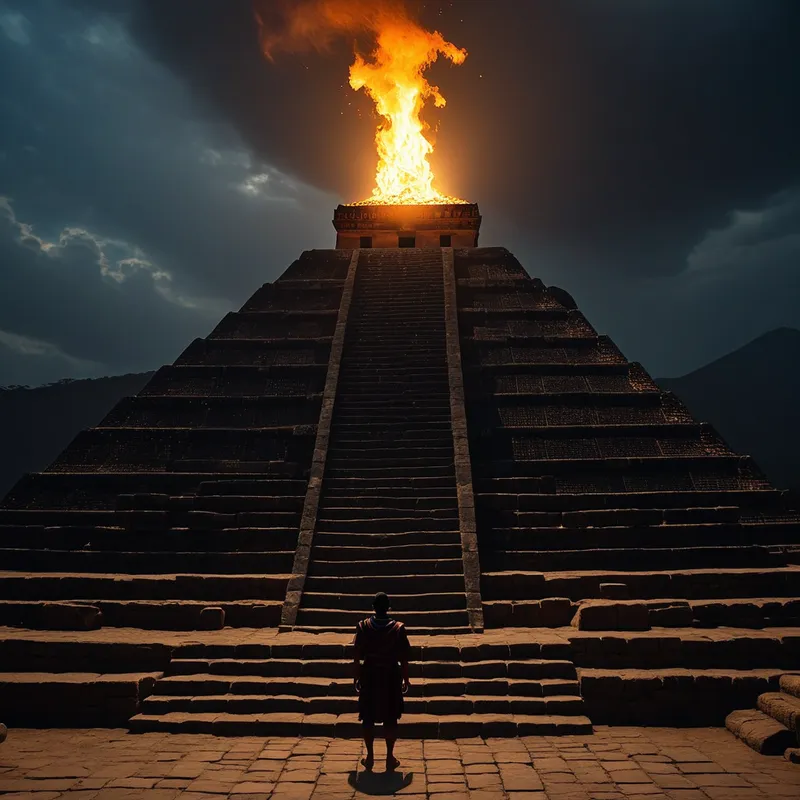
This myth, central to the Mexica (Aztec) worldview, was not mere storytelling but the foundational cosmology of an empire. It was preserved in oral tradition by tlamatinime (wise ones, philosophers) and recorded in post-Conquest codices like the Florentine Codex. Its primary societal function was to explain and justify the core ritual of Aztec state religion: human sacrifice, or nextlahualli (“the paying of debts”).
The myth positioned the Mexica as the people charged with a cosmic duty. They were the “People of the Sun,” responsible for providing the tonalli (solar life-force, animating energy) contained in blood and hearts to nourish Tonatiuh. Without this sustenance, the sun would halt, the world would plunge into eternal darkness, and the fifth and final creation would end. This created a framework of profound reciprocity: the sun gave life to corn, and people gave life to the sun. It was a terrifying, sacred contract that infused daily life, agriculture, warfare (as a means to obtain sacrificial captives), and imperial ideology with ultimate purpose.
Symbolic Architecture
At its core, the myth of Tonatiuh is a profound allegory of transformation through utter self-surrender and the paradox of a burdensome, life-giving duty.
The most radiant consciousness is not born of privilege, but of the courageous immolation of the small, suffering self.
Nanahuatl represents the undervalued, wounded, and humble aspect of the psyche—the part we deem unworthy. His leap is not an act of grandiosity, but of total acceptance. He offers exactly what he is: his brokenness. The fire that transforms him is the alchemical crucible of necessity, the extreme pressure that transmutes base suffering into golden purpose. Tecciztecatl, in contrast, symbolizes the ego—adorned, proud, but ultimately fearful of being consumed, of losing its identity. His failure and subsequent transformation into the moon (a reflective, lesser light) illustrates that a consciousness ruled by pride and hesitation cannot bear the central, generative role.
Tonatiuh’s subsequent demand for sacrifice reveals the myth’s most challenging truth: creation and maintenance are not one-time events. They are a relentless, ongoing process that requires constant energy input. The sun’s journey is not a triumphant parade; it is a daily struggle against entropy, supported by a cycle of give-and-take that is as brutal as it is beautiful.
The Dreamer’s Resonance
When this myth stirs in the modern unconscious, it often manifests in dreams of immense responsibility, burning pressure, or a demand for a painful offering. You may dream of a radiant but distant light you must feed with something precious of your own, or of standing before a great furnace, knowing you must jump in to initiate a crucial change.
Somatically, this can feel like a tightening in the chest—the region of the heart (yollotl), the seat of life and sacrifice in Aztec thought. Psychologically, this is the process of confronting a “cosmic bargain” in your own life. What indispensable duty have you taken on? What brilliant, life-giving role (a career, a relationship, a creative project) have you ascended to, only to find it requires a piece of your vitality each day to keep it moving? The dream points to the anxiety and exhaustion of sustaining a central identity or purpose. It asks: What are you feeding your sun? Is it nourishing energy, or is it a draining obligation? The dream may be signaling that your current “sacrifices” are out of alignment, or that you, like Nanahuatl, must sacrifice an old, suffering identity to ignite a new and vital phase of being.

Alchemical Translation
The individuation process modeled here is not about achieving a static state of enlightenment, but about committing to the dynamic, exhausting, and sacred work of being the central star in your own psychic cosmos.
The first stage is Nanahuatl’s Sacrifice: the conscious, voluntary offering of the ego’s cherished attachments—its pride, its self-pity, its sense of inadequacy—into the transformative fire of truth. This is the leap into therapy, into a creative void, into a major life change that feels like a death. You must offer your “sores,” your authentic woundedness, not your polished gold.
The second stage is Becoming Tonatiuh: You emerge from the fire with a new, radiant consciousness. You have a purpose, a direction. But the alchemy is not complete. Now you must move. And to move, you must engage in the third stage: The Sustaining Sacrifice.
The individuated Self does not shine for free. It demands the continuous sacrifice of the ego’s petty demands to fuel its transcendent journey.
This is the ongoing inner work. Your “Tonatiuh”—your mature, guiding Self—requires payment. It demands you sacrifice trivial distractions (the tlazolli, or “precious matter” of your time and attention) and offer your vital passion (the chalchiuhatl, or “precious liquid” of your heartfelt engagement). When you withhold these, your inner sun stalls; depression, stagnation, and meaninglessness set in. The myth teaches that a vibrant, purposeful life is a cycle of receiving light and giving life-force, a perpetual exchange between the depth of your soul and the demands of your daily journey. You are both the sacrificer and the sun, eternally responsible for the dawn.
Associated Symbols
Explore related symbols from the CaleaDream lexicon: