Tombo Myth Meaning & Symbolism
A myth of a celestial maiden transformed into a dragonfly, embodying resilience, fleeting beauty, and the soul's journey through loss and transcendence.
The Tale of Tombo
Listen, and let [the veil between worlds](/myths/the-veil-between-worlds “Myth from Celtic culture.”/) grow thin. In the age when [the sky](/myths/the-sky “Myth from Persian culture.”/) was closer to [the earth](/myths/the-earth “Myth from Hindu culture.”/), when the kami walked in the dappled light of the cryptomeria forests, there lived a maiden of the celestial plains. Her name was Teruko, and she was a daughter of the weaving star, tasked with spinning the threads of twilight into the soft cloth of dawn. Her life was one of serene, measured cycles, until the day a tempest, born from a clash of mountain gods, tore a rent in the fabric of the heavens.
Teruko was cast down, a falling star of silken robes and bewildered grace, into the mortal realm of Ashihara no Nakatsu Kuni. She landed not with a crash, but with the soft sigh of displaced air, in a secluded valley where a single, perfect pond mirrored the sky. Here, she was found by a humble woodcutter, a man of few words but profound stillness named Yamato. In his quiet company, she learned the weight of earth, the taste of spring [water](/myths/water “Myth from Chinese culture.”/), and the slow, deep language of the forest. The celestial rhythm of stars was replaced by the heartbeat of the soil. They built a life, a small harmony woven from shared silence and growing love.
But the heavens are jealous, and order must be restored. The celestial weavers, finding their dawns dimmed without her, sent a stern envoy—a [raijin](/myths/raijin “Myth from Japanese culture.”/) in the form of a storm crow—to reclaim their lost daughter. The command was absolute: return or be forever severed from the loom of fate. Torn between the deep, rooted love of her earthly life and the immutable duty of her celestial origin, Teruko stood at the shore of the pond that had first received her. Her heart, now mortal in its attachments, could not bear the severance. Yet, to disobey was to invite divine wrath upon Yamato and their valley.
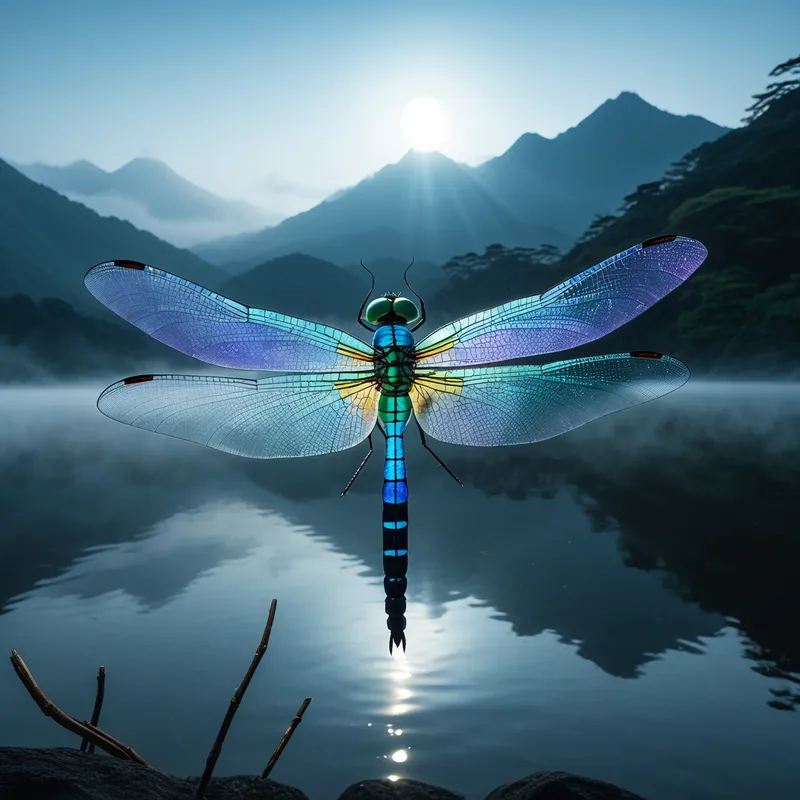
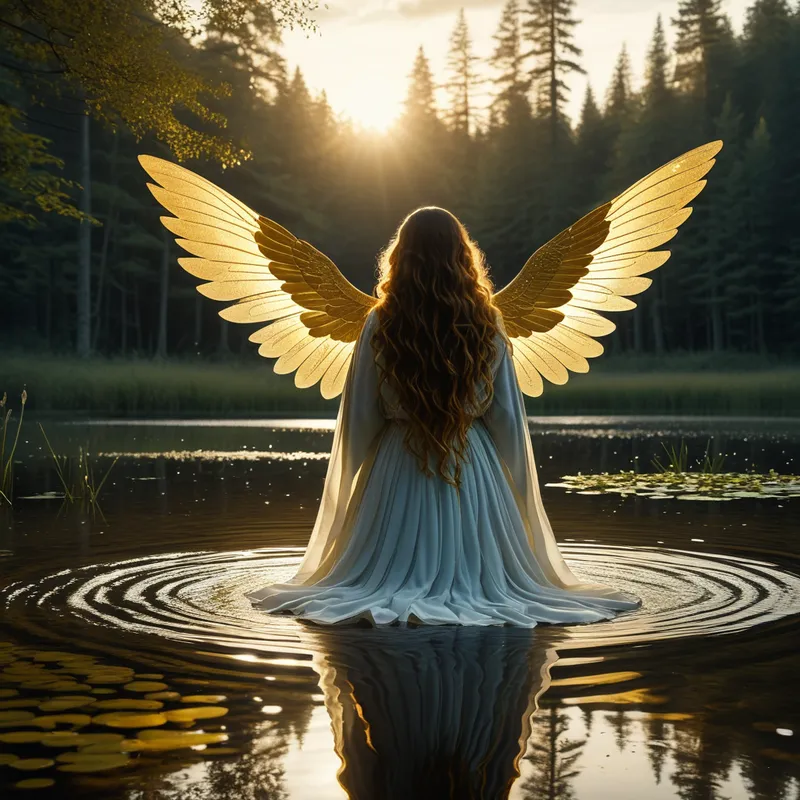
In her moment of ultimate tension, a miracle of refusal occurred. She would not return to the cold tapestry of the stars, nor would she let her defiance destroy [the world](/myths/the-world “Myth from Tarot culture.”/) she loved. Letting out a cry that was both sorrow and song, she stretched her arms toward the pond and the forest. Her form did not ascend. Instead, it began to dissolve, not into nothingness, but into transformation. Her silken robes became iridescent, membranous wings. Her slender body elongated, gleaming like lacquer. Her sorrowful eyes grew large and multifaceted, seeing not just one world, but all its layers at once. Where the celestial maiden once stood, a magnificent dragonfly—a tombo—took to the air.
It did not fly to the heavens. It danced over the pond, a living jewel of light and shadow, tracing the contours of the world she had chosen. It would forever be a creature of [the threshold](/myths/the-threshold “Myth from Folklore culture.”/)—of water and air, earth and sky, memory and presence. Yamato, watching, felt his grief soften into awe. He knew her not gone, but translated. Every summer, when the dragonflies danced on the sunlit breeze, he would feel the whisper of a love that had transformed itself to remain.
Cultural Origins & Context
The myth of Tombo finds its roots not in a single, canonical text like the Kojiki or Nihon Shoki, but in the rich loam of regional folklore and mukashibanashi. It is a story of the mountains and remote valleys, passed down by village elders and traveling storytellers. Its function was multifaceted. On one hand, it served as an etiological tale, explaining the origin of the dragonfly’s beauty and its seemingly magical, hovering flight—a creature too exquisite to be merely of this world.
More profoundly, it operated as a narrative vessel for exploring themes of irreconcilable belonging. In the rigidly structured societies of feudal Japan, where duty (giri) often brutally conflicted with human feeling (ninjo), the myth presented a third way: not victory, not defeat, but transcendent transformation. The story also resonates deeply with Shinto animism, where spirits (kami) inhabit natural phenomena. The Tombo became a localized ujigami, a spirit of the pond and the marsh, a guardian born of sacrifice and enduring love, embodying the belief that powerful emotions and events can literally change the fabric of a place and its inhabitants.
Symbolic Architecture
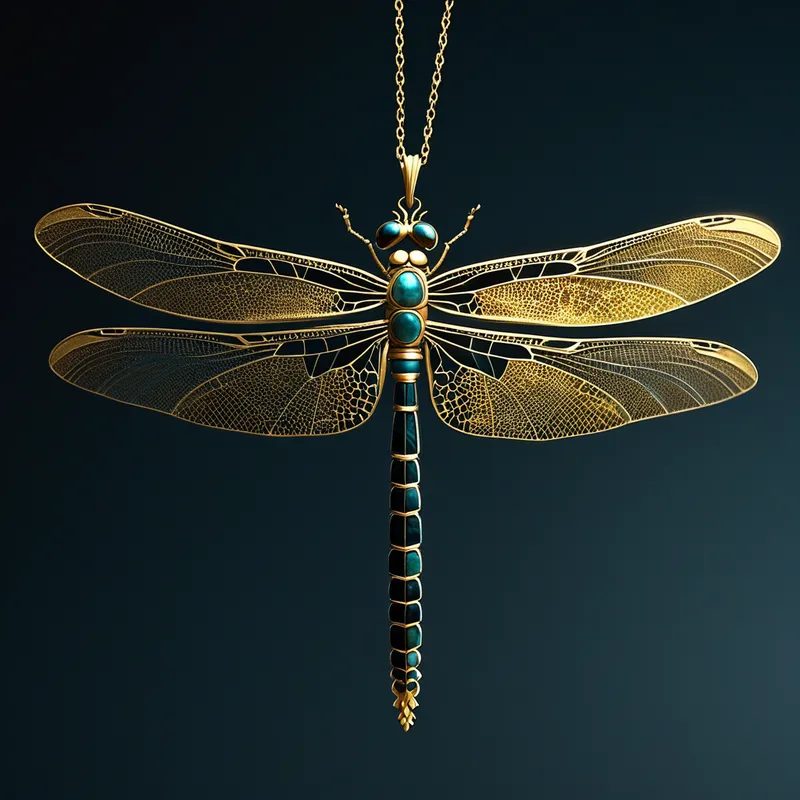
The [dragonfly](/symbols/dragonfly “Symbol: The dragonfly symbolizes transformation, change, and the lightness of being, often associated with the spiritual realm.”/), in this myth, is far more than an insect. It is a [hieroglyph](/symbols/hieroglyph “Symbol: Ancient Egyptian writing system using pictorial symbols, representing sacred knowledge, communication with the divine, and the power of language to shape reality.”/) of the [soul](/symbols/soul “Symbol: The soul represents the essence of a person, encompassing their spirit, identity, and connection to the universe.”/) in transition. Its [life](/symbols/life “Symbol: The symbol of ‘Life’ represents a journey of growth, interconnectedness, and existential meaning, encompassing both the joys and challenges that define human experience.”/) cycle—from aquatic [nymph](/symbols/nymph “Symbol: Nymphs are nature spirits embodying specific aspects of the natural world, often associated with beauty and allure.”/) to aerial adult—mirrors the [story](/symbols/story “Symbol: The symbol of ‘Story’ represents the narrative woven through our lives, embodying experiences, lessons, and emotions that shape our identities.”/)’s [movement](/symbols/movement “Symbol: Movement symbolizes change, progress, and the dynamics of personal growth, reflecting an individual’s desire or need to transform their circumstances.”/) from one elemental state of being (celestial) to another (earthly), culminating in a third, synthesized form. The Tombo is the embodied [symbol](/symbols/symbol “Symbol: A symbol can represent an idea, concept, or belief, serving as a powerful tool for communication and understanding.”/) of the liminal—the entity that exists permanently in the in-between.
The true transformation is not from one state to another, but into the state of transformation itself.
Teruko’s refusal to choose between two impossible worlds is the critical psychological pivot. It represents [the ego](/myths/the-ego “Myth from Jungian culture.”/)’s surrender to a process greater than binary [choice](/symbols/choice “Symbol: The concept of choice often embodies decision-making, freedom, and the multitude of paths available in life.”/). Her [dissolution](/symbols/dissolution “Symbol: The process of breaking down, dispersing, or losing form, often representing transformation, release, or the end of a state of being.”/) is not annihilation; it is the deconstruction of a fixed [identity](/symbols/identity “Symbol: Identity represents the sense of self, encompassing personal beliefs, cultural background, and social roles.”/) ([celestial maiden](/symbols/celestial-maiden “Symbol: A divine feminine figure associated with the heavens, representing purity, guidance, and spiritual connection beyond earthly realms.”/), earthly [wife](/symbols/wife “Symbol: The symbol of a ‘wife’ in a dream often represents commitment, partnership, and personal relationships, reflecting one’s desires for intimacy or connection.”/)) to allow for the [emergence](/symbols/emergence “Symbol: A process of coming into being, rising from obscurity, or breaking through a barrier, often representing birth, transformation, or revelation.”/) of a more complex, integrated self. The multifaceted eyes of the Tombo symbolize this new [capacity](/symbols/capacity “Symbol: A measure of one’s potential, limits, or ability to contain, process, or achieve something, often reflecting self-assessment or external demands.”/)—to hold multiple perspectives, to see the world of form and the world of [spirit](/symbols/spirit “Symbol: Spirit symbolizes the essence of life, vitality, and the spiritual journey of the individual.”/) simultaneously. The dragonfly’s dance over [water](/symbols/water “Symbol: Water symbolizes the subconscious mind, emotions, and the flow of life, representing both cleansing and creation.”/) reflects the soul’s [relationship](/symbols/relationship “Symbol: A representation of connections we have with others in our lives, often reflecting our emotional state.”/) with the unconscious; it can move freely above the [depths](/symbols/depths “Symbol: Represents the subconscious, hidden emotions, or foundational aspects of the self, often linked to primal fears or profound truths.”/), reflecting and interacting, but is not submerged by them.
The Dreamer’s Resonance
When this myth stirs in the modern dreamer, it often surfaces during periods of excruciating life-choice, cultural dislocation, or identity crisis. To dream of being torn between two realms, or of transforming into an insectoid or hybrid creature, can be the [psyche](/myths/psyche “Myth from Greek culture.”/) enacting the Tombo’s drama.
Somatically, this may manifest as a feeling of being “pulled apart” or stretched thin, often centered in the chest or solar plexus—the seat of identity and emotion. The dream is not necessarily about finding a solution, but about initiating the process of psychic translation. The dream-ego, like Teruko, is learning that some conflicts cannot be solved on the plane where they were created. The emergence of the dragonfly in a dream is a profoundly hopeful sign. It suggests the unconscious is forging a new vehicle for consciousness—one that is agile, multifaceted, and capable of hovering at the threshold of change without needing to permanently land in one camp or the other. It is the symbol of resilience born of adaptability.

Alchemical Translation
The alchemical process mirrored in the Tombo myth is that of [solutio](/myths/solutio “Myth from Alchemical culture.”/) (dissolution) followed not by coagulatio (re-solidification into the old form), but by sublimatio (elevation into a higher, more spiritualized form). The “[prima materia](/myths/prima-materia “Myth from Alchemical culture.”/)” is the conflicted self, trapped between the celestial (spiritual ideals, ancestral expectations) and the earthly (corporeal desires, personal loves). The “fire” of the conflict does not burn it to ash; it vaporizes it, allowing it to rise and reconstitute at a different vibrational level.
For the modern individual navigating the cross-pressures of career and calling, tradition and individuality, or attachment and freedom, the myth offers a radical model. Individuation is not about choosing one side of our nature over another. It is about undergoing the terrifying, glorious dissolution of the ego’s rigid stance so that a more authentic, integrated pattern can emerge.
The goal is not to become who you think you should be, but to become what you truly are—a process that often looks, from the outside, like becoming something else entirely.
The Tombo teaches us that our deepest loyalties and loves do not have to be abandoned in the face of impossible choices. They can be transmuted. We can become [the vessel](/myths/the-vessel “Myth from Alchemical culture.”/) that carries their essence in a new way, dancing in the liminal space, a living testament to the fact that the soul’s survival sometimes depends on its capacity for metamorphosis. We are invited to exchange a fixed form for a dynamic flight, trading the security of a single world for the freedom of the threshold.
Associated Symbols
Explore related symbols from the CaleaDream lexicon: