
Toba Lake Creation Myth Myth Meaning & Symbolism
A fisherman marries a goddess. A broken promise unleashes a deluge of grief, transforming the world into a vast, silent lake and a new lineage of humanity.
The Tale of Toba Lake Creation Myth
Listen, and hear the story of how the world wept, and from its tears, a great mirror was born.
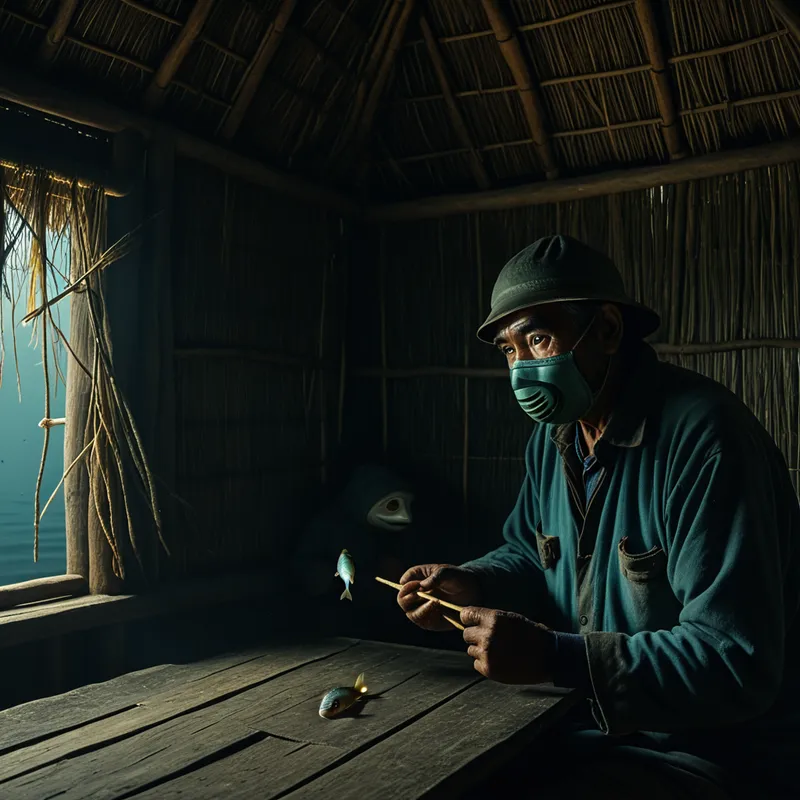
In the highlands of Sumatra, where the earth was young and the forests whispered secrets to the clouds, there lived a young man. He was a fisherman of little means but pure heart, casting his nets into the clear rivers that sang down from the mountains. One day, his line grew heavy, not with struggle, but with a gentle, radiant weight. He pulled from the water not a fish, but a creature of impossible beauty—a large, shimmering golden fish that seemed to hold the light of the moon in its scales. Its eyes were deep pools of knowing.
Moved by a compassion he could not name, he did not take it to market. Instead, he carried it home and placed it in his humble bathing pool. That night, under a sky dusted with stars, a miracle unfolded. The fish shed its skin of scales, and from the water rose a woman of such breathtaking grace that the very air seemed to bow. She was Putri Ikan, a princess from the celestial realms, transformed and trapped. The fisherman, awestruck, offered her his home, his heart, his silence. She saw his purity and accepted, on one sacred condition: he must never, ever speak of her origin. He must never utter a word about her being born from a fish. Their love was a quiet, profound thing. They married, and in time, she bore him a son.
The boy grew strong but possessed a hunger that was bottomless, a ravenousness that gnawed at the family’s peace. One day, the father sent his son to deliver his lunch to the fields. The boy, consumed by his appetite, devoured the entire meal on the path. When the weary father asked for his food, the son lied, claiming there was none. Twice this happened. On the third day, the father, faint with hunger and burning with a frustration he could no longer contain, followed his son. He saw the boy hidden in the tall grass, greedily consuming the rice. A wave of rage, hot and blinding, swept over the fisherman. All the years of wonder, of holding a celestial secret, of living with a miracle, collapsed under the weight of this mundane, human betrayal.
He pointed a trembling finger at his son and shouted the words that could never be taken back: “You foolish, greedy child! You are just like your mother! You are the son of a fish!”
The moment the words left his lips, the world froze. In their hut, Putri Ikan let out a cry that was not of this earth—a sound of profound sorrow and shattered trust. She ran to her son, held him close, and her eyes met her husband’s across the clearing. In them, he saw not anger, but an ocean of grief. “You have broken your vow,” she said, her voice the sound of distant thunder. “Now, the consequence must be borne.”
She took her son’s hand and walked to the riverbank where they had first met. She began to weep. Her tears were not like human tears; they were a torrent. They fell upon the earth, and the earth drank until it could drink no more. The river swelled, then overflowed. The valleys filled. The forests drowned. The waters rose and rose, swallowing the village, the fields, the mountainsides, until all that remained was a vast, silent, and impossibly deep inland sea—Danau Toba. As the final waves settled, the fisherman, now utterly alone, saw two things emerge: a new island in the center of the lake, Samosir, and on its shore, the figures of his wife and son, transforming one last time before vanishing into the mist. From them, it is said, sprang a new people, forever carrying the memory of the union between the human and the divine, and the flood that their broken word unleashed.
Cultural Origins & Context
This myth is the foundational narrative of the Batak people of North Sumatra. It is not merely a story of a lake’s origin; it is the mythic charter for Batak identity, social structure, and their relationship with a dramatic, awe-inspiring landscape. Passed down orally through generations, likely by village elders and storytellers (datu or guru), it served multiple vital functions. It explained the sublime geography of Lake Toba and Samosir Island, offering an ontological map of their homeland. More profoundly, it encoded core societal values: the sacredness of one’s word (hata), the catastrophic consequences of breaking a taboo (pemali), and the delicate, often tragic, interface between the human and spiritual worlds. The myth establishes a lineage that is both humbled and exalted—born of a human failing and a divine grief, the Batak people see themselves as children of this profound rupture and reconciliation.
Symbolic Architecture
At its [heart](/symbols/heart “Symbol: The heart symbolizes love, emotion, and the core of one’s existence, representing deep connections with others and self.”/), the myth is a profound exploration of the [psychology](/symbols/psychology “Symbol: Psychology in dreams often represents the exploration of the self, the subconscious mind, and emotional conflicts.”/) of the promise and the [nature](/symbols/nature “Symbol: Nature symbolizes growth, connectivity, and the primal forces of existence.”/) of transformative [grief](/symbols/grief “Symbol: A profound emotional response to loss, often manifesting as deep sorrow, yearning, and a sense of emptiness.”/). Putri Ikan is not just a fish or a [wife](/symbols/wife “Symbol: The symbol of a ‘wife’ in a dream often represents commitment, partnership, and personal relationships, reflecting one’s desires for intimacy or connection.”/); she is the [anima](/symbols/anima “Symbol: The feminine archetype within the male unconscious, representing soul, creativity, and connection to the inner world.”/), the [soul](/symbols/soul “Symbol: The soul represents the essence of a person, encompassing their spirit, identity, and connection to the universe.”/)-[image](/symbols/image “Symbol: An image represents perception, memories, and the visual narratives we create in our minds.”/), the miraculous otherness that enters a mundane [life](/symbols/life “Symbol: The symbol of ‘Life’ represents a journey of growth, interconnectedness, and existential meaning, encompassing both the joys and challenges that define human experience.”/) and transforms it through a sacred contract. The [fisherman](/symbols/fisherman “Symbol: Represents exploration of emotional depths and the pursuit of desires, often reflecting patience and skill.”/)’s [life](/symbols/life “Symbol: The symbol of ‘Life’ represents a journey of growth, interconnectedness, and existential meaning, encompassing both the joys and challenges that define human experience.”/) is elevated by her [presence](/symbols/presence “Symbol: Presence in dreams often signifies awareness or acknowledgment of something significant in one’s life.”/), but he must contain the [mystery](/symbols/mystery “Symbol: An enigmatic, unresolved element that invites curiosity and exploration, often representing the unknown or hidden aspects of existence.”/).
The taboo is the container for the numinous. To speak the secret is to profane the miracle, releasing its power in an uncontrolled, destructive form.
The fish is a near-universal [symbol](/symbols/symbol “Symbol: A symbol can represent an idea, concept, or belief, serving as a powerful tool for communication and understanding.”/) of the unconscious, the [depth](/symbols/depth “Symbol: Represents profound layers of consciousness, hidden truths, or the unknown aspects of existence, often symbolizing introspection and existential exploration.”/), the soul itself. To pull it up is an act of [fate](/symbols/fate “Symbol: Fate represents the belief in predetermined outcomes, suggesting that some aspects of life are beyond human control.”/); to care for it is an act of reverence; to marry it is to wed oneself to the [depths](/symbols/depths “Symbol: Represents the subconscious, hidden emotions, or foundational aspects of the self, often linked to primal fears or profound truths.”/) of one’s own psyche. The son represents the [product](/symbols/product “Symbol: This symbol represents tangible outcomes of one’s efforts and creativity, often reflecting personal value and identity.”/) of this union—the new [consciousness](/symbols/consciousness “Symbol: Consciousness represents the state of awareness and perception, encompassing thoughts, feelings, and experiences.”/), the “Self” in Jungian terms, which has a ravenous, undifferentiated [appetite](/symbols/appetite “Symbol: Represents desire, need, and consumption in physical, emotional, or spiritual realms. Often signals unmet needs or excessive cravings.”/). The [father](/symbols/father “Symbol: The father figure in dreams often symbolizes authority, protection, guidance, and the quest for approval or validation.”/)’s outburst is not just anger at a boy’s greed; it is the ego’s catastrophic failure to hold the [tension](/symbols/tension “Symbol: A state of mental or emotional strain, often manifesting physically as tightness, pressure, or unease, signaling unresolved conflict or anticipation.”/) of the sacred [marriage](/symbols/marriage “Symbol: Marriage symbolizes commitment, partnership, and the merging of two identities, often reflecting one’s feelings about relationships and social obligations.”/). In naming the mystery (“son of a fish”), he reduces the sublime to the literal, killing the symbolic life. The resulting flood is not a [punishment](/symbols/punishment “Symbol: A dream symbol representing consequences for actions, often tied to guilt, societal rules, or internal moral conflicts.”/), but the inevitable psychic consequence: the unconscious, once contained by trust, now breaks its banks in a [deluge](/symbols/deluge “Symbol: A massive, overwhelming flood representing cleansing, destruction, or emotional inundation.”/) of grief, drowning the old world of the ego.

The Dreamer’s Resonance
When this myth pattern stirs in the modern dreamer, it often manifests as dreams of broken promises, of speaking an unforgivable truth, or of being overwhelmed by rising waters from a domestic source—a overflowing sink, a burst pipe, tears that become a flood. Somatically, one might feel a constriction in the throat (the unspoken vow) or a sinking, drowning sensation in the chest (the grief).
Psychologically, this signals a critical moment in relationship to one’s inner covenants. The dreamer is processing a profound betrayal, either of another or, more commonly, of themselves. Have they violated a core personal value? Have they “named the magic” in a way that destroyed its power—perhaps by cynically analyzing a creative inspiration, or by exposing a vulnerable, soulful connection to reductive gossip? The flood represents the emotional and psychic fallout: a depression (the still lake) that follows a storm of shame and sorrow. The dream asks: What sacred agreement have you broken within your own soul? What depth have you betrayed?

Alchemical Translation
The individuation process modeled here is the journey from a state of blessed, but naive, containment to a state of conscious responsibility born of catastrophic failure. The initial phase is the coniunctio, the sacred marriage, where the ego is graced by the Self. But individuation requires more than grace; it requires the endurance of the shadow.
The fisherman’s rage at his son is the eruption of his own undisciplined shadow—his hunger, his impatience, his very humanity. His failure is not that he has a shadow, but that he lets it speak the unspeakable. The alchemical nigredo, the blackening, is the flood—the utter dissolution of the old psychic landscape in the waters of grief and regret.
The lake that remains is the vas, the new vessel. It is not the joyful pool that held the fish, but a vast, deep, and silent container born of tragedy.
This is the key: the new world, Samosir, and the new lineage emerge from the other side of the flood. The alchemical gold is not the avoidance of failure, but the consciousness forged because of it. The modern individual undergoing this pattern is not striving to be the flawless fisherman who never speaks. They are, perhaps, learning to be the lake itself: deep, reflective, and able to hold the memory of both the miracle and the deluge, integrating them into a broader, more resilient identity. The vow is not forgotten; it is remembered in its breaking, and that memory becomes the foundation for a more conscious, humble, and profound connection to the depths within.
Associated Symbols
Explore related symbols from the CaleaDream lexicon:
- Fish — The primordial symbol of the soul, the unconscious, and the miraculous; the divine essence captured in a mundane form, whose care requires a sacred vow.
- Lake — The vast, still container born of cataclysmic grief; the symbol of the deep, reflective unconscious that holds the memory of a drowned world and a transformed identity.
- Water — The element of emotion, the unconscious, and psychic dissolution; it is the medium of both the miraculous birth and the world-ending flood.
- Grief — The overwhelming, transformative emotion that floods the psyche when a sacred trust is broken, dissolving the old structures to make way for a new, more sorrowful depth.
- Mountain — The stable, earthly realm of the human (the fisherman’s world) that is both surrounded and transformed by the rising waters of unconscious emotion.
- Child — The product of the sacred union, representing new life, undifferentiated appetite, and the innocent catalyst for the catastrophic revelation.
- Key — The spoken word that breaks the taboo; it unlocks not a treasure, but a deluge, representing the dangerous power of literal speech over symbolic reality.
- Mirror — The surface of Lake Toba itself, reflecting the sky and the surrounding mountains, symbolizing self-reflection, the unconscious showing the ego its own transformed world.
- Door — The threshold of the vow; the fisherman’s mouth becomes the door through which the forbidden words pass, irrevocably changing the inner and outer worlds.
- Sacrifice — The sacrifice is not of an object, but of a relationship and an old world; it is the involuntary offering demanded by the broken covenant to the powers of the deep.
- Dream — The entire myth operates like a collective dream, portraying in stark imagery the psychic consequences of betraying an inner, numinous truth.
- Shadow — The fisherman’s unintegrated rage and hunger, which erupts to shatter the conscious agreement, forcing a confrontation with the darker aspects of the human self.